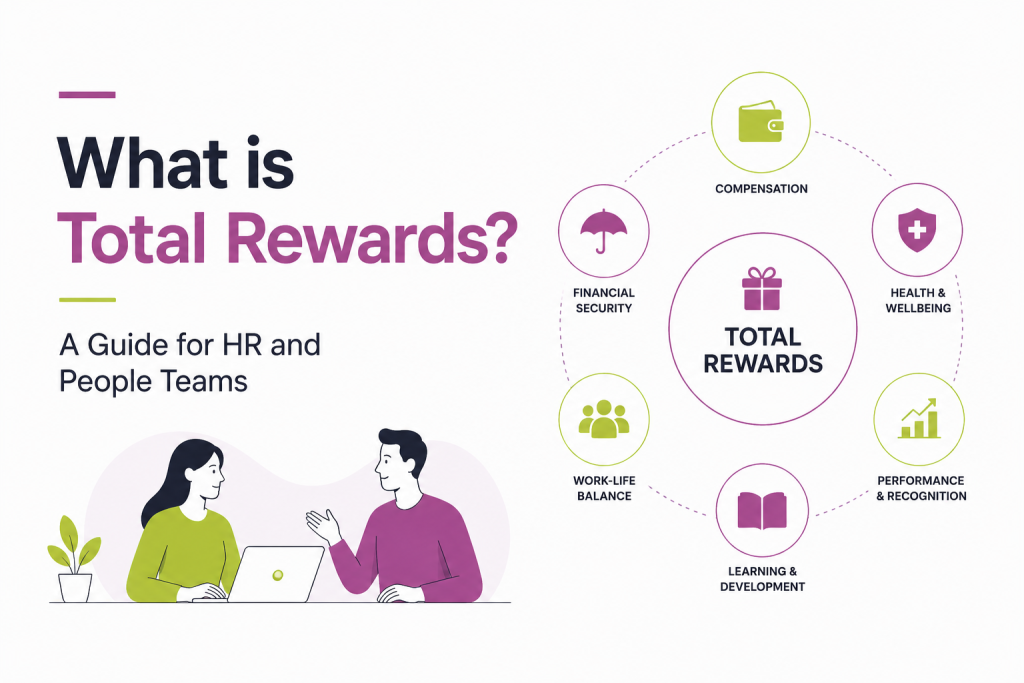
Ask ten employees what they are paid to do their job, and most will tell you a number: their salary. Ask them what they actually get from working at the company, and the answer gets a lot longer. Health coverage. A flexible schedule. A learning stipend. Equity. The 401(k) match nobody remembers signing up for. That gap between “what’s my salary” and “what do I actually get” is exactly what total rewards is built to close.
For HR and People teams, total rewards is both a philosophy and a practical framework. It is how you think about compensation holistically, and it is also the operational work of designing, pricing, communicating, and defending every element of the employee value proposition. This guide covers what total rewards means, the components that make it up, why it has become a board-level topic, and how modern People teams are building and communicating it.
- Total rewards is everything an employee gets for their work, not just salary: compensation, benefits, well-being, recognition, and career development.
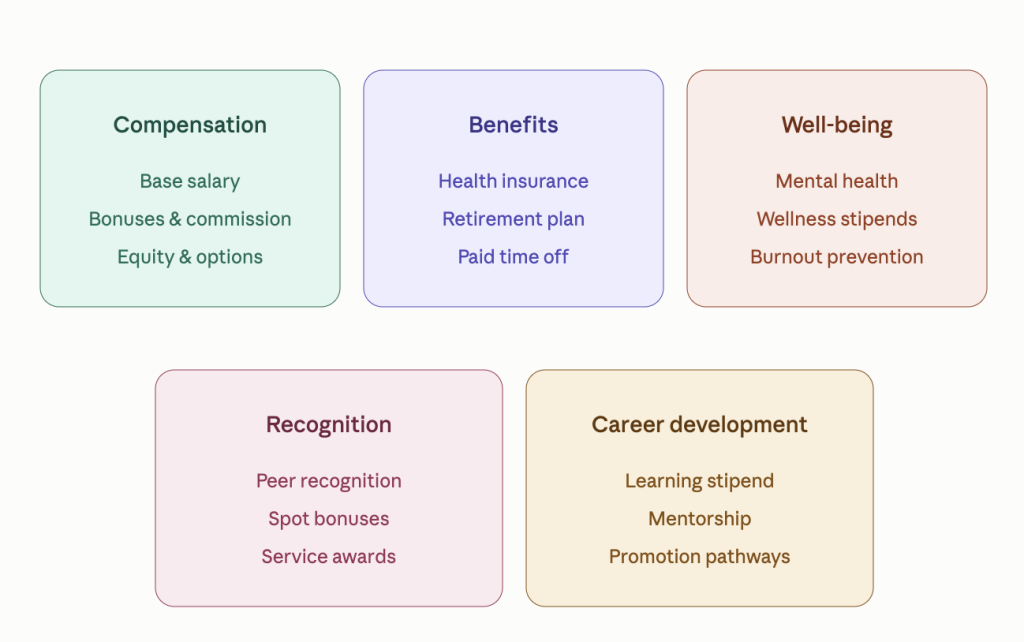
- It’s built on 5 pillars: compensation, benefits, well-being, recognition, and career development (per WorldatWork’s original framework).
- Compensation ≠ total rewards: compensation (pay, bonus, equity) is just one pillar within the broader total rewards umbrella.
- It matters now because of pay transparency laws, rising benefits costs, expensive turnover, and employees expecting personalized packages.
- Total rewards statements make invisible value (benefits, 401k match, equity) visible by showing employees one total dollar figure.
- Common challenges: scattered data across payroll/benefits/equity systems, undertrained managers, unmeasured programs, and expanding transparency requirements.
- The strategic shift: from designing better packages to communicating the value that already exists.
Total Rewards, Defined
Total rewards is the complete set of tools an employer uses to attract, motivate, and retain employees, spanning compensation, benefits, well-being programs, recognition, and career development. The term comes from WorldatWork, the HR association that first codified the concept in the early 2000s, and it has since become the standard framework compensation and HR professionals use to describe everything an employee receives in exchange for their work, not just their paycheck.
The key word is “total.” Total rewards deliberately expands the conversation beyond base pay to include everything that has real or perceived value to an employee: bonuses, equity, healthcare, retirement contributions, paid time off, wellness programs, professional development, flexible work arrangements, and even less tangible elements like company culture and career growth opportunities.
This matters because pay alone rarely tells the full story of why someone joins a company, stays at one, or leaves. Two offers with identical base salaries can feel completely different once you account for equity upside, healthcare quality, remote flexibility, and learning budgets. Total rewards is the language HR uses to make that difference visible, both internally and to candidates.
Also read: Agentic AI in HR: What Changes When AI Doesn’t Just Draft, But Acts
The Five Pillars of Total Rewards
Most total rewards frameworks, including WorldatWork’s original model, break the concept into five core components. Different organizations weight these differently depending on industry, size, and talent strategy, but nearly every total rewards program touches all five.
1. Compensation
This is the most familiar pillar: base salary, variable pay like bonuses and commissions, and long-term incentives such as stock options or RSUs. Compensation is usually the largest line item in a total rewards package and the one candidates evaluate first, but it is also the piece most exposed to market pressure. Compensation bands need to stay competitive with the market, internally consistent across roles, and defensible under pay equity scrutiny, which is why compensation planning has become its own specialized discipline within HR.
2. Benefits
Health insurance, dental and vision coverage, retirement plans, life and disability insurance, and paid leave all sit under benefits. Benefits costs have risen steadily for years, often outpacing base pay growth, which means the benefits pillar increasingly represents a larger share of total compensation spend than most employees realize. Communicating that value clearly is one of the most persistent challenges in total rewards, and one of the biggest reasons total rewards statements exist at all.
3. Well-being
A newer addition to the classic framework, well-being covers mental health support, wellness stipends, employee assistance programs, financial wellness tools, and increasingly, policies around workload and burnout prevention. Well-being programs grew significantly after 2020 and have become a differentiator in competitive hiring markets, particularly among younger workforces who weight this pillar heavily when comparing offers.
4. Recognition
Recognition includes both formal programs, like service awards and spot bonuses, and informal practices, like peer shoutouts and manager feedback. It is the pillar most tied to day-to-day engagement rather than financial value, and it is often the cheapest to improve relative to its impact on retention.
5. Career Development
Learning stipends, tuition reimbursement, internal mobility programs, mentorship, and clear promotion pathways fall here. Career development has become a top driver of retention, particularly for early and mid-career employees who increasingly evaluate jobs based on where they will be in three years, not just what they earn today.
Why Total Rewards Matters Now
Total rewards is not a new concept, but a handful of shifts have pushed it from an HR back-office framework to a genuine strategic priority.
Pay transparency laws changed the conversation. As more states and countries require salary ranges in job postings, base pay alone is now visible to candidates before they ever speak to a recruiter. That transparency puts more pressure on the rest of the total rewards package to explain why one offer is meaningfully better than another with a similar salary range.
Benefits costs are a growing share of the budget. Employers are spending a larger percentage of total compensation on benefits than they were a decade ago, largely driven by healthcare inflation. When that spend grows without employees noticing, it is effectively wasted from a retention standpoint. Making that value visible is now a financial argument, not just a communications one.
Retention has gotten more expensive to ignore. Replacing an employee typically costs a significant multiple of their salary once recruiting, onboarding, and lost productivity are factored in. A well-communicated total rewards package is one of the more cost-effective retention tools available, because it often means selling employees on value that already exists rather than adding new spend.
Employees expect personalization. A single parent, a recent graduate, and someone nearing retirement value very different parts of a benefits package. Flexible and personalized total rewards, sometimes called “total rewards optimization,” has emerged as a response to workforces that no longer accept one-size-fits-all packages.
Also read: Where AI in HR Creates Legal Exposure: A Practical Risk Audit
Total Rewards vs. Compensation: What’s the Difference?
It is worth being precise here because the terms get used loosely. Compensation refers specifically to direct financial pay: salary, bonuses, commissions, and equity. Total rewards is the broader umbrella that includes compensation as one of its five pillars, alongside benefits, well-being, recognition, and development.
In practice, this means a compensation strategy is a subset of a total rewards strategy, not a replacement for it. A company can have a highly competitive compensation strategy and still lose candidates and employees if the rest of its total rewards story, benefits quality, growth opportunities, flexibility, is weak or poorly communicated.
How to Build a Total Rewards Strategy
A total rewards strategy is the document and process that ties all five pillars back to business goals. While every organization’s approach looks different, most effective strategies follow a similar sequence.
Start with your talent strategy, not your budget. Before deciding what to offer, decide who you are trying to attract and retain, and what they actually value. A strategy built around “what can we afford” tends to produce generic packages; one built around “who do we need to keep” produces sharper, more differentiated ones.
Benchmark against the right market. Compensation and benefits benchmarking should reflect your actual talent competitors, not just your industry broadly. A fintech competing for engineering talent is competing against Big Tech pay scales, not just other fintechs.
Audit for equity, not just competitiveness. A total rewards package can be market-competitive and still be internally inconsistent or inequitable across gender, race, or tenure. Regular pay equity audits are now considered a baseline requirement, not a nice-to-have.
Decide what to standardize and what to personalize. Core compensation structure usually needs to stay standardized and defensible. Benefits and well-being programs are increasingly where companies build in flexibility, letting employees choose the mix that fits their life stage.
Communicate it, consistently and often. A total rewards strategy that employees don’t understand delivers a fraction of its intended value. This is where total rewards statements come in.
Total Rewards Statements: Making the Invisible Visible
A total rewards statement is a personalized summary that shows an employee the full value of their compensation package, salary plus the dollar value of benefits, retirement contributions, equity, and other perks, usually presented as a single annual figure alongside a breakdown.
The logic behind total rewards statements is simple: employees consistently underestimate how much they are compensated because most of the value is invisible in a normal paycheck. Employer 401(k) matches, health insurance premiums the company covers, and equity grants rarely show up anywhere an employee actually looks. A well-designed total rewards statement closes that gap by putting a number next to everything.
Done well, total rewards statements have a measurable effect on how employees perceive their compensation and, by extension, on retention and engagement. Done poorly, generic templates, confusing jargon, numbers that don’t match what employees actually experience, they can erode trust instead of building it.
This is also where total rewards work has gotten harder to do manually. Pulling accurate, individualized data across payroll, benefits administration, and equity platforms, then packaging it into something employees can actually understand, used to mean weeks of spreadsheet work for the People team, often repeated only once a year because of the effort involved. Purpose-built total rewards and compensation platforms now automate much of this, generating accurate, personalized statements continuously rather than as an annual project, which is increasingly the standard employees and HR teams both expect.
Common Total Rewards Challenges
Even well-resourced People teams run into the same recurring obstacles.
Data lives in too many systems. Compensation data sits in payroll, benefits data sits with a broker or carrier, and equity data sits in a cap table tool. Pulling all of it together accurately is often the biggest practical barrier to good total rewards communication.
Managers aren’t equipped to explain it. Employees usually hear about their compensation from their manager first, but most managers are not trained compensation communicators. A strong total rewards strategy needs manager enablement built in, not just a document sent to HR.
Programs get built but never measured. It is common for companies to launch well-being or recognition programs without ever tracking whether they move retention or engagement. Total rewards, done rigorously, treats every pillar as measurable, not just compensation.
Transparency requirements keep expanding. As pay transparency laws spread, total rewards strategies that were designed around discretion and case-by-case negotiation increasingly need to be rebuilt around consistent, explainable bands.
The Bottom Line
Total rewards is the framework that connects everything an employer gives an employee, pay, benefits, well-being, recognition, and growth, back to a single, coherent story about why someone should join and stay. It has moved from an HR concept to a business one because the cost of getting it wrong, in turnover, in disengagement, in losing candidates to more transparent competitors, has become too visible to ignore.
For People teams, the work ahead isn’t just designing better total rewards packages. It’s making the value of what already exists impossible to miss.
FAQs
What are the 5 components of total rewards?
Compensation, benefits, well-being, recognition, and career development. Most total rewards frameworks, including WorldatWork’s original model, organize around these five pillars.
Is total rewards the same as compensation?
No. Compensation, base salary, bonuses, and equity, is one of the five pillars. Total rewards is the broader umbrella that also includes benefits, well-being, recognition, and development.
What is a total rewards statement?
A personalized summary showing an employee the full dollar value of their package, salary plus benefits, retirement contributions, and equity, usually as one total figure with a breakdown.
Why does total rewards matter for retention?
Employees often underestimate their real compensation because most of its value, benefits, equity, retirement matches, is invisible in a normal paycheck. Making it visible is one of the cheapest, most effective retention levers available.
Who owns total rewards strategy in a company?
Usually HR or People teams, often with a dedicated compensation and benefits or total rewards leader, working closely with finance on budget and legal on pay equity compliance.