Most finance and HR leaders can recite the basic purpose of compensation management: pay people fairly, stay within budget. But that framing understates how much leverage a well-designed compensation strategy actually has. Compensation touches recruiting, retention, motivation, legal exposure, and the bottom line — and a strategy that isn’t deliberately built toward specific objectives tends to drift into reactive, inconsistent decision-making.
Industry research backs this up. A 2024 HR Research Institute report found that roughly three in four organizations rate their own compensation and total rewards approach as only moderately effective or worse. That’s not a minor execution gap — it’s a sign that most companies are managing compensation without a clear framework for what it’s actually supposed to achieve.
This article lays out the five core objectives every compensation strategy should be built around, and because this is increasingly where the real differentiation happens where AI changes what’s achievable against each one.
TL;DR
- Roughly 3 in 4 organizations rate their own compensation strategy as only moderately effective or worse — most companies lack a clear framework for what compensation is supposed to achieve.
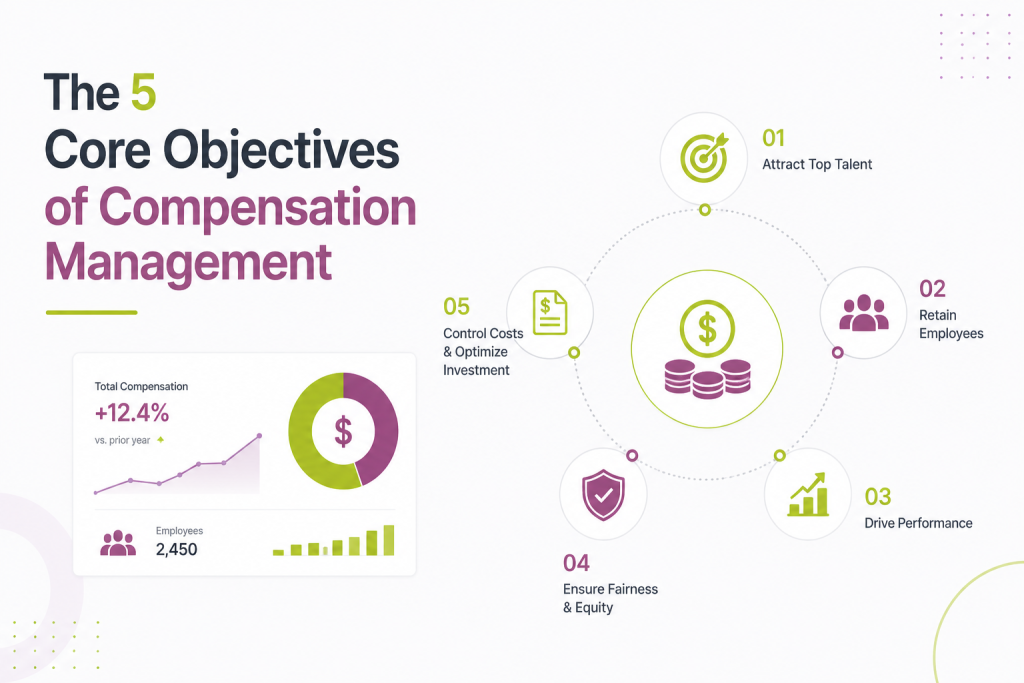
- Five core objectives anchor every effective compensation strategy: attract top talent, retain and reward personnel, boost motivation, ensure compliance, and maximize ROI.
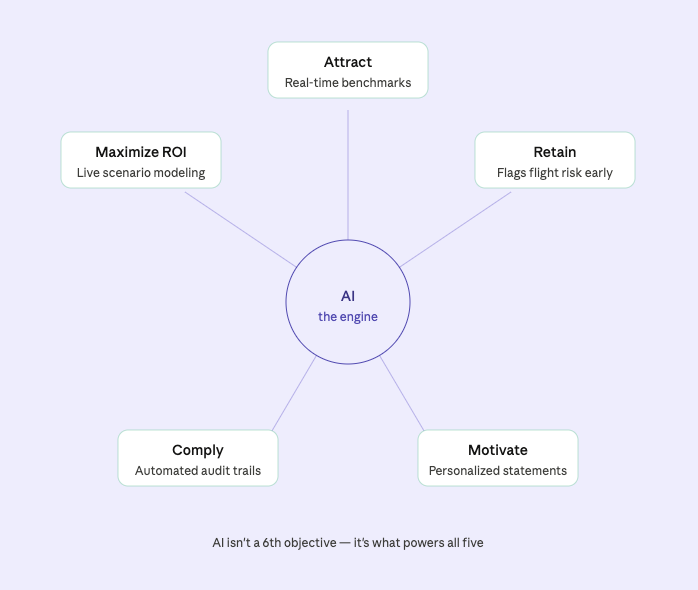
- AI doesn’t add a sixth objective — it’s the engine that makes the other five achievable with current data instead of annual snapshots.
- For attraction and retention, AI delivers continuous market benchmarking and flags employees whose total compensation has fallen behind market — before they start interviewing elsewhere.
- For motivation and compliance, AI generates personalized equity statements employees actually understand, and automates audit trails that flag pay equity issues before they become legal exposure.
- For ROI, AI replaces the annual compensation review with real-time scenario modeling — answers that used to take weeks now take minutes.
- AI doesn’t replace compensation judgment — it replaces the manual labor that used to stand between data and judgment. Where to position bands and how to balance cash vs. equity remain human decisions.
1. Attract Top Talent
Compensation is consistently one of the top factors candidates weigh when evaluating an offer, often ahead of flexibility or culture. A compelling package signals that an organization values its people and is willing to compete for them — and in tight talent markets, the companies willing to move fastest on competitive offers tend to win.
For companies that include equity in their offers, this objective extends beyond base salary. Candidates evaluating a startup or scale-up offer are weighing total compensation — cash plus the present and future value of equity — against offers from competitors who may structure their packages very differently. Getting that framing right, and being able to articulate it clearly during recruiting, often determines whether a candidate accepts.
Where finance teams get this wrong: Relying on outdated benchmark data or generic salary surveys leads to offers that are technically defensible but practically uncompetitive. By the time a stale benchmark gets updated, the market has often already moved.
2. Retain and Reward Personnel
Attracting talent is only half the job. Retention requires a compensation strategy that recognizes performance, rewards loyalty, and stays competitive over the full arc of someone’s tenure — not just at the offer stage.
This is where most traditional compensation strategies show their age. Annual merit cycles and ad-hoc equity refreshes were built for a slower-moving labor market. In faster-moving sectors, an employee whose compensation falls behind market rate doesn’t wait for the next review cycle to notice — they start taking calls from recruiters.
Equity plays an outsized role here for any company that grants it. Traditional refresh models are reactive: an employee’s equity nears full vesting, anxiety builds, and a refresh gets approved (or doesn’t) depending on how loudly their manager advocates. Structured alternatives — like BoxCar grant programs, which issue smaller overlapping grants on a fixed cadence — replace that reactive cycle with continuous vesting and predictable retention coverage. We’ve written in detail about how BoxCar compares to traditional refresh grants for finance teams evaluating the shift.
Where finance teams get this wrong: Treating equity refreshes as a discretionary, case-by-case decision rather than a policy-driven system creates inconsistency, unpredictable cost, and retention gaps precisely when they matter most.
Also read: Spreadsheets vs. AI: The Real Cost of Managing Equity Manually
3. Boost Motivation
Compensation that’s transparent and clearly tied to performance does more than retain people — it shapes how engaged and productive they are day to day. When employees understand how their contributions translate into pay outcomes, they have a direct incentive to perform; when the connection is opaque, compensation becomes background noise at best and a source of resentment at worst.
Goal-based incentive structures, team performance bonuses, and individual recognition awards all serve this objective. But the structure only motivates if employees can actually see and understand it. A compensation plan that exists only in a policy document or a spreadsheet the employee never sees has no motivational power at all.
Where finance teams get this wrong: Designing a sound incentive structure but failing to communicate it clearly to employees. A well-designed comp plan that employees don’t understand performs no better than no plan at all.
4. Be Compliant
Compensation decisions carry legal weight. In the U.S., that means alignment with the Fair Labor Standards Act, the Equal Pay Act, and a growing patchwork of state-level pay transparency laws — and the regulatory and reputational stakes around pay equity have only increased. Regulators and employees alike are scrutinizing whether compensation is applied consistently across gender, race, and role.
For companies managing equity, compliance extends further: grant documentation needs to be reconciled against board approvals, vesting calculations need to be accurate and auditable, and 409A valuations need to be current and properly applied. Inconsistencies here aren’t just compliance risks — they’re the kind of thing that surfaces, expensively, during fundraising or acquisition due diligence.
Where finance teams get this wrong: Treating compliance as a once-a-year audit exercise rather than something built into the day-to-day system. By the time an inconsistency is caught manually, it has often already affected multiple employees or grant cycles.
5. Maximize ROI
Every dollar allocated to compensation should be traceable to a business outcome — better retention, stronger performance, more competitive hiring. Maximizing ROI means identifying which roles and which compensation levers actually move the needle, and reallocating budget away from programs that don’t.
This requires data: which employees are flight risks, which compensation programs correlate with retention, where equity spend is concentrated relative to performance and impact. Without that visibility, ROI optimization is guesswork dressed up as strategy.
Where finance teams get this wrong: Evaluating compensation ROI annually, using backward-looking data, rather than continuously, using current data. A strategy reviewed once a year can only ever be a year behind.
Where AI Fits Into Each Objective
The objectives above haven’t changed in decades. What has changed is the gap between the data needed to pursue them well and the tools most finance and HR teams have to work with. AI closes that gap directly.
Attracting talent: AI-powered benchmarking platforms aggregate compensation signals continuously — from job postings, offer data, and market sources — rather than relying on annual survey cycles. That means the offer a finance team approves reflects what the market is paying this quarter, not what it was paying a year ago. For equity specifically, AI can model the total present value of a candidate’s package, accounting for grant size, vesting structure, and current valuation, giving recruiters a clear, defensible number to put in front of a candidate.
Retention: AI systems can model each employee’s total compensation trajectory — including the value of unvested equity — and flag when that trajectory is falling behind market positioning, before the employee starts interviewing elsewhere. Combined with a structured refresh program like BoxCar, this turns retention from a reactive scramble into a managed, forecastable process. Automation also handles the operational complexity that a structured program creates — overlapping grant schedules, vesting calculations, and cadence-based issuance — at a scale manual processes can’t sustain accurately.
Motivation: AI-generated, personalized compensation and equity statements give every employee a clear, individual view of what they hold, what’s vesting, and what’s coming next — replacing static policy documents with something an employee can actually engage with. This is one of the more underrated applications of AI in compensation: the technology isn’t doing anything mathematically complex here, it’s making information legible at a scale that manual processes can’t match.
Compliance: AI-powered platforms can flag pay equity issues automatically by continuously analyzing compensation data across levels, roles, and demographics — surfacing problems before they become legal exposure rather than after an external audit finds them. Automated audit trails on every grant action — issuance, modification, board approval — create the documentation trail that due diligence requires, without manual reconciliation.
Maximizing ROI: Real-time analytics replace the annual compensation review with continuous visibility into budget utilization, dilution, and the relationship between compensation spend and retention outcomes. Finance teams can run scenario models — what happens to retention if we reposition bands, what’s the dilution impact of a new refresh cadence — and get answers in minutes rather than commissioning a multi-week analysis.
The Honest Caveat
AI doesn’t replace compensation judgment — it replaces the manual labor that used to stand between data and judgment. Deciding where to position bands relative to market, how to balance cash against equity, which roles warrant above-market investment: these remain human decisions, grounded in company strategy and culture. What AI changes is how much reliable, current data informs those decisions, and how much of the operational burden around executing them disappears.
For finance leaders evaluating whether to invest in AI-powered compensation tooling, the right question isn’t whether the five objectives above matter — they clearly do, and have for decades. The right question is whether your current tools give you continuous, accurate visibility into how well you’re meeting them, or whether you’re relying on annual snapshots and manual reconciliation to find out months after a decision has already had its effect.
The Bottom Line
A compensation strategy built around these five objectives — attracting talent, retaining people, motivating performance, staying compliant, and maximizing ROI — gives an organization a coherent framework instead of a series of disconnected decisions. AI doesn’t change what the objectives are. It changes how quickly and accurately an organization can tell whether it’s actually meeting them, and how much of the operational work required to act on that information can happen without manual effort.
For companies managing equity alongside cash compensation, that shift matters even more, because equity introduces complexity — vesting schedules, valuation changes, overlapping grants — that compounds the cost of operating without the right tooling.
Stello AI combines equity management and AI-powered compensation intelligence in a single platform — helping finance and HR teams pursue all five objectives with current data instead of annual snapshots. Book a demo →