According to iHire, nearly half of employees have left a job because of unsatisfactory pay. That’s not the whole story, but it’s a big part of it. That’s where compensation management in HR comes in.
At its core, compensation management is how organizations decide what to pay people, why, and how to keep that strategy competitive over time. It’s not just about salaries. It’s about building a pay structure that attracts top talent, keeps your best people from walking out the door, and ensures everyone is paid fairly.
This guide breaks it all down, simply.
TL;DR: Compensation Management in HR
- Compensation management is the strategic process of deciding what to pay employees, how to structure it, and how to keep it competitive over time.
- It covers both direct compensation (salary, bonuses, commissions) and indirect compensation (benefits, perks, equity).
- HR’s role includes benchmarking salaries, building pay structures, ensuring pay equity, and maintaining legal compliance.
- A strong compensation strategy helps organizations attract top talent, retain employees, and motivate performance.
- Compensation should be reviewed at least once a year and adjusted to reflect market changes and business growth.
What Is Compensation Management in HR?
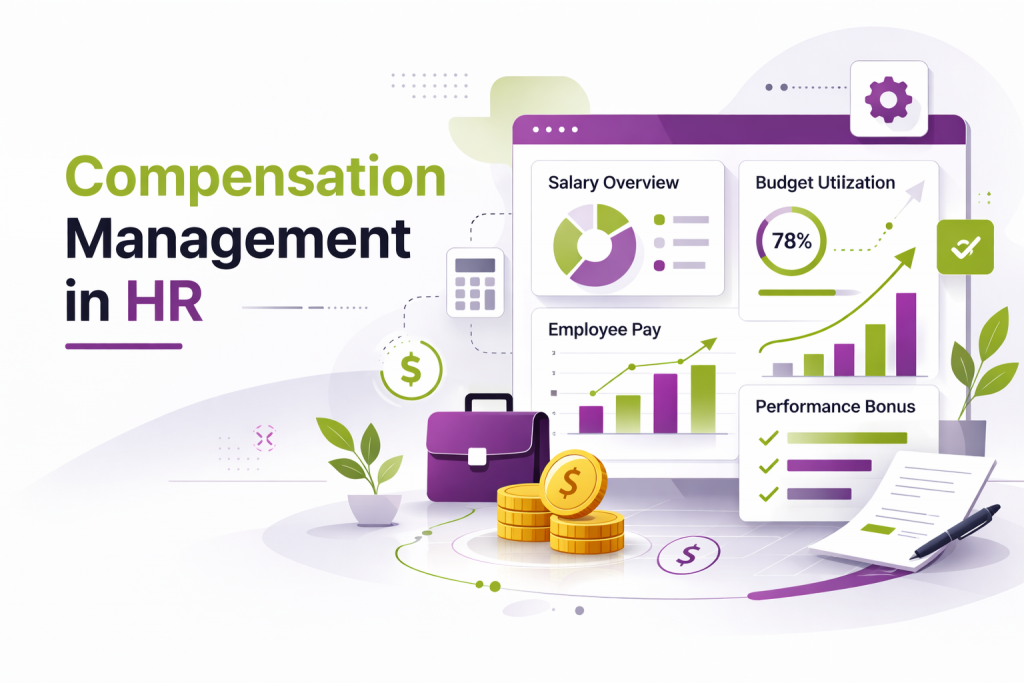
Compensation management in HR is the process of designing, implementing, and overseeing how employees are paid. This includes base salaries, bonuses, benefits, and any other form of financial or non-financial reward an organization offers.
But here’s what separates compensation management from simply “running payroll.” Payroll is operational. It ensures people get paid accurately and on time. Compensation management is strategic. It’s about deciding what to pay, how to structure it, and why, in a way that aligns with business goals and keeps the organization competitive.
Think of it this way: payroll asks “did everyone get paid correctly this month?” Compensation management asks “are we paying people in a way that helps us attract, retain, and motivate the right talent?”
Done well, it creates a clear, fair, and consistent framework for every pay decision across the organization, from entry-level hires to senior leadership.
Why Does Compensation Management Matter?
Compensation is one of the most powerful levers an HR team has. Get it right and it drives real business results. Get it wrong and the costs show up fast, in turnover, disengagement, and lost candidates.
Here’s why it matters:
Talent Attraction
The job market is competitive. Candidates compare offers, research salary ranges on Glassdoor and LinkedIn, and often have multiple options on the table. A well-structured compensation package signals that your organization values its people and is serious about paying fairly.
Employee Retention
Replacing an employee can cost anywhere from 50% to 200% of their annual salary when you factor in recruiting, onboarding, and lost productivity. Competitive, transparent compensation reduces the urge to look elsewhere.
Performance and Motivation
When pay is tied to performance in a clear and fair way, employees understand what’s expected and what they stand to gain. That clarity drives effort and accountability.
Pay Equity and Legal Compliance
Organizations are under increasing pressure to close gender and racial pay gaps. A structured compensation management process helps HR identify and address disparities before they become legal or reputational issues.
Types of Compensation
Compensation isn’t just a salary number. It’s a package, and understanding its components helps HR build offers that are both competitive and meaningful to employees.
Compensation generally falls into two categories: direct and indirect.
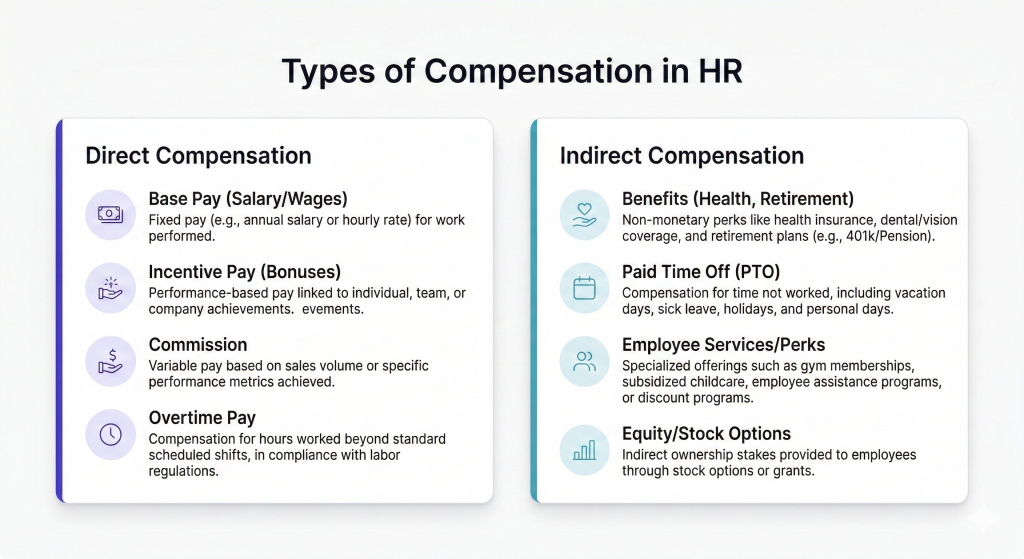
Direct Compensation
This is the monetary side of the equation, what shows up in an employee’s bank account.
- Base salary or hourly wages: The fixed amount an employee earns, regardless of performance or hours worked beyond their standard schedule.
- Bonuses: One-time payments tied to performance, company results, or milestones. This includes sign-on bonuses, annual performance bonuses, and retention bonuses.
- Commissions: Common in sales roles, where a portion of pay is tied directly to revenue generated.
- Overtime pay: Additional compensation for hours worked beyond the standard workweek, often required by law.
Indirect Compensation
This is the non-cash side of the package, and it’s often undervalued by both employers and employees.
- Health, dental, and vision insurance
- Retirement plans and employer contributions
- Paid time off, parental leave, and sick days
- Stock options or equity
- Perks like remote work flexibility, learning stipends, meal allowances, or childcare support
Together, direct and indirect compensation make up an employee’s total compensation package. Smart HR teams don’t just build competitive packages, they also make sure employees understand the full value of what they’re receiving.
What Is HR’s Role in Compensation Management?
Compensation management doesn’t happen in a vacuum. HR sits at the center of it, balancing the needs of employees, leadership, finance, and legal compliance all at once.
Here’s what that looks like in practice:
Market Research and Salary Benchmarking
HR regularly surveys the market to understand what competitors are paying for similar roles. This involves using tools like salary surveys, compensation databases, and platforms like Radford or Mercer to ensure pay stays competitive externally.
Designing Pay Structures
HR builds salary bands and pay grades that create consistency across the organization. These structures define the minimum, midpoint, and maximum pay for each role or level, giving managers a clear framework for making offers and approving raises.
Ensuring Internal Equity
It’s not enough to be competitive externally. HR also has to make sure pay is fair internally. That means a senior engineer hired two years ago shouldn’t be earning significantly less than a new hire in the same role just because the market shifted.
Running Pay Equity Audits
HR periodically reviews compensation data across gender, race, tenure, and other factors to identify and close unexplained pay gaps. This is both a legal safeguard and a trust-building exercise with employees.
Legal Compliance
From minimum wage laws to overtime regulations and pay transparency requirements, HR ensures compensation practices stay on the right side of the law.
Collaborating With Finance
Compensation decisions have a direct impact on headcount budgets and overall financial planning. HR works closely with finance to ensure pay strategies are sustainable and aligned with business growth.
The Compensation Management Process
Compensation management isn’t a one-time task. It’s an ongoing cycle that HR revisits as the business grows, the market shifts, and employee needs evolve. Here’s how the process typically works:
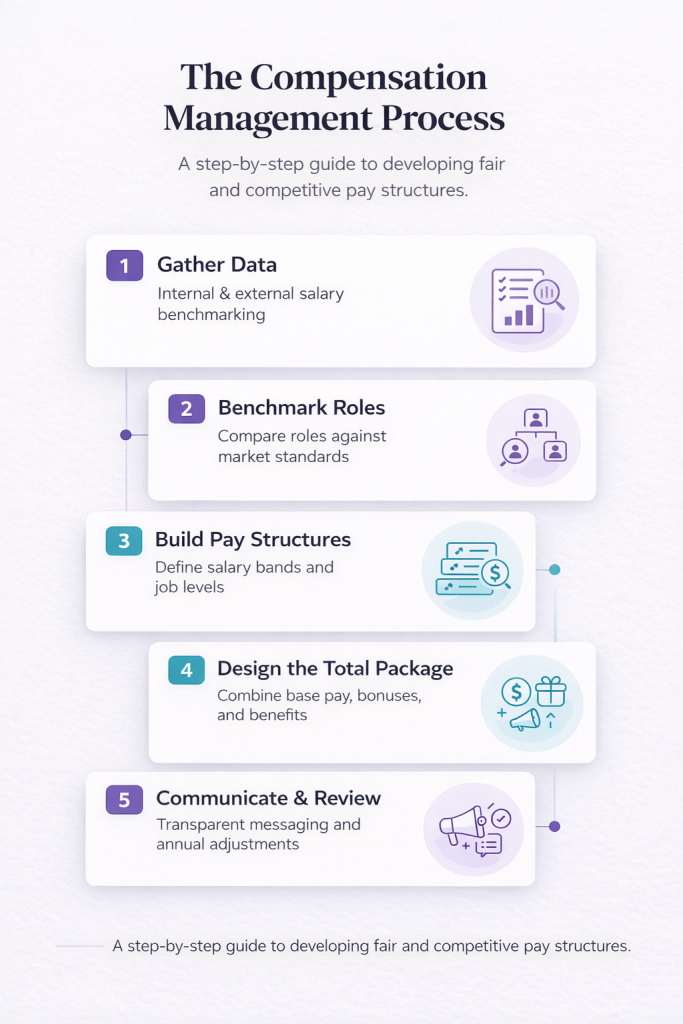
Step 1: Gather Data
Start with what you know. Pull together internal salary data, recent offer history, employee feedback, and any existing pay structures. Then layer in external data from market salary surveys, industry reports, and compensation benchmarking tools.
Step 2: Benchmark Roles
Compare each role in your organization against equivalent positions in the market. This tells you whether your pay ranges are competitive, where you’re falling behind, and where you might be overpaying relative to the market.
Step 3: Build Pay Structures
Using your benchmarking data, define salary bands for each role or job level. These bands give managers guardrails for making offers, approving merit increases, and planning promotions, without every decision becoming a negotiation from scratch.
Step 4: Design the Total Package
Base salary is just the starting point. At this stage, HR combines base pay with bonuses, benefits, equity, and perks to build a total compensation package that is competitive, sustainable, and aligned with what employees actually value.
Step 5: Communicate, Review, and Adjust
A compensation strategy that nobody understands isn’t working. HR needs to communicate clearly to employees how pay is determined, what influences increases, and where they sit within their band. Then, at least annually, the entire structure should be reviewed and adjusted to reflect market changes, business performance, and internal feedback.
Compensation Management Best Practices
Having a compensation process is one thing. Running it well is another. Here are seven best practices that separate organizations with strong compensation strategies from those constantly playing catch-up.
1. Conduct Regular Pay Equity Audits
Don’t wait for a complaint or a lawsuit to review your pay data. Build equity audits into your annual HR calendar and address gaps proactively. Employees notice when pay feels unfair, even if they never say it out loud.
2. Use External Market Data, Not Just Internal Benchmarks
It’s easy to set pay based on what you’ve always paid. But the market moves, and if you’re only looking inward, you’ll fall behind without realizing it. Use updated salary surveys and compensation tools to stay anchored to what’s actually happening outside your organization.
3. Tie Variable Pay to Clear, Measurable Goals
Bonuses and incentives only motivate when employees understand exactly what they need to do to earn them. Vague performance criteria leads to frustration, not performance. Keep the link between effort and reward simple and transparent.
4. Be Transparent About How Pay Is Determined
Employees don’t need to know what their colleagues earn, but they should understand how pay decisions are made at your organization. What factors influence a raise? How are salary bands structured? Transparency builds trust and reduces the rumor mill.
5. Share Total Compensation Statements
Many employees underestimate the full value of their package because they only see their base salary. A total compensation statement that breaks down salary, benefits, retirement contributions, and perks gives employees a clearer picture and increases perceived value without adding cost.
6. Use Compensation Software at Scale
Spreadsheets work until they don’t. As your organization grows, manual compensation tracking becomes error prone and time consuming. Dedicated compensation management software helps HR automate pay calculations, surface equity gaps, and generate reports that inform smarter decisions.
7. Align Compensation Strategy With Company Culture
A startup focused on innovation might lean heavily on equity and flexible perks. A large enterprise might prioritize stability, strong benefits, and structured pay grades. There’s no one-size-fits-all approach. Your compensation strategy should reflect what your organization values and what your employees care about most.
Compensation Management Software: Do You Need It?
For small teams, a well-maintained spreadsheet might be enough to track salaries and benefits. But as headcount grows, manual compensation management becomes increasingly difficult to sustain accurately.
Compensation management software helps HR teams automate the time-consuming parts of the process, things like salary band calculations, merit increase modeling, and pay equity reporting. It also integrates with existing HR and payroll platforms, giving HR a single source of truth for all compensation data.
More importantly, it surfaces problems that are easy to miss in a spreadsheet. Pay gaps, budget overruns, and roles that have drifted outside their salary bands all become visible before they become expensive.
You don’t need an enterprise-level tool to get started. Many HCM platforms like Workday, BambooHR, and Lattice include built-in compensation modules that work well for mid-sized organizations. The right tool depends on your team size, budget, and how complex your pay structure is.
Conclusion
Compensation management in HR is about far more than deciding what number goes on an offer letter. It’s a strategic function that shapes how people feel about their work, their employer, and their future at the organization.
When done well, it attracts stronger candidates, retains your best people, motivates performance, and builds a culture of fairness and trust. When neglected, it quietly drives your talent out the door.
The organizations that treat compensation as an ongoing strategic investment, rather than a once-a-year administrative task, are the ones that consistently win on talent.
FAQs-
What is the difference between compensation management and payroll?
Payroll is an operational function that ensures employees are paid accurately and on time. Compensation management is a strategic function that determines what employees should be paid, how pay structures are designed, and how the organization stays competitive in the market. Payroll executes the payment. Compensation management informs the decision behind it.
What are the main types of compensation in HR?
Compensation falls into two broad categories. Direct compensation includes base salary, bonuses, commissions, and overtime pay. Indirect compensation covers non-cash rewards like health insurance, retirement plans, paid time off, stock options, and workplace perks. Together, these make up an employee’s total compensation package.
What is a salary band in compensation management?
A salary band, also called a pay range, defines the minimum, midpoint, and maximum pay for a specific role or job level within an organization. Salary bands give HR and managers a consistent framework for making offers, approving raises, and planning promotions fairly and consistently across the organization.
Why is pay equity important in compensation management?
Pay equity ensures that employees are compensated fairly regardless of gender, race, age, or other factors unrelated to their role or performance. Beyond being a legal requirement in many regions, pay equity builds employee trust, reduces turnover, and protects the organization from reputational and legal risk.
How often should compensation be reviewed?
Most organizations conduct a formal compensation review annually, typically aligned with performance review cycles or budget planning. However, HR should also benchmark against the market whenever there is significant hiring activity, notable turnover in specific roles, or major shifts in industry salary trends.
What is total compensation in HR?
Total compensation refers to the complete value of everything an employee receives in exchange for their work. This includes base salary, variable pay like bonuses and commissions, and all benefits and perks. Sharing total compensation statements with employees helps them understand the full value of their package beyond just their take-home pay.