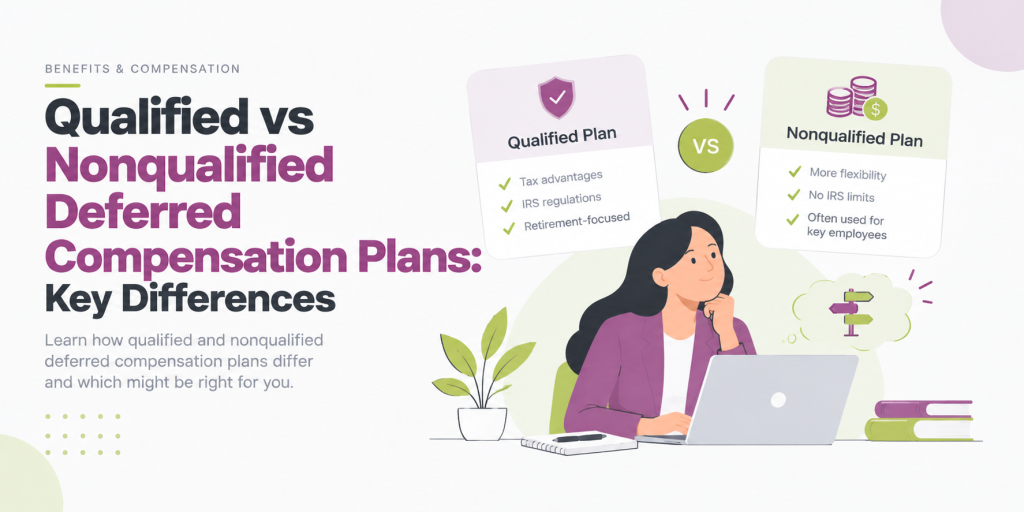
A qualified deferred compensation plan, such as a 401(k), follows federal retirement law, must be offered fairly to most employees, has IRS contribution limits, and keeps savings in a protected trust. A nonqualified deferred compensation plan is usually offered only to executives, has no IRS contribution limit, and gives more flexibility, but the money stays part of the company’s assets and can be lost if the company fails.
Qualified vs Nonqualified at a Glance
| Qualified plan | Nonqualified plan | |
| Examples | 401(k), 403(b), governmental 457(b), pension plans | Executive deferral plans, supplemental retirement plans (SERPs) |
| Who can join | Most employees, under nondiscrimination rules | Usually a select group of executives and highly paid employees |
| Contribution limit | Yes ($24,500 employee deferral in 2026) | No IRS limit |
| Where the money is held | In a trust for employees | Part of the company’s general assets |
| Protection if the company fails | Protected from company creditors | Participants are unsecured creditors |
| Main rules | ERISA and the tax code | Section 409A of the tax code |
| When employee pays income tax | When money is withdrawn | When money is paid out |
| When employer gets a tax deduction | When it contributes | When the employee is paid |
| Rollover to an IRA | Usually allowed | Not allowed |
What Is a Qualified Deferred Compensation Plan?
A qualified deferred compensation plan meets the requirements of federal retirement law (ERISA) and the Internal Revenue Code. In return, it gets important tax benefits.
The trade-off is rules. Qualified plans must:
- Be offered to employees on a fair basis, without favoring highly paid staff, and pass yearly nondiscrimination tests
- Follow IRS contribution limits ($24,500 for employee deferrals in 2026, plus catch-up contributions for those 50 and over, according to the IRS)
- Hold money in a trust separate from the company
- Follow set vesting and reporting rules
For most employees, the company 401(k) is their only deferred compensation plan.
What Is a Non-Qualified Deferred Compensation Plan?
A nonqualified deferred compensation (NQDC) plan is an agreement between a company and an employee to pay part of the employee’s earnings at a later date. It doesn’t meet ERISA’s qualified plan rules, so it avoids most of them.
Most nonqualified plans are “top-hat” plans, meaning they’re limited to a select group of management or highly paid employees. That lets companies offer them to executives without opening them to everyone.
Nonqualified deferred compensation plans are popular because they let executives save far more than the 401(k) limit. A senior leader earning $400,000 who can only defer $24,500 into a 401(k) might defer
$100,000 or more through a nonqualified plan.
Key Differences Explained
Who can participate
Qualified plans must cover employees broadly. Nonqualified plans can be offered to just a few people, which is why they’re a common part of executive compensation.
How much you can contribute
Qualified plans have annual IRS limits. Nonqualified plans have no IRS limit, though the plan itself may set one.
Safety of the money
This is the biggest difference. Qualified plan assets sit in a trust and are protected if the employer goes bankrupt. Nonqualified plan balances are just a promise to pay. Some companies use a “rabbi trust” to set money aside, but it can still be claimed by creditors if the company fails.
Timing rules
Nonqualified plans follow Section 409A. Deferral elections usually have to be made before the year in which the pay is earned. Payouts can only happen on specific events: leaving the company, disability, death, a change in control, an unforeseeable emergency, or a fixed date chosen in advance. Breaking the rules can make the deferred amount taxable right away, plus a 20% additional tax and interest.
Taxes
In both plans, income tax is deferred until payout. Payroll taxes work differently. Nonqualified deferrals are generally subject to Social Security and Medicare taxes when they vest, even though income tax waits until they’re paid.
Flexibility after leaving
Qualified plan balances can usually be rolled into an IRA or a new employer’s plan. Nonqualified balances can’t, and are paid out on the schedule chosen in the original election.
What Is a Non Deferred Compensation Plan?
A non deferred compensation plan is simply one that pays you in the current year, such as your regular salary or an annual bonus paid in cash. You pay income tax on it in the year you receive it. Most employees are paid entirely through non-deferred pay, with a 401(k) as their only form of deferral.
Which Plan Is Right?
For employees: Max out a qualified plan first, especially if your employer offers a match. Consider a nonqualified plan only if you’ve hit the 401(k) limit, expect a lower tax rate later, and are confident in your employer’s financial health.
For employers: Qualified plans are the standard retirement benefit for the whole workforce. Nonqualified plans are a targeted tool for attracting and keeping senior leaders, and work best as part of a wider executive compensation plan.
Making Deferred Pay Visible to Employees
Both types of plan are easy for employees to undervalue, because the money doesn’t show up in their paycheck. Stello AI’s total rewards statements show each employee their full package, including base pay, bonus, equity and, if you choose, benefits, with wording HR can tailor to explain plans like these. See how Stello AI handles total rewards statements.
Frequently Asked Questions
What is a qualified deferred compensation plan?
A qualified deferred compensation plan, such as a 401(k), meets federal retirement law requirements. It must be offered fairly to employees, has IRS contribution limits, and keeps savings in a protected trust.
What is a non-qualified deferred compensation plan?
It’s an agreement to pay part of an employee’s earnings in a future year, usually offered only to executives. It has no IRS contribution limit, but the money stays part of the company’s assets.
Is a 457(b) plan qualified or nonqualified?
Governmental 457(b) plans are generally treated like qualified plans, with similar contribution limits and protections. 457(b) plans at tax-exempt nonprofits are nonqualified and limited to select employees.
Are nonqualified deferred compensation plans safe?
They carry more risk than qualified plans. If the employer goes bankrupt, participants are unsecured creditors and may not get their full balance.
Can I roll a nonqualified deferred compensation plan into an IRA?
No. Nonqualified balances are paid out according to the plan and your election, and can’t be rolled into an IRA or a 401(k).