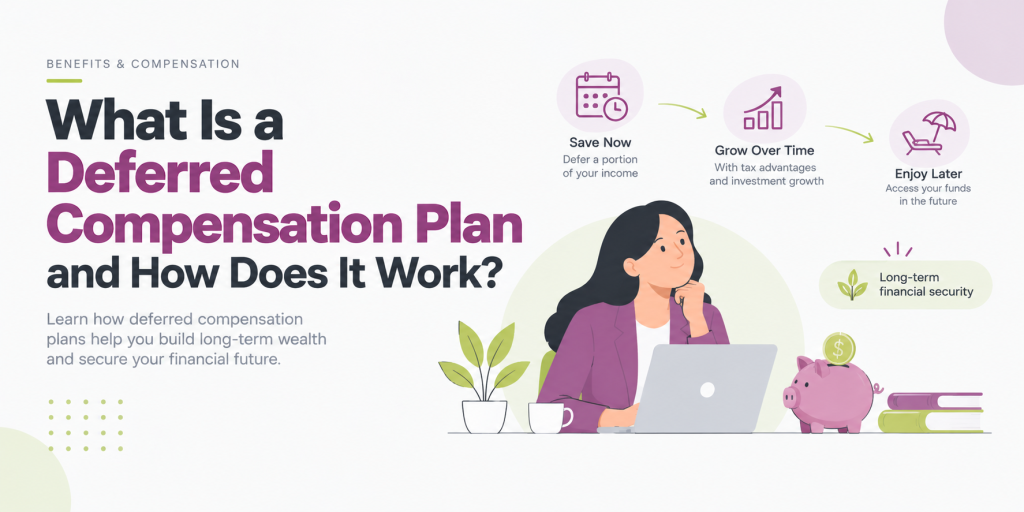
A deferred compensation plan lets an employee set aside part of their pay now and receive it at a later date, usually at retirement or after leaving the company. Income tax on the deferred amount is generally postponed until it’s paid out. Deferred compensation plans come in two types: qualified plans, such as a 401(k), and nonqualified plans, which are usually offered only to executives and other highly paid employees.
What Are Deferred Compensation Plans?
Deferred compensation means pay you earn this year but receive in a future year. The plan sets the rules for how much you can defer, how the money grows while you wait, and when it’s paid out.
There are two broad types:
- Qualified plans are covered by federal retirement law (ERISA) and the tax code. They include 401(k), 403(b) and governmental 457(b) plans, and are open to most employees.
- Nonqualified deferred compensation (NQDC) plans are mainly for executives and other highly paid employees. They have no IRS contribution limit, but come with more risk and strict tax rules.
Our guide to qualified vs nonqualified deferred compensation plans compares them in detail.
How Does a Deferred Compensation Plan Work?
The basic steps are the same for most plans.
1. You choose how much to defer
You elect to defer a portion of your salary or bonus. In a 401(k), this is usually a percentage of each paycheck. In a nonqualified plan, you usually make your election before the year in which you earn the pay.
2. The money is set aside
In a qualified plan, the money goes into a trust in your name, invested in the funds you choose. In a nonqualified plan, the company usually keeps the money as part of its own assets and tracks your balance against investment options you select.
3. Your balance grows
Investment gains build up without being taxed each year.
4. You receive the money later
You’re paid at a time set by the plan, such as retirement, leaving the company, or a fixed date you chose in advance. Income tax is due when you receive it.
Example of a Deferred Compensation Plan
Maria is a vice president earning a $250,000 salary and a $100,000 bonus. She maxes out her company 401(k) at $24,500, the 2026 limit. Her employer also offers a nonqualified plan, so she defers another
$50,000 of her bonus.
Maria pays no income tax on the $50,000 this year. The company tracks the money in her account, and it grows with the investments she chose. When she retires in 10 years, she’s paid in five yearly installments, and pays income tax on each one, possibly at a lower rate than she would have paid while working.
An illustration. Actual tax treatment depends on the plan and the person’s circumstances.
2026 Contribution Limits for Qualified Plans
For 2026, the IRS limits for 401(k), 403(b) and governmental 457(b) plans are:
| Limit | 2026 amount |
| Employee elective deferral | $24,500 |
| Catch-up contribution, age 50 and over | $8,000 |
| Catch-up contribution, ages 60 to 63 | $11,250 |
The IRS usually announces next year’s limits in the fall.
Nonqualified plans have no IRS cap, which is why they’re popular with executives who have already hit these limits.
Benefits of Deferred Compensation Plans
For employees
- Lower taxable income in high-earning years
- Tax-deferred investment growth
- A way to save beyond 401(k) limits, through a nonqualified plan
- Control over when income arrives, such as spreading it over retirement
For employers
- A tool to attract and keep senior talent
- Vesting schedules can encourage executives to stay
- Nonqualified plans can be offered to a select group, without covering everyone
Risks and Rules to Know
Nonqualified plans carry real risks. The money stays part of the company’s general assets until it’s paid. If the company goes bankrupt, participants become unsecured creditors and could lose their balance.
The rules are also strict. Nonqualified plans must follow Section 409A of the tax code, which controls when you can elect to defer and when you can be paid. Breaking those rules can make the whole deferred amount taxable immediately, plus an extra 20% tax and interest.
Deferred Compensation Planning: Questions to Ask
Before deferring pay, it’s worth thinking through a few questions, ideally with a financial adviser:
- Have I already maxed out my 401(k)?
- Do I expect my tax rate to be lower when I’m paid?
- How financially stable is my employer?
- When do I want to receive the money, and in a lump sum or installments?
- Can I afford to have this money locked away until then?
Helping Employees See the Full Value of Their Pay
Deferred compensation is easy to overlook when employees think about what they’re paid, because it doesn’t appear in the paycheck. Clear communication helps employees value the full package.
Stello AI creates personalized total rewards statements that show each employee their base salary, bonus, equity and, if you choose, benefits. HR can edit the wording of every statement, so the value of plans like deferred compensation can be explained in plain language. See how Stello AI handles total rewards statements.
Frequently Asked Questions
What is a deferred compensation plan?
A deferred compensation plan lets an employee receive part of this year’s pay at a later date, usually at retirement. Income tax is generally postponed until the money is paid out.
How does a deferred compensation plan work?
You choose an amount to defer, the money is invested or tracked against investments, it grows without yearly tax, and you’re paid at a set time, such as retirement, when income tax becomes due.
Is a 401(k) a deferred compensation plan?
Yes. A 401(k) is a qualified deferred compensation plan. Nonqualified plans are a separate type, usually offered only to executives.
Can you lose money in a deferred compensation plan?
In a nonqualified plan, yes. The money remains part of the company’s assets, so you could lose it if the company goes bankrupt. Investment values can also fall.
When can I withdraw from a deferred compensation plan?
Only at times the plan allows, such as retirement, leaving the company, disability, death or a fixed date chosen in advance. Nonqualified plans rarely allow early withdrawals.