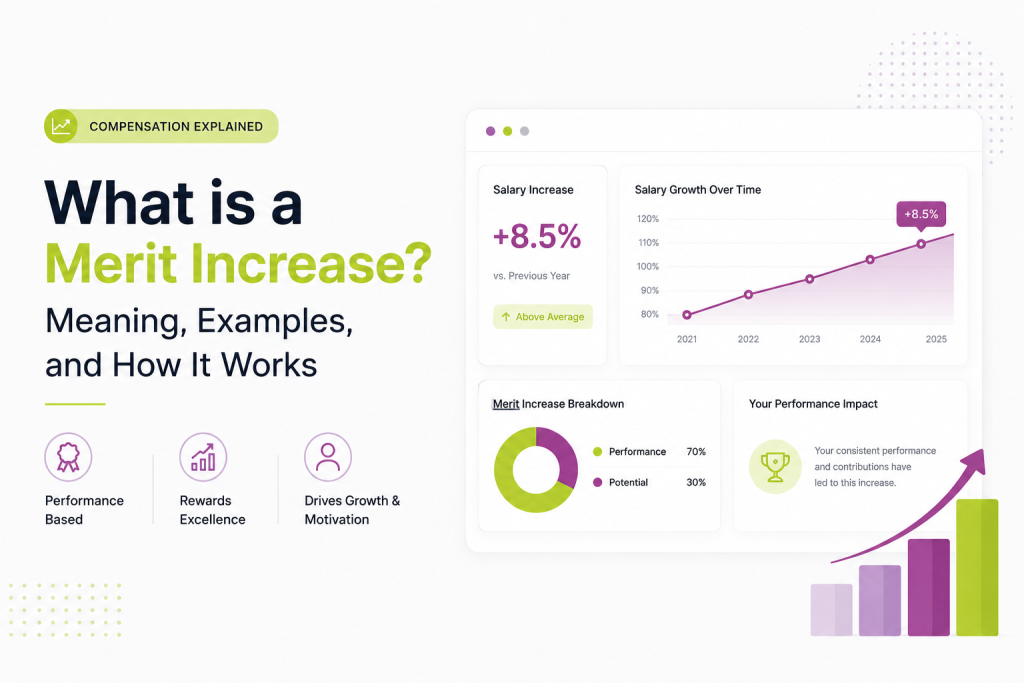
If you’ve ever gotten a raise tied to your performance review instead of a promotion or a cost-of-living adjustment, you’ve received a merit increase. The term shows up constantly in comp conversations, but a lot of managers and employees use it loosely without understanding what actually separates it from other types of raises.
This guide breaks down what a merit increase means, how companies calculate it, and how it differs from other pay increases you’ll run into during a comp cycle.
TL;DR
- A merit increase is a raise tied to individual performance, not tenure, promotion, or cost of living.
- It’s different from a COLA, promotion increase, market adjustment, or bonus. Each is calculated and awarded differently.
- Most companies use a merit matrix that combines performance rating with compa-ratio to set the increase percentage.
- Typical merit increases fall between 3–5% overall, with top performers often seeing 5–8%.
- Getting the merit budget and matrix right makes merit increases one of the strongest retention tools a comp team has.
Merit increase meaning
A merit increase is a raise given to an employee based on their individual job performance, not on tenure, cost of living, or a change in role.
It’s typically awarded during an annual or semi-annual performance review cycle, and the size of the increase usually reflects how the employee was rated. A “meets expectations” employee might get a smaller merit increase than someone rated “exceeds expectations.”
Merit increases are meant to reward and retain strong performers, and to reinforce the link between performance and pay.
Also read: What is Compa-Ratio? A Simple Guide for Comp Teams
Merit increase vs. other types of raises
Merit increase gets confused with a handful of other comp terms. Here’s how they differ:
Merit increase vs. cost-of-living adjustment (COLA): A COLA is given to everyone regardless of performance, meant to help pay keep pace with inflation. A merit increase is performance-based and varies by individual.
Merit increase vs. promotion increase: A promotion increase comes with a change in title, level, or responsibilities. A merit increase happens within the same role, tied purely to how well someone performed in it.
Merit increase vs. market adjustment: A market adjustment corrects pay that’s fallen behind external market rates, regardless of performance. A merit increase is about rewarding performance, not fixing a market gap.
Merit increase vs. bonus: A bonus is typically a one-time payout. A merit increase raises the employee’s base salary permanently, compounding into future pay.
Also read: Pay Equity vs. Pay Parity: What’s the Difference and Why It Matters
How merit increases are calculated
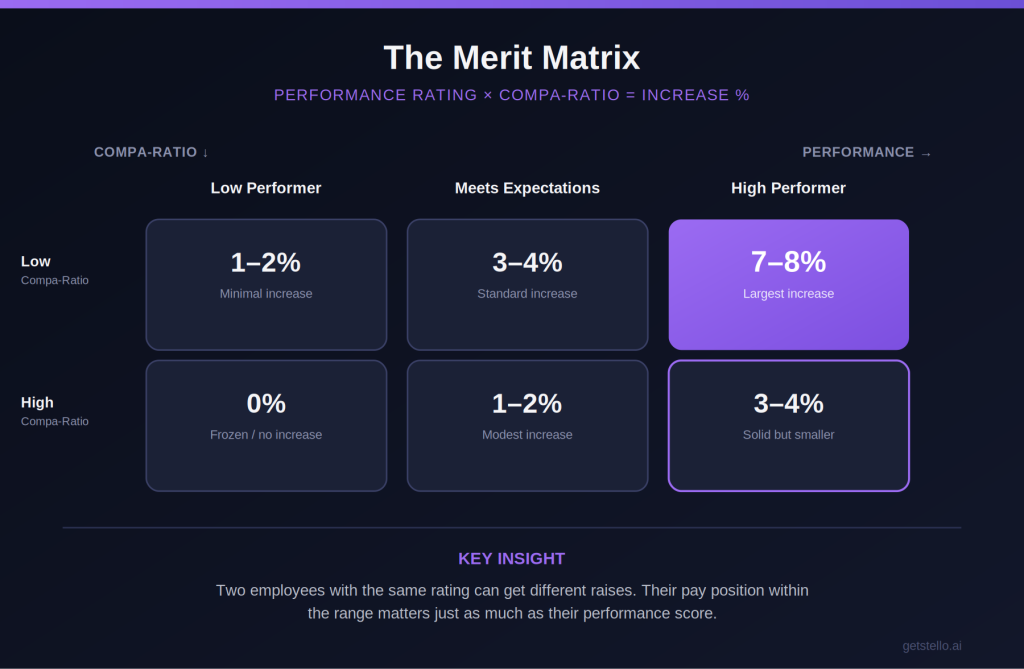
Most companies calculate merit increases using a merit matrix, which maps performance rating against compa-ratio (how the employee’s current pay compares to their salary range midpoint) to determine the increase percentage.
The logic behind a merit matrix:
- High performer, low compa-ratio: Gets the largest increase. They’re performing well and have room to move up within their range.
- High performer, high compa-ratio: Gets a smaller increase, since they’re already paid near or above the range midpoint.
- Low performer, low compa-ratio: Gets little to no increase, since performance doesn’t support a larger raise.
- Low performer, high compa-ratio: Typically frozen or given a minimal increase.
This is why two employees with identical performance ratings can receive different merit increase percentages. Their pay relative to their range plays just as big a role as their rating does.
Average merit increase percentage
Merit increase budgets vary by year, industry, and company performance, but they typically fall somewhere between 3% and 5% of base salary for the overall employee population. Top performers within that pool often receive increases in the 5% to 8% range, while employees rated as underperforming may receive 0% to 1%.
These numbers shift depending on the broader economic environment. Companies planning merit budgets usually benchmark against market salary survey data before finalizing the year’s increase percentages.
Also read: What is a Compensation Cycle? A Complete Guide for HR and Comp Teams
Why merit increases matter
Merit increases play a few different roles in a comp strategy:
Retention. Strong performers who don’t see their pay grow relative to their contribution are more likely to leave. Merit increases signal that performance is recognized and rewarded.
Pay-for-performance culture. Tying raises to performance ratings reinforces the idea that outcomes matter, not just tenure.
Range progression. Merit increases gradually move employees toward the midpoint or top of their salary range over time, assuming consistent strong performance.
Budget discipline. Because merit increases are budgeted as a percentage of total payroll, they give finance and HR a predictable, controllable mechanism for raises, unlike ad hoc off-cycle adjustments.
Common mistakes with merit increases
A few issues come up repeatedly when companies run merit cycles:
- Treating merit increases as automatic. If every employee gets roughly the same increase regardless of rating, the raise stops functioning as a performance signal.
- Ignoring compa-ratio. Awarding the same percentage increase to someone at 80% of range and someone at 115% of range treats two very different pay situations identically.
- Underfunding the merit budget. If the total merit pool is too small, even top performers end up with increases too small to feel meaningful or retentive.
- Poor manager calibration. If performance ratings vary wildly across teams due to inconsistent manager standards, merit increases end up rewarding manager leniency instead of actual performance.
FAQs
What is a good merit increase percentage? For a strong performer, a merit increase between 4% and 6% is generally considered solid in a typical year, though this varies by company budget and role. Increases above 7% to 8% are usually reserved for top performers or those significantly under their range midpoint.
Is a merit increase the same as a raise? A merit increase is a type of raise, but not all raises are merit increases. A raise can also come from a promotion, a market adjustment, or a cost-of-living adjustment. A merit increase specifically ties the raise to individual performance.
How often do merit increases happen? Most companies run merit increases once a year, typically tied to an annual performance review cycle. Some companies with more frequent review cycles offer merit adjustments semi-annually.
Do merit increases affect bonus calculations? Not directly. Merit increases raise base salary, while bonuses are usually calculated as a percentage of that base salary or against separate performance targets. A merit increase can indirectly raise future bonus amounts if bonuses are calculated as a percentage of base pay.
Can you get a merit increase and a promotion in the same year? Yes, though they’re usually handled as separate line items. Some companies combine a promotion increase with a merit increase in the same cycle, while others keep the two events at different points in the year to keep the reasoning behind each increase clear.
The bottom line
A merit increase is a raise earned through performance, not simply granted through tenure or inflation. Understanding how compa-ratio and performance ratings interact through a merit matrix explains why two people with the same rating can walk away with very different increases. Get the merit matrix and budget right, and merit increases become one of the most effective retention tools a comp team has.