Compensation has its own language. If you’re building a comp plan, running a comp cycle, or just trying to keep up with your HR team’s vocabulary, half the battle is knowing what people actually mean when they say “compa-ratio” or “range penetration.” This compensation terms glossary covers the terms that come up most in compensation management, from base pay basics to the newer AI-driven tools reshaping how comp teams work. Bookmark it. Come back when a term trips you up.
Compensation Management Glossary: 60 Terms You Should Know
A reference glossary covering the language of compensation management, organized into 9 categories from base pay basics to AI-driven comp tools.
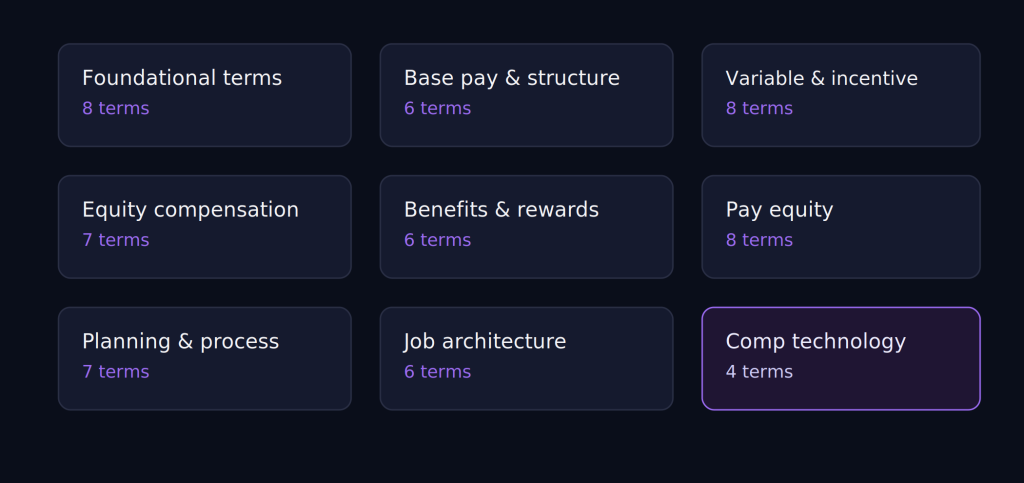
- Foundational terms — compensation, total rewards, comp philosophy, comp strategy
- Base pay & structure — base salary, pay range, pay grade, midpoint
- Variable & incentive pay — bonus, commission, merit increase, SPIFF
- Equity compensation — stock options, RSUs, vesting, cliff, strike price
- Benefits & total rewards — PTO, perks, fringe benefits
- Pay equity & compliance — compa-ratio, pay gap, FLSA, exempt vs. non-exempt
- Planning & process — comp cycle, merit matrix, budget pool
- Job architecture — leveling, job family, career ladder, benchmarking
- Compensation technology — comp management software, pay data analytics, AI compensation agent
Read the full glossary for definitions of all 60 terms.
Foundational terms
Compensation Everything an employee receives in exchange for their work. This includes salary, bonuses, equity, and benefits, not just the number on a paycheck.
Total compensation The full value of an employee’s pay package, combining base salary, variable pay, equity, and the dollar value of benefits. Total compensation is what candidates should compare when weighing offers.
Total rewards A broader concept than total compensation. It includes pay and benefits, plus intangibles like career growth, recognition, flexibility, and company culture.
Compensation philosophy A company’s guiding stance on how it wants to pay people. This might mean paying at the market median, above market to win talent, or below market with more equity upside.
Compensation strategy The practical plan for executing a compensation philosophy. It covers how pay decisions get made, what data informs them, and how often pay gets reviewed.
Compensation structure The framework of pay grades, ranges, and levels a company uses to keep pay consistent and organized across roles.
Compensation package The full set of pay elements offered to an employee: base salary, bonus potential, equity, and benefits, usually presented together in an offer letter.
Compensation review A periodic check of an employee’s or role’s pay against market data, internal equity, and performance, usually done annually or during a comp cycle.
Base pay and structure
Base salary The fixed amount an employee is paid before bonuses, commissions, or other variable pay. It’s the foundation of most compensation packages.
Base pay Used interchangeably with base salary, though it can also apply to hourly wages for non-exempt employees.
Pay range The minimum and maximum salary a company will pay for a specific role or level, usually set based on market data and internal budget.
Pay grade A tier or band that groups similar roles together for pay purposes, based on factors like scope, skill, and impact.
Salary band Another term for pay range, often used specifically within a leveling framework to show where a role sits relative to others.
Midpoint The middle value of a pay range, typically representing market rate for a fully competent employee in that role.
Variable and incentive pay
Variable pay Compensation tied to performance or results rather than fixed. Bonuses, commissions, and profit-sharing all fall under this umbrella.
Incentive compensation Pay designed to motivate specific behaviors or outcomes, most common in sales roles but increasingly used across departments to drive company goals.
Bonus A one-time payment on top of base salary, usually tied to individual, team, or company performance over a set period.
Commission Pay calculated as a percentage of sales or revenue generated, standard in sales roles and some customer success positions.
Spot bonus A small, unplanned bonus given to recognize a specific achievement or contribution, outside the normal bonus cycle.
Merit increase A raise to base salary based on individual performance, typically delivered during an annual compensation cycle.
Performance-based pay Any compensation, whether a raise, bonus, or equity grant, directly linked to how an employee performed against goals.
SPIFF (Sales Performance Incentive Fund) A short-term bonus program designed to boost sales of a specific product or hit a specific target within a defined window.
Equity compensation
Equity compensation Ownership stake in a company given as part of a pay package, usually in the form of stock options or RSUs.
Stock options The right to buy company stock at a fixed price (the strike price) after a vesting period. Common at startups where cash compensation may be lower.
RSUs (Restricted Stock Units) A promise to grant shares of company stock once vesting conditions are met. Unlike options, RSUs have value even if the stock price drops.
Vesting The schedule over which an employee earns the right to their equity grant, often four years with a one-year cliff.
Cliff The initial period, often one year, before any equity vests. If an employee leaves before the cliff, they receive no equity.
Strike price The fixed price at which an employee can purchase stock through their options, set at the time of grant.
ESPP (Employee Stock Purchase Plan) A program letting employees buy company stock, often at a discount, through payroll deductions.
Benefits and total rewards
Benefits Non-salary compensation like health insurance, retirement contributions, and paid leave, provided as part of an employment package.
Total rewards statement A document showing employees the full value of their compensation, including salary, bonus, equity, and the dollar value of benefits, often underused as a retention tool.
Perquisites (perks) Extras beyond standard benefits, like commuter stipends, wellness budgets, or free meals.
Non-monetary compensation Anything valuable to an employee that isn’t cash, including flexible schedules, professional development, and recognition programs.
PTO (Paid Time Off) Time away from work that employees are still paid for, covering vacation, sick leave, and personal days, sometimes combined into one policy.
Fringe benefits A catch-all term for additional benefits provided beyond wages, often used in a legal or tax context.
Pay equity and compliance
Pay equity The principle that employees doing similar work should be paid similarly, regardless of gender, race, or other protected characteristics.
Pay transparency The practice of sharing salary ranges, and sometimes actual pay, with employees or the public. Increasingly required by state and local law.
Pay gap The difference in average pay between groups, most commonly discussed in terms of gender or race.
Pay audit A formal analysis of compensation data to identify unexplained pay differences and ensure compliance with equity laws.
Compa-ratio An employee’s salary divided by the midpoint of their pay range, used to see whether someone is paid below, at, or above market for their role.
Range penetration How far an employee’s salary sits within their pay range, expressed as a percentage, useful for spotting who’s near the top or bottom of their band.
FLSA (Fair Labor Standards Act) The U.S. federal law that sets minimum wage, overtime pay, and recordkeeping requirements, and determines exempt versus non-exempt status.
Exempt vs. non-exempt Exempt employees are not entitled to overtime pay under the FLSA, typically salaried roles meeting certain duties tests. Non-exempt employees must be paid overtime for hours worked beyond 40 per week.
Compensation planning and process
Compensation planning The process of designing and allocating pay decisions, including raises, bonuses, and equity, ahead of a comp cycle.
Compensation cycle The recurring period, usually annual, when a company reviews and adjusts employee pay based on performance, market data, and budget.
Merit matrix A grid used to guide raise decisions, combining performance rating and current position in pay range to recommend an increase.
Budget pool The total amount of money allocated for raises, bonuses, or promotions during a comp cycle, often set as a percentage of payroll.
Off-cycle adjustment A pay change made outside the normal comp cycle, usually to address retention risk, a market shift, or a pay equity gap.
Promotion increase A raise given alongside a promotion to bring pay in line with the new role’s responsibilities and pay range.
Market adjustment A pay increase made to keep an employee’s salary competitive with current market rates, independent of performance.
Job architecture and leveling
Job architecture The overall framework a company uses to organize roles, levels, and career paths in a consistent, comparable way.
Job leveling The process of assigning roles to specific levels based on scope, complexity, and impact, forming the backbone of a pay structure.
Job family A group of roles that share similar skills and career paths, like engineering or sales, used to organize leveling and pay.
Career ladder The defined progression of roles and levels an employee can move through within a job family or function.
Job evaluation A systematic process for assessing the relative value of different roles within a company, often used to set pay grades.
Salary benchmarking Comparing internal pay data against external market data to ensure compensation stays competitive.
Compensation technology
Compensation management software A platform that helps HR and comp teams plan, model, and administer pay decisions, replacing manual spreadsheets with structured workflows.
Comp cycle tool Software specifically built to manage the annual or biannual process of allocating raises, bonuses, and equity across an organization.
Pay data analytics The use of data and reporting to spot pay equity gaps, compression issues, and trends across a workforce.
AI compensation agent An AI-powered tool that helps compensation teams model pay decisions, flag equity risks, and answer pay-related questions in real time, an emerging category as comp management shifts from static spreadsheets to intelligent, always-on systems.
Compensation terms vocabulary keeps evolving, especially as AI tools enter the space. If there’s a term you keep hearing and can’t quite place, this is the list to send your team.