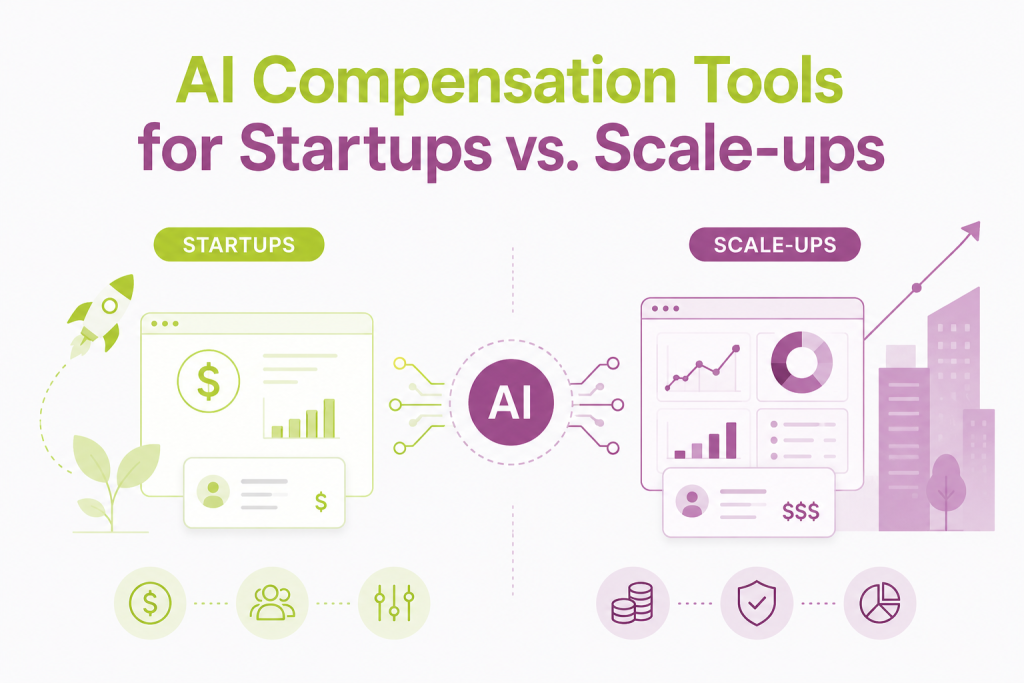
Not every compensation problem is the same. A 30-person seed-stage startup and a 300-person Series C company both need to pay people fairly and retain the talent they’ve worked hard to hire — but the tools, processes, and level of sophistication required to do that well are fundamentally different.
The mistake most founders make is buying too little too early, then scrambling to catch up when they scale. The mistake most scale-up leaders make is holding onto manual processes too long, then discovering the compounding cost of that inertia when attrition spikes or a board asks a question they can’t answer.
This article draws a clear line between what each stage actually needs — and where the right AI compensation tools make the biggest difference.
TL;DR
- The most common founder mistake: buying too little too early, then scrambling to catch up — or holding onto manual processes too long and paying for it in attrition and board credibility.
- At 0–50 employees, you need two things: a simple documented equity framework and lightweight on-demand benchmarking. Don’t over-engineer beyond that.
- At 50–150 employees, informal decisions start creating expensive inconsistencies — a job leveling framework, AI benchmarking, and a structured equity refresh policy (like BoxCar) are no longer optional.
- At 150–500+ employees, compensation is a finance function — equity expense is a P&L line item, dilution is a board conversation, and spreadsheets are a material operational risk.
- Scale-ups need four capabilities: automated equity lifecycle management, real-time dilution modeling, individual equity valuation, and integrated benchmarking tied to their actual workforce.
- The decisions you make on compensation policy and tooling today determine how much flexibility and credibility you have at the next stage — getting ahead costs less than catching up.
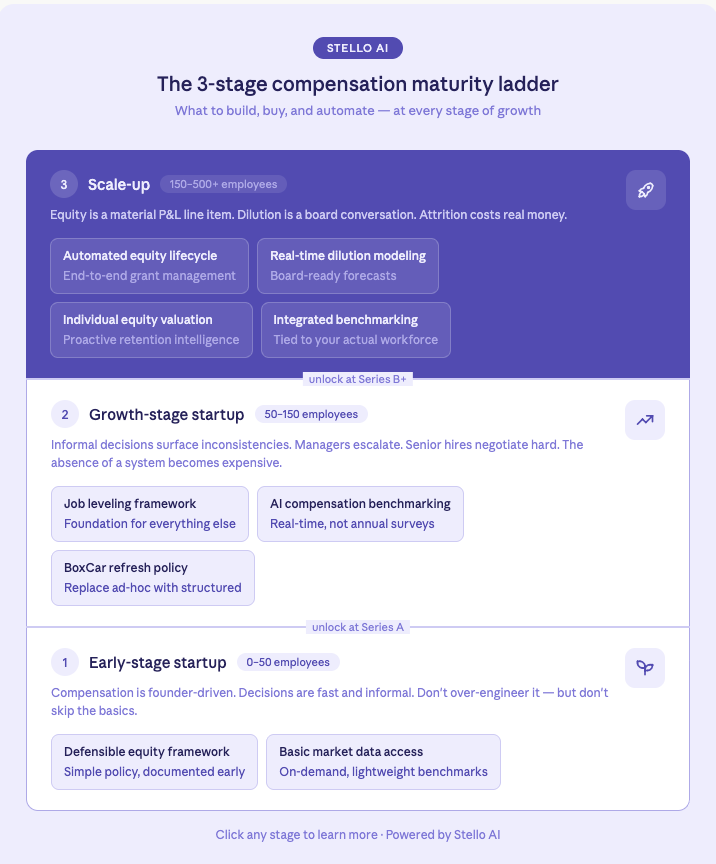
Stage 1: Early-Stage Startups (0–50 employees)
At this stage, compensation is largely founder-driven. You’re making offers based on instinct, market conversations, and whatever benchmark data you can find online. You probably don’t have a dedicated HR or finance function. Decisions are fast, informal, and highly individualized.
That’s fine — and largely appropriate. Over-engineering compensation at 20 people is a distraction. But there are two things early-stage founders consistently underinvest in that create compounding problems later.
What you actually need at this stage
A defensible equity framework. Even at 10 people, equity decisions made without a framework create inconsistencies that are painful and expensive to unwind later. You don’t need a full compensation benchmarking platform — but you do need a simple, documented approach to how you size equity grants by role and seniority, and what your vesting structure looks like.
The decisions you make on your first 20 hires set the precedent for everything that follows. Founders who treat early equity grants as purely negotiated outcomes — with no policy anchoring them — typically find themselves at Series A or B with a cap table full of inconsistencies that complicate fundraising, team dynamics, and future grant decisions.
Basic market data access. You don’t need an enterprise benchmarking subscription at this stage. But you do need a reliable way to check whether your offers are in the right ballpark — for both cash and equity. AI-powered tools that provide on-demand salary and equity benchmarks by role, level, and geography are increasingly accessible at startup-friendly price points, and they’re meaningfully better than Googling “senior engineer salary San Francisco 2024.”
What you don’t need yet
A full equity management platform, automated grant workflows, or AI-powered retention modeling. The administrative overhead of a 30-person company doesn’t justify it. A well-maintained cap table tool and a simple equity policy document will carry you further than you think.
Stage 2: Growth-Stage Startups (50–150 employees)
This is where things get complicated — fast. You’ve probably raised a Series A or B. Headcount is growing. You’re hiring across multiple functions, geographies, and seniority levels. Informal compensation decisions are starting to surface inconsistencies. Someone asks why their colleague got a different equity package. A manager escalates a refresh request. A senior hire negotiates hard on total comp and you’re not sure if you’re giving too much or too little.
This is the stage where the absence of a compensation system becomes expensive. Not because you’re making egregiously wrong decisions — but because you’re making slightly wrong decisions at increasing volume, and those decisions compound.
What you actually need at this stage
A job leveling framework. This is the foundational requirement for everything else. Without defined levels tied to scope and seniority, every compensation decision is bespoke. You can’t benchmark consistently, you can’t set defensible bands, and you can’t implement a structured equity refresh program. If you haven’t built a leveling framework by the time you reach 50 people, it’s already overdue.
AI-powered compensation benchmarking. At this stage, the annual survey model doesn’t work. You’re making offers every week, the market is moving, and you don’t have a compensation analyst to reconcile survey data. AI benchmarking tools that surface real-time salary and equity data by role and level — and flag when your bands are falling behind the market — are no longer a luxury. They’re the difference between winning offers and losing them.
We cover how AI benchmarking works in detail in our guide to AI-powered compensation benchmarking — including what to look for in a platform at this stage.
A structured equity refresh policy. By 50–100 employees, ad-hoc equity refreshes are a management and finance problem. Managers are lobbying for their reports. Finance can’t forecast equity expense. Employees near their vesting cliff are anxious and interviewing. This is the stage where a structured approach — like a BoxCar grant program — pays back immediately.
BoxCar grants replace reactive, discretionary refreshes with a policy-driven cadence: defined grant sizes by level, issued on a fixed schedule, with continuous vesting that eliminates the cliff anxiety that drives attrition. We’ve written a full breakdown of how BoxCar compares to traditional refresh grants if you want to understand the mechanics before committing to a model.
What you don’t need yet
Enterprise-grade HRIS integration, full total rewards modeling, or a dedicated compensation committee. Keep the tooling lean and the policy clear. The goal at this stage is consistency and defensibility — not sophistication.
Stage 3: Scale-ups (150–500+ employees)
At this stage, compensation is no longer an HR function — it’s a finance function. Equity expense is a material line item on your P&L. Dilution is a board-level conversation. Attrition in a key function costs real money. And the complexity of managing overlapping grants, multiple geographies, and a leveled workforce across dozens of teams exceeds what any manual process can handle accurately.
The founders and finance leaders who thrive at this stage are the ones who made the right foundational investments at Stage 2. The ones who didn’t are spending this stage firefighting — trying to retroactively build the frameworks and tooling they should have had at 100 people.
What you actually need at this stage
Automated equity lifecycle management. Grant issuance, vesting tracking, refresh cadence, employee statements — all of it needs to run on a system, not a spreadsheet. At 200+ employees with multiple overlapping grants per person, manual tracking is not just inefficient — it’s a material risk. Errors in grant records, missed refresh triggers, or incorrect vesting calculations create legal exposure and employee trust issues that are expensive to fix.
Real-time dilution and budget modeling. At this stage, your board expects a credible multi-year equity expense forecast. That forecast needs to account for headcount growth, promotion rates, grant cadence, and share pool consumption — and it needs to update when assumptions change. AI platforms that model these scenarios in real time give finance leaders the ability to present to the board with confidence rather than a best-guess estimate.
Individual equity valuation and retention intelligence. This is where AI compensation tools move beyond operational efficiency into genuine strategic value. By modeling each employee’s total equity position — current grants, vesting schedule, 409A value, and upcoming refresh — AI systems can identify employees whose equity value has fallen below competitive levels before those employees start interviewing. For a scale-up where losing a senior engineer or a key account manager costs $150,000–$300,000 in recruiting and productivity, that early warning capability has a clear ROI.
Integrated benchmarking tied to your actual workforce. Generic benchmarks are less useful at this stage than benchmarks contextualized against your specific job architecture, geography mix, and equity program structure. Platforms that integrate benchmarking directly with your equity and compensation data — rather than requiring a separate reconciliation step — give finance and HR leaders a single source of truth instead of three spreadsheets that never quite agree.
What changes at this stage
The conversation shifts from “are we paying fairly?” to “are we managing compensation as a strategic asset?” That means tying compensation decisions to retention outcomes, modeling the cost of attrition against the cost of equity refreshes, and presenting compensation strategy to the board as a financial discipline — not an HR deliverable.
Stello AI is built specifically for this transition. Finance and HR teams use Stello to automate the full equity lifecycle, run real-time budget and dilution models, benchmark compensation against current market data, and give every employee a clear, personalized view of their equity picture. If you’re approaching or past the 150-employee mark and still managing compensation in spreadsheets, the operational and strategic cost of that is almost certainly higher than you think.
The Honest Summary
| Early-stage (0–50) | Growth-stage (50–150) | Scale-up (150–500+) | |
|---|---|---|---|
| Equity framework | Simple, documented policy | Leveling framework required | Full job architecture |
| Benchmarking | On-demand, lightweight | AI-powered, real-time | Integrated, workforce-specific |
| Equity refresh | Ad-hoc is fine | Structured policy needed | Automated, policy-driven |
| Dilution modeling | Basic cap table | Scenario modeling | Real-time, board-ready |
| Retention intelligence | Not yet | Starting to matter | Critical |
| Tooling complexity | Low | Medium | High — automation required |
The through-line across all three stages is the same: the decisions you make on compensation policy and tooling today determine how much flexibility and credibility you have at the next stage. Getting ahead of the curve costs less than catching up.
Stello AI helps growth-stage and scale-up teams design, model, and automate their compensation and equity programs. Book a demo →
FAQs-
1. Do early-stage startups really need a compensation tool?
Not a full platform — but you do need two things from day one: a documented equity framework and a reliable way to benchmark offers. The decisions you make on your first 20 hires set the precedent for everything that follows.
2. When is the right time to implement a BoxCar grant program?
Typically between 50–100 employees, when ad-hoc refresh requests become hard to track and equity expense starts to matter to Finance. If managers are lobbying for refreshes and you can’t forecast equity cost, you’re already overdue.
3. Can a small HR team manage a structured equity program?
Yes — if it’s tooled correctly. The whole point of a policy-driven program like BoxCar is that execution becomes process, not judgment. The right platform handles grant scheduling, vesting tracking, and employee statements automatically.
4. What’s the biggest sign a scale-up has outgrown its compensation setup?
When Finance can’t answer basic board questions — what’s our equity expense next year, what’s our dilution run rate, which employees are flight risks — without pulling data from three different spreadsheets.
5. Is AI benchmarking worth it for a 60-person startup?
Yes. At this stage you’re making offers every week in a fast-moving market, and you likely don’t have a dedicated comp analyst. AI benchmarking gives you real-time salary and equity data by role and level — without the cost or lag of an annual survey subscription.