Compensation benchmarking has always been one of the most data-intensive tasks in finance and HR. Done correctly, it tells you whether your salary bands, equity ranges, and total rewards packages are competitive enough to attract and retain the people you need — and conservative enough to stay within budget.
Done incorrectly, it produces false confidence. You set bands based on survey data that was collected twelve months ago, filtered through a methodology you don’t fully control, and delivered in a spreadsheet that took three weeks to reconcile. By the time you act on it, the market has moved.
AI-powered compensation benchmarking changes the inputs, the speed, and the precision of the entire process. This article explains how it works — and why the difference matters for finance leaders managing compensation at scale.
TL;DR
- Traditional compensation benchmarking relies on annual survey cycles — data that can be 6–18 months old by the time finance teams act on it.
- Three structural weaknesses make the traditional model unreliable at scale: data lag, coverage gaps for niche roles, and heavy manual reconciliation.
- AI-powered benchmarking aggregates compensation signals continuously — from job postings, offer data, and third-party providers — so benchmarks reflect current market conditions, not last year’s.
- Automated job matching eliminates the most time-consuming step in traditional benchmarking, reducing weeks of analyst work to hours.
- AI systems surface percentile-based band recommendations directly, aligned to the organization’s compensation philosophy and budget parameters.
- Real-time scenario modeling lets finance leaders test the budget impact of repositioning bands before committing to a strategy.
- Equity benchmarking is harder than salary benchmarking — AI models total equity value at the individual level, not just grant sizes in aggregate, enabling proactive retention analysis.
- For companies running BoxCar programs, AI benchmarking can model the aggregate value of overlapping grants and flag employees whose equity value has fallen below competitive levels.
The Problem with Traditional Benchmarking
Traditional compensation benchmarking relies on annual survey cycles. Companies like Radford, Mercer, and Compdata collect salary and equity data from participating organizations, aggregate it into percentile bands by role and geography, and publish the results — typically once a year.
The model has three structural weaknesses that compound as organizations scale.
Lag. Survey data reflects what companies paid six to eighteen months ago. In stable markets, that lag is manageable. In fast-moving sectors — technology, biotech, fintech — compensation norms can shift materially in a single quarter. A benchmark built on last year’s data may already be wrong by the time it reaches the compensation committee.
Coverage gaps. Survey participation is voluntary and uneven. Niche roles, emerging job families, and newer geographies are frequently underrepresented. When a benchmark for a specific role has a small sample size, the percentile bands are wide and unreliable. Finance teams making decisions on thin data are often more exposed than they realize.
Manual reconciliation. Even with a high-quality survey subscription, the work of matching your internal job architecture to survey job codes, slicing the data by the right cut-points, and loading the results into your compensation model is largely manual. For organizations with complex leveling frameworks or frequent restructuring, that reconciliation is a significant recurring cost.
What AI-Powered Benchmarking Actually Does
AI-powered benchmarking doesn’t replace market data — it changes how that data is gathered, processed, and applied.
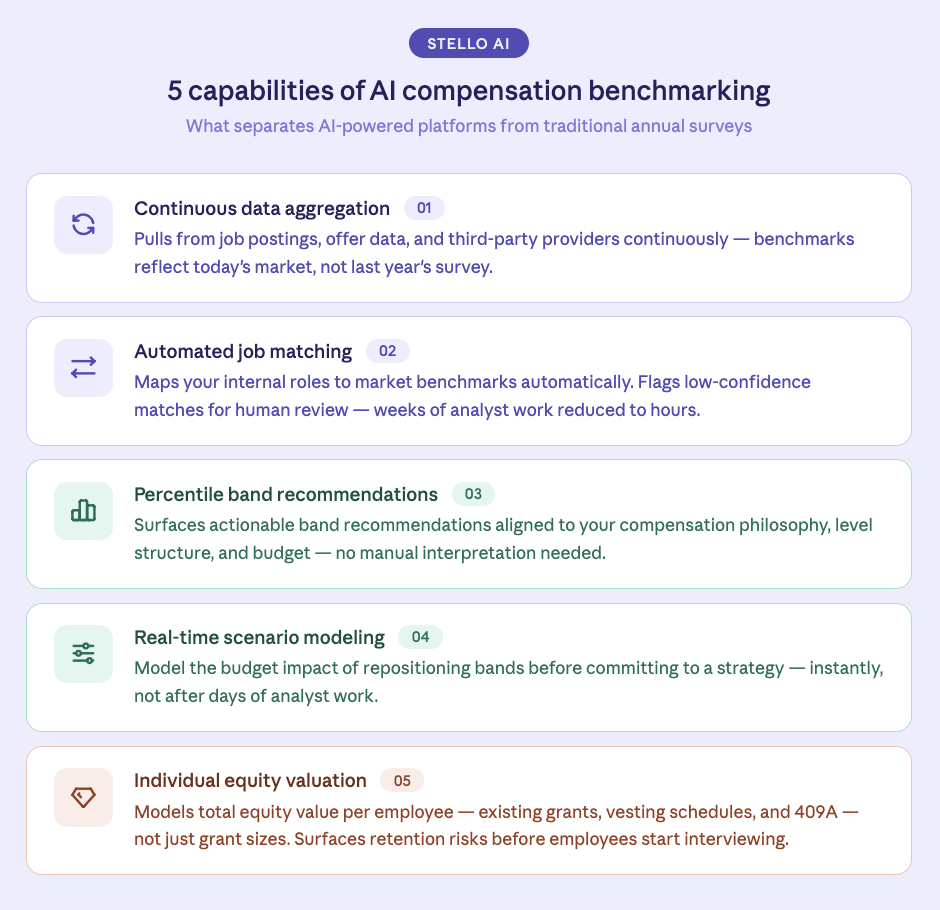
Continuous data aggregation
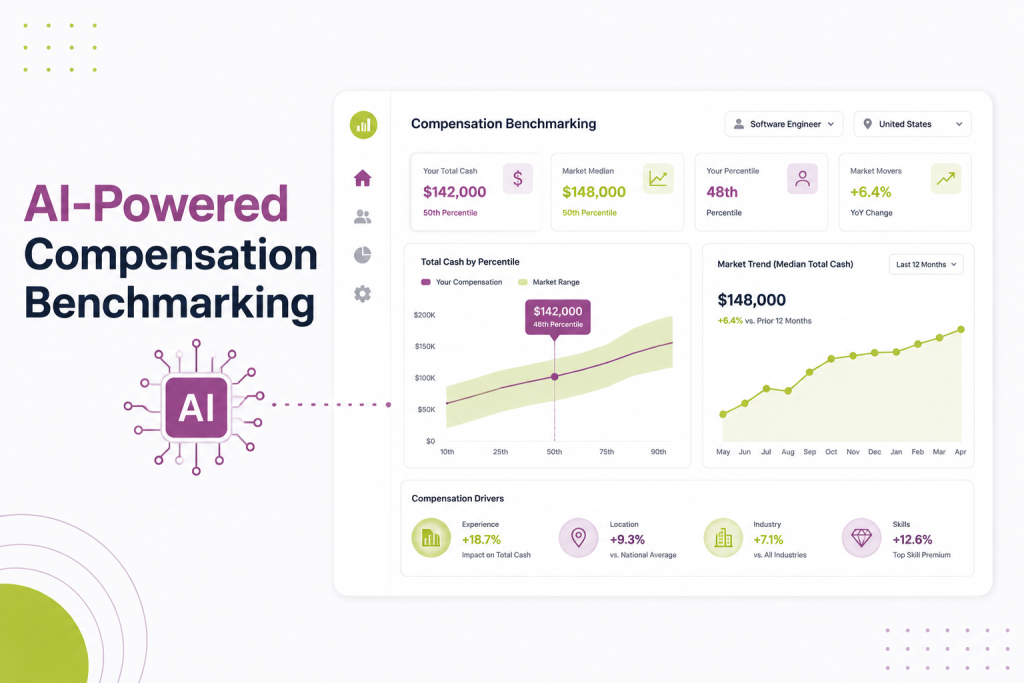
Rather than relying on a single annual survey, AI platforms aggregate compensation signals continuously from multiple sources: job postings, offer data shared by participating employers, public filings, third-party data providers, and — in some platforms — anonymized internal data contributed by users of the network.
The result is a benchmark that reflects current market conditions, not last year’s. When a surge in demand for a particular skill set drives up compensation for a role, an AI-powered system detects that movement in weeks, not months. Finance teams get a signal that is responsive to market dynamics rather than a snapshot of a moment that has already passed.
Automated job matching
One of the most time-consuming elements of traditional benchmarking is job matching — mapping your internal job titles and level definitions to survey job codes. The matches are rarely clean. A “Senior Software Engineer, Level 5” at one company might map to three different survey codes depending on scope, team size, and domain. Getting those matches right requires human judgment applied repeatedly across every role in the organization.
AI models trained on large volumes of job architecture data can automate the initial matching pass with high accuracy, flagging only the cases where human review is warranted. What previously took weeks of analyst time can be completed in hours — and updated automatically when job families change.
Percentile recommendations by role and level
Traditional survey outputs require the compensation team to interpret raw percentile data and translate it into actionable band recommendations. That translation involves judgment calls about where to anchor relative to the market (50th percentile? 65th? higher for critical roles?), how wide to set the band, and how to handle outliers.
AI systems surface these recommendations directly, informed by the organization’s stated compensation philosophy, internal equity constraints, and budget parameters. A finance leader can set the target positioning — “competitive at the 60th percentile for engineering roles, 50th for all others” — and the system will calculate the resulting bands, model the budget impact, and flag any current employees whose compensation falls outside the updated ranges.
Real-time scenario modeling
Perhaps the most valuable capability for finance leaders is scenario modeling. Traditional benchmarking produces a static output — a set of bands that reflects one moment in time. AI-powered platforms allow finance teams to run dynamic scenarios: what happens to total compensation expense if we move all engineering bands to the 65th percentile? What is the cost of bringing every out-of-range employee to the new band minimum? How does a 10% headcount increase in a high-cost geography affect the total compensation budget?
These are questions that previously required significant analyst time to answer. AI systems answer them in real time, giving finance leaders the ability to test assumptions before committing to a compensation strategy.
How It Changes the Finance Team’s Role
The shift to AI-powered benchmarking doesn’t eliminate the need for compensation expertise — it reorients where that expertise is applied.
Under a traditional model, a significant share of the compensation team’s time goes toward data collection, survey participation, job matching, and reconciliation. These are necessary but low-judgment activities. The high-value work — deciding how to position relative to the market, making trade-offs between cash and equity, modeling the budget impact of different strategies — gets compressed into the time that remains after the operational work is done.
AI handles the operational layer. Benchmarks are updated automatically. Job matches are maintained without manual effort. Out-of-range flags surface without anyone having to run a comparison. The compensation team’s time shifts toward the decisions that actually require strategic judgment.
For CFOs, this has a concrete implication: the compensation benchmarking process becomes a source of real-time intelligence rather than a periodic deliverable. Instead of receiving a benchmark report once a year and acting on it in the following cycle, finance leaders can monitor compensation positioning continuously — and respond to market movements before they become retention problems.
Equity Benchmarking: The Harder Problem
Salary benchmarking is difficult. Equity benchmarking is harder.
Equity compensation varies not just by role and level but by company stage, funding history, share price, vesting structure, and the employee’s current equity position. A benchmark that tells you what a Senior Engineer receives in equity at a Series B company is a useful starting point, but it doesn’t tell you whether that employee’s total equity value — accounting for their existing grants, vesting schedule, and the company’s current 409A valuation — is competitive with an offer they might receive elsewhere.
AI-powered equity benchmarking closes this gap by modeling total equity value at the individual level. Rather than comparing grant sizes in isolation, the system calculates the present value of each employee’s equity position, benchmarks it against market comparables, and surfaces employees whose total equity value has fallen below competitive levels — before those employees start interviewing.
For companies running BoxCar grant programs, this capability is particularly valuable. BoxCar’s overlapping grant structure means that individual employees may have multiple active grants at different points in their vesting schedules. AI systems that can model the aggregate value of those grants — and compare that value against current market rates — give finance and HR teams the insight they need to manage retention proactively rather than reactively.
What to Look For in an AI Benchmarking Platform
Not all AI compensation platforms offer the same depth of capability. For finance leaders evaluating options, the key questions are:
Data freshness. How frequently is the benchmark data updated? Monthly is the minimum for fast-moving sectors; real-time or near-real-time is the standard for leading platforms.
Job matching accuracy. What methodology does the platform use to match internal roles to market benchmarks? Can the matching be customized to reflect your job architecture, or does it rely on a fixed taxonomy?
Equity modeling depth. Does the platform model total equity value at the individual level, or does it benchmark grant sizes in aggregate? The former is meaningfully more useful for retention analysis.
Scenario modeling. Can finance teams run dynamic budget scenarios against updated benchmarks, or does the platform produce static outputs?
Integration with your equity management system. A benchmarking platform that operates in isolation from your equity cap table and grant management system creates reconciliation work. Platforms that integrate directly with your equity data deliver benchmarks in context.
The Bottom Line
Compensation benchmarking has historically been a once-a-year exercise that produces a document, not a capability. AI changes that. When benchmarks are updated continuously, job matching is automated, equity value is modeled at the individual level, and scenario analysis is available on demand, compensation benchmarking becomes a real-time input to financial decision-making — not a periodic report that arrives too late to act on.
For finance leaders managing compensation at scale, the question is no longer whether AI-powered benchmarking is better than the traditional model. It clearly is. The question is how quickly the organization can make the transition — and how much competitive ground it loses in the meantime.
FAQs-
1. How is AI compensation benchmarking different from traditional salary surveys?
Traditional surveys reflect data collected 6–18 months ago. AI platforms aggregate compensation signals continuously, so benchmarks reflect what companies are paying today — not last year.
2. How accurate is automated job matching?
High accuracy for standard roles; lower for niche or hybrid roles. Good platforms flag low-confidence matches for human review rather than applying them automatically.
3. Can AI benchmarking handle equity, not just base salary?
Yes — and this is where it adds the most value. AI models total equity value at the individual level, accounting for existing grants, vesting schedules, and current valuations, not just grant sizes.
4. How does it integrate with existing HRIS and equity management systems?
Integration depth varies by platform. The best solutions connect directly to your HRIS and cap table, eliminating manual data exports and reconciliation entirely.
5. Is AI compensation benchmarking only relevant for large companies?
No — it’s often more valuable for fast-growing companies scaling from 100 to 500 employees, where compensation moves fastest and dedicated comp teams are lean or nonexistent.