Human Resources has always been about people. But for decades, the mechanics of it — sorting resumes, scheduling interviews, tracking compliance, answering the same onboarding questions on loop — consumed enormous amounts of time that HR teams could have spent on, well, humans.
AI is changing that equation. Not by replacing HR professionals, but by handling the routine so they can focus on the relationship-driven, judgment-heavy work that actually moves organizations forward. Here’s how companies are putting AI to work across the full HR lifecycle right now.
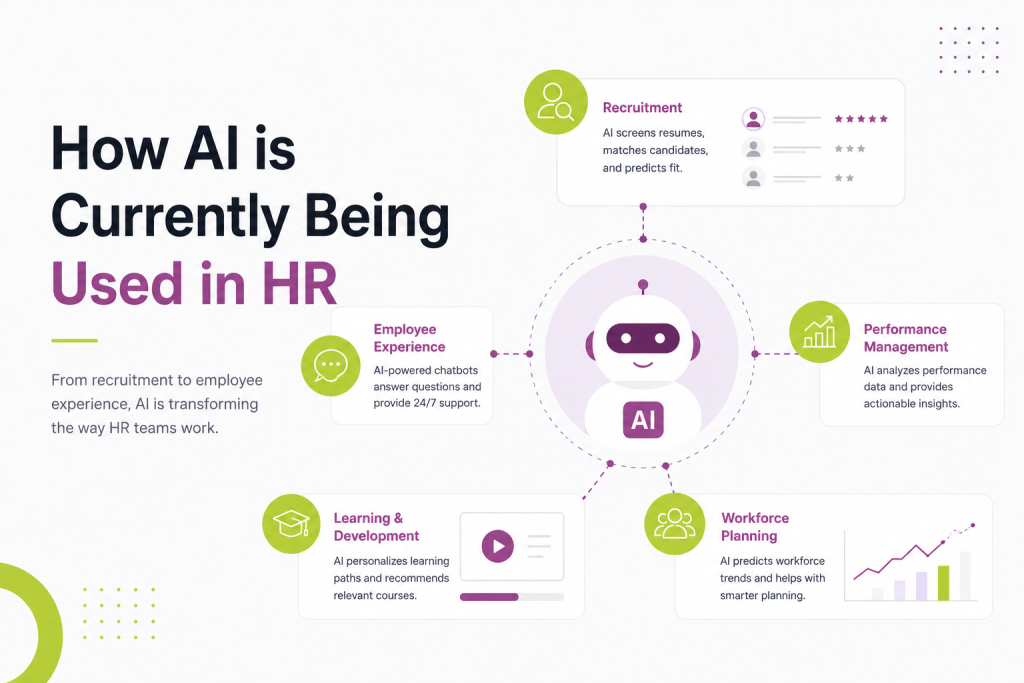
How AI Is Currently Being Used in HR
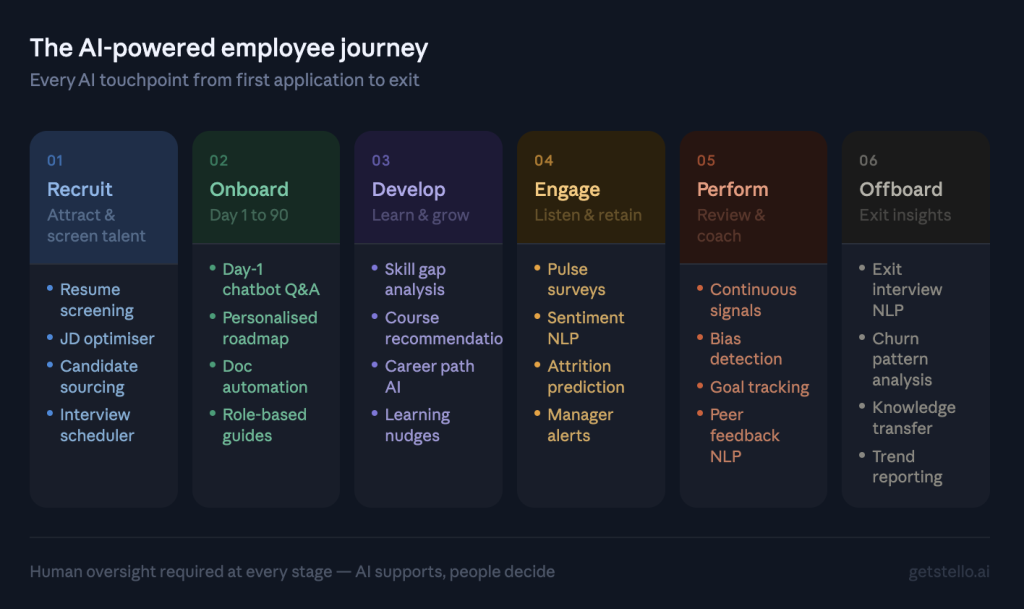
- AI screens resumes, sources candidates, and automates interview scheduling — cutting time-to-hire significantly
- Onboarding chatbots handle routine Day 1 questions and deliver personalized 30/60/90-day roadmaps by role
- Pulse surveys and NLP-powered sentiment tools give HR real-time visibility into employee engagement — not just annual snapshots
- Predictive attrition models flag at-risk employees early, so managers can intervene before someone quits
- AI handles compliance monitoring, document automation, and benefits Q&A — freeing HR teams for higher-value work
- AI cannot replace human judgment in sensitive situations — oversight, transparency, and bias audits are non-negotiable
Recruiting and Talent Acquisition
Hiring is where AI made its earliest and most visible inroads — and where it’s had the most measurable impact.
Resume screening at scale. Large employers receive thousands of applications for a single role. AI-powered applicant tracking systems (ATS) can scan and rank candidates based on skills, experience, and role-fit signals in seconds. Tools like Greenhouse, Lever, and Workday’s AI layer do this as standard practice at mid-to-enterprise companies. The result: recruiters spend time on the top 5% of applicants rather than skimming the entire pool.
Job description optimization. AI tools now analyze job postings before they go live — flagging biased language, identifying missing qualifications, and benchmarking salary ranges against real-time market data. This matters because the quality of a job description directly affects who applies. Vague or exclusionary language quietly narrows your talent pool before a single resume comes in.
Candidate sourcing. Tools like HireEZ and SeekOut use AI to proactively surface passive candidates across LinkedIn, GitHub, and other platforms — building shortlists based on a recruiter’s stated criteria without hours of manual searching.
Interview scheduling. Coordinating interviews across time zones and calendars used to eat entire afternoons. AI scheduling assistants (integrated into most modern ATS platforms) automate this entirely, reducing time-to-interview by days and improving the candidate experience.
One important caveat: AI in recruiting still requires human oversight. Algorithmic bias is a real risk — models trained on historical hiring data can reinforce patterns that excluded qualified candidates in the past. Responsible deployment means auditing outputs, not just accepting them.
Also read: Cloud-Based HRIS: What It Is, How It Works, and What to Look For
Onboarding
First impressions matter. A disorganized onboarding experience is one of the fastest ways to lose a new hire before they’ve even started contributing.
AI is helping companies build onboarding experiences that are faster, more consistent, and more personalized. AI-powered chatbots handle the flood of Day 1 questions — where do I submit expenses, who handles IT, what’s the PTO policy — without routing everything through an overloaded HR inbox. Platforms like ServiceNow and Workday have embedded these assistants directly into their HR portals.
Beyond Q&A, AI is being used to generate personalized onboarding roadmaps: a new marketing manager gets different 30/60/90-day guidance than a new software engineer. The content is tailored to role, department, and location, and delivered progressively rather than as a document dump on Day 1.
Employee Experience and Engagement
Keeping people engaged is harder than hiring them. AI is becoming a key tool for understanding what employees actually need — before they start looking elsewhere.
Pulse surveys and sentiment analysis. Instead of annual engagement surveys that deliver stale data, companies are deploying AI-powered continuous listening tools (Glint, Qualtrics, Peakon) that run short, frequent check-ins and use NLP to detect sentiment trends across teams, roles, and geographies. Managers get early warnings when engagement drops — not a retrospective report six months later.
Predictive attrition modeling. This is one of the more sophisticated applications in HR today. By analyzing patterns like performance review scores, tenure, promotion history, salary benchmarks, and even communication metadata, AI models can assign attrition risk scores to employees. HR teams and managers can then intervene proactively — a conversation, a development opportunity, a compensation adjustment — before someone hands in their notice.
Personalized career development. Platforms like LinkedIn Learning, Degreed, and Cornerstone are using AI to recommend learning content based on an employee’s current role, career goals, and skill gaps. This shifts L&D from a one-size-fits-all catalog to something that actually feels relevant to the individual.
Performance Management
Annual performance reviews are increasingly seen as inadequate — too infrequent, too subjective, too disconnected from day-to-day work. AI is enabling a shift toward more continuous, data-informed performance conversations.
AI tools can aggregate signals from across work systems — project completion rates, peer feedback, goal tracking — and surface them in manager dashboards. This doesn’t replace human judgment, but it gives managers a more complete picture and reduces the recency bias that plagues traditional reviews (where the last two months before a review period end up weighing more than the previous ten).
Some platforms are also using AI to flag potential bias in performance write-ups — alerting managers when language patterns suggest inconsistent evaluation standards across demographic groups.
HR Operations and Compliance
This is the unglamorous but essential category — the administrative backbone of HR that consumes disproportionate time.
Document automation. Offer letters, contracts, policy acknowledgments, and compliance documents are increasingly generated and routed through AI-assisted workflows. What took HR generalists hours to produce manually now takes minutes.
Compliance monitoring. Labor laws vary by state, country, and industry. AI tools can track regulatory changes and flag when company policies or practices may be out of compliance — a particularly valuable function for companies operating across multiple jurisdictions.
Benefits administration. AI chatbots now handle open enrollment questions, help employees compare benefit options based on their personal situation, and reduce the support burden on HR teams during peak periods.
Also read: What Does HRIS Stand For? (And Why the Answer Has Changed)
What AI Still Can’t Do in HR
It’s worth being clear-eyed about limits.
AI cannot replace the judgment required in sensitive employee situations — conflicts, terminations, accommodation requests, or mental health conversations. It can support these processes, but it cannot lead them. The human element isn’t a bug to be engineered out; it’s often the entire point.
AI also cannot audit itself. Bias, fairness, and equity concerns require active human oversight. Deploying AI in HR without governance frameworks isn’t just risky — it can expose companies to legal liability and erode employee trust.
The Bottom Line
AI in HR isn’t a future state. It’s the present reality at most companies with more than a few hundred employees — and increasingly at smaller ones too. The organizations getting the most value aren’t treating AI as a replacement for HR expertise. They’re using it to extend what their teams can do: reach more candidates, spot problems earlier, personalize at scale, and free up time for the conversations that machines genuinely can’t have.
The companies still running HR on spreadsheets and gut feel aren’t just inefficient. They’re operating with a structural disadvantage in the competition for talent.
FAQs-
Will AI replace HR professionals?
No — and that’s not the direction most organizations are heading. AI handles repetitive, high-volume tasks like resume screening, document generation, and answering routine employee questions. The work that requires empathy, judgment, and relationship-building — navigating conflicts, supporting employees through difficult situations, shaping company culture — remains fundamentally human. AI frees HR teams to do more of that work, not less.
Is AI in HR actually reducing hiring bias, or making it worse?
Both outcomes are possible, which is why governance matters. AI can reduce certain biases — like the inconsistency of a tired recruiter screening their 200th resume — but it can also encode historical bias if trained on skewed data. For example, a model trained on past hiring decisions may learn to deprioritize candidates from certain schools or backgrounds simply because those groups were underrepresented in previous hires. Responsible use requires regular audits, diverse training data, and human review of algorithmic outputs.
What’s the ROI of implementing AI in HR?
It varies by use case, but the most documented returns come from recruiting efficiency (reduced time-to-hire, lower cost-per-hire), attrition reduction (catching at-risk employees before they resign is significantly cheaper than replacing them), and HR operational time savings. Companies using AI-assisted recruiting tools report 30–50% reductions in time-to-screen. Attrition modeling, when acted on, can meaningfully reduce turnover costs — which typically run 50–200% of an employee’s annual salary depending on role seniority.
How do employees feel about AI being used in HR decisions?
Acceptance depends heavily on transparency. Employees are generally more comfortable with AI being used for administrative tasks (scheduling, benefits Q&A, document routing) than for evaluative ones (performance scoring, promotion decisions). The key is clear communication: telling employees what data is being collected, how it’s being used, and where human oversight exists. Organizations that deploy AI quietly or without explanation tend to erode trust, even when the AI is being used responsibly.
Where should a company start if it wants to bring AI into its HR function?
Start with a high-volume, low-stakes process where the efficiency gain is obvious and the risk of error is manageable. Resume screening, interview scheduling, and onboarding chatbots are common entry points. Avoid starting with evaluative use cases like performance management or attrition prediction until you have governance frameworks in place and your team understands how the models work. Quick wins build confidence; early mistakes in sensitive areas can set an AI adoption program back significantly.