Generative AI has moved from boardroom buzzword to everyday business tool faster than almost any technology before it. Nowhere is that shift more visible — or more consequential — than in Human Resources. From the moment a candidate first sees a job posting to the day an employee retires, AI now has the potential to touch every stage of the employee lifecycle.
But with that potential comes real complexity. HR leaders who want to capture the upside without stumbling into the pitfalls need a clear-eyed view of what GenAI can actually do, where it can go wrong, and how to get started responsibly.
In this article, we cover the most impactful use cases of generative AI across the employee lifecycle, the key risks HR teams must account for, a spotlight on Stello AI and how purpose-built tools are transforming compensation planning, and a practical framework for where to begin.
TL;DR
- Generative AI is transforming every stage of the employee lifecycle — from hiring to retirement — and HR leaders need a clear strategy to keep up.
- Top use cases include AI-written job descriptions, CV screening, personalised onboarding, L&D content creation, performance review assistance, and smarter compensation planning.
- Key risks to manage: bias amplification from historical data, employee data privacy, AI hallucinations in high-stakes decisions, over-reliance, and lack of transparency with staff.
- Stello AI is a purpose-built compensation planning platform that uses AI to automate salary benchmarking, model budget scenarios, and deliver pay recommendations — while keeping HR teams in control.
- Where to start: pilot low-risk, high-volume tasks first; audit your data; keep humans in the loop for consequential decisions; and always be transparent with employees about AI use.
What Generative AI Actually Means for HR
Generative AI refers to models that can produce text, images, code, and other content based on patterns learned from vast datasets. In an HR context, this means tools that can draft, summarize, analyse, recommend, and converse — at scale, and often in seconds.
This is meaningfully different from the “AI” HR teams have used for years, such as keyword-matching in ATS systems or rule-based chatbots. Generative models understand context, handle nuance, and can produce outputs that feel genuinely human. That combination is what makes them both powerful and, if misused, risky.
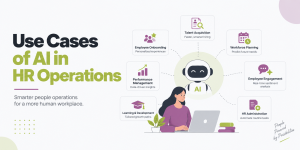
Key Use Cases Transforming HR Today
Recruiting and Talent Acquisition
Writing job descriptions is one of the most immediate wins. GenAI can produce inclusive, role-specific job postings in minutes, cutting down on the copy-paste cycle that produces vague or biased language. Beyond that, AI can screen and summarise CVs, draft personalised outreach messages to passive candidates, and generate structured interview guides tailored to specific roles and competencies. Early adopters report significant reductions in time-to-fill without sacrificing quality of hire.
Onboarding and Employee Experience
New hire onboarding is document-heavy, repetitive, and often inconsistent across teams. AI can generate customised onboarding plans, answer common “Day 1” questions through intelligent HR chatbots, and produce role-specific training materials automatically. Employees get a more coherent experience; HR teams spend less time answering the same questions repeatedly.
Learning and Development
L&D is arguably where generative AI has the highest ceiling. AI can create course outlines, write microlearning content, develop scenario-based simulations, and personalise learning pathways based on an employee’s role, skills gaps, and career goals. Large enterprises that once spent months commissioning training content can now iterate in days.
HR Communications and Policy
Drafting company-wide communications, updating employee handbooks, summarising policy changes in plain language — these are tasks that consume HR time disproportionate to their strategic value. GenAI handles the first draft, leaving people leaders free to focus on the message, not the mechanics of writing it.
Performance Management
AI can help managers write more balanced, specific performance reviews by suggesting language, flagging overly vague feedback, and drawing on documented examples. It can also identify patterns across review cycles to surface potential bias — for example, if women or minority employees consistently receive feedback that focuses on personality rather than outcomes.
Compensation and Total Rewards
Pay decisions are increasingly data-intensive, and AI is helping HR teams make sense of market data, internal equity, and budget constraints simultaneously. This is where dedicated platforms are beginning to make a real difference (more on this below).
Also read: 10 Real-World AI in HR Examples (And What You Can Learn From Each)
The Risks HR Leaders Cannot Ignore
Enthusiasm for GenAI in HR is justified, but uncritical adoption is not. The risks are real, and some are specific to the HR domain in ways that make them particularly sensitive.
Bias Amplification
AI models learn from historical data, and historical HR data is often biased. A model trained on past hiring decisions may systematically deprioritise candidates from underrepresented groups, not because it has been instructed to, but because that pattern exists in the training data. Deploying such a model at scale makes the bias faster and larger, not smaller.
Privacy and Data Security
HR data is among the most sensitive in any organisation: salaries, performance ratings, medical accommodations, disciplinary records. Feeding this data into third-party AI tools — especially consumer-grade ones — creates real compliance and confidentiality risks. GDPR, DPDPA (India’s data protection law), and equivalent frameworks impose strict rules on how personal data can be processed. Before any GenAI tool touches employee data, legal and compliance teams must be involved.
Accuracy and Hallucination
Generative models can produce confident-sounding content that is factually wrong. In an HR context, this might mean a policy summary that misrepresents the actual policy, or a compensation recommendation based on misread data. Any AI-generated output that informs a consequential decision — hiring, pay, promotion, discipline — must be reviewed by a human before it is acted upon.
Over-reliance and De-skilling
If AI writes every job description, drafts every performance review, and answers every employee question, HR professionals may gradually lose the skills to do those things themselves. More concerning, the human judgement that makes HR genuinely effective — reading between the lines, building trust, navigating complex interpersonal dynamics — cannot be automated. Organisations need to be deliberate about where AI augments human work and where it must not replace it.
Transparency and Trust
Employees have a right to know when AI is involved in decisions that affect them. Using AI to screen applications, influence promotion decisions, or generate performance feedback without disclosure erodes trust and, in some jurisdictions, may be legally problematic. Transparency about AI use is not just an ethical obligation — it is increasingly a regulatory one.
Also read: How to Use AI in HR: A Step-by-Step Guide for Mid-Market Teams
Stello AI and the Compensation Planning Frontier
One of the more technically demanding applications of AI in HR is compensation planning. Managing pay across thousands of employees — factoring in market data, internal equity, performance, budget constraints, and regulatory requirements — is exactly the kind of complex, data-intensive work where AI can add genuine value.
Stello AI is a Tampa-based platform, founded in 2023, built specifically to address this challenge. It serves as an AI-powered compensation planning and management platform for enterprises, offering tools for budget management, compensation recommendations, and configuration of compensation elements.
The platform includes an AI Compensation Agent that can answer compensation data questions and perform complex calculations instantly, alongside an AI Market Pricing capability that streamlines salary benchmarking by speeding up job matching. HR teams can model different budget scenarios to stay within budget while maintaining pay equity and rewarding top performers — and the platform integrates with HRIS systems, performance management tools, equity assessment platforms, and benefits data.
What makes Stello representative of the broader trend is its focus on a specific, high-stakes HR process rather than trying to be a general-purpose AI tool. Compensation decisions directly affect employee financial wellbeing and retention; getting them wrong — whether through inequity, budget overruns, or poor market alignment — has real consequences. By bringing AI precision to that process while keeping HR and finance teams in control of the final decisions, Stello illustrates the “augmentation, not replacement” model that responsible AI adoption in HR should aspire to.
Also read: The Ultimate Guide to AI in HR: Strategy, Tools & Implementation
Where to Start: A Practical Framework
For HR leaders who want to move from curiosity to action, the following principles offer a sensible starting point.
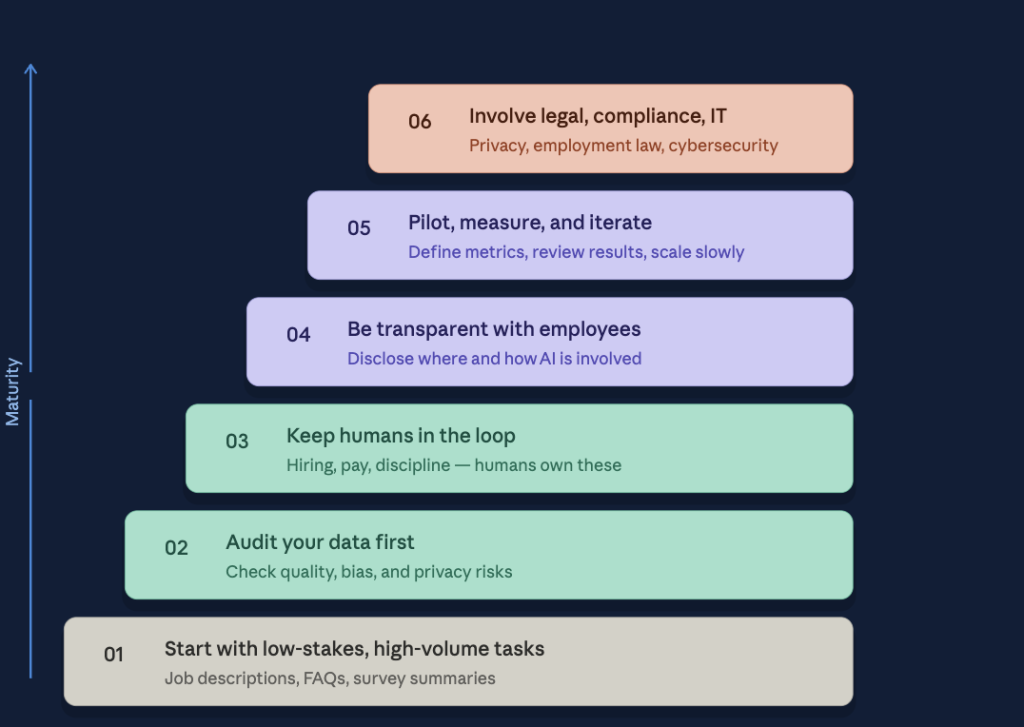
Start with low-stakes, high-volume tasks. The best early use cases are those where the cost of an error is low and the volume of work is high — drafting job descriptions, generating FAQ responses, summarising survey results. These build confidence and capability without exposing the organisation to significant risk.
Audit your data before you deploy. AI is only as good as the data it learns from or operates on. Before deploying any GenAI tool that touches employee data, understand what data it is using, where it is stored, and whether it reflects historical biases that could be perpetuated at scale.
Keep humans in the loop for consequential decisions. Hiring, promotion, compensation, discipline — these decisions affect people’s livelihoods and careers. AI can inform and support these decisions, but a human being must own them. Build that principle into every workflow from the start.
Be transparent with employees. Tell your workforce how AI is and is not being used in HR processes. Proactive transparency prevents the erosion of trust that tends to follow when employees discover AI involvement after the fact.
Pilot, measure, and iterate. Pick one process, run a structured pilot, define clear success metrics (time saved, quality improvement, candidate experience scores), and use the results to inform broader rollout. Resist the pressure to deploy broadly before you have evidence that something is actually working.
Involve legal, compliance, and IT early. In HR, AI is not just a productivity question — it is a legal and ethical one. Data privacy, employment law, anti-discrimination requirements, and cybersecurity all need to be addressed before any tool goes live at scale.
The Bottom Line
Generative AI will not replace HR professionals — but HR professionals who use it effectively will have a significant advantage over those who do not. The organisations that get this right will move faster on talent, make fairer and more data-informed people decisions, and free their HR teams to focus on the genuinely human work that technology cannot replicate.
The organisations that get it wrong will automate their biases, expose sensitive employee data, and undermine the trust that makes HR functions effective in the first place.
The difference between those two outcomes is not the technology itself. It is whether HR leaders approach adoption with the same rigour, care, and human judgement they would bring to any other high-stakes people decision.