Total rewards programs are supposed to be a competitive advantage. In practice, most run on annual cycles, static spreadsheets, and benefits packages that look identical for every employee regardless of life stage, financial goals, or role.
A 28-year-old engineer prioritizing equity upside and a 45-year-old operations manager focused on healthcare and retirement are not looking for the same thing. Yet most organizations send them the same open enrollment email in November and call it a strategy.
The cost of that gap is real. According to Mercer, nearly half of employees would give up a 10% pay increase in exchange for more personalized benefits. That is not a preference — it is a structural misalignment between how companies deliver total rewards and what employees actually value.
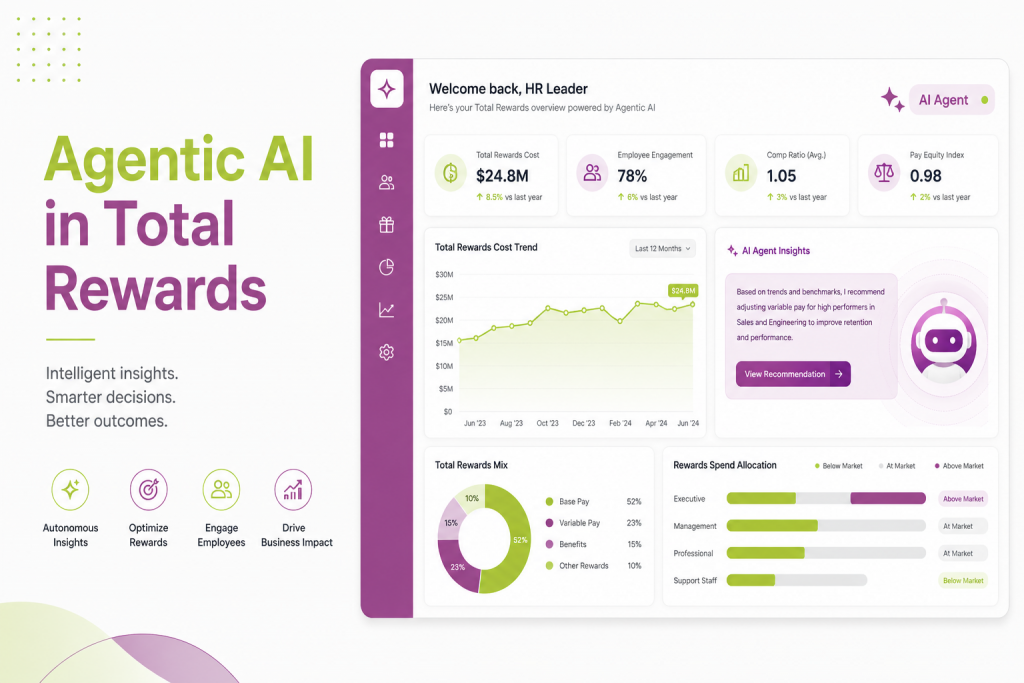
Agentic AI is what closes it. Not by automating a single workflow, but by making it possible to run a total rewards program that responds to individual employees in real time — across compensation, benefits, and recognition — without waiting for the next planning cycle.
TL;DR
Agentic AI in total rewards, explained in 60 seconds
- Most total rewards programs run on annual cycles and generic packages that fail to reflect individual employee needs, creating a costly gap between what companies offer and what employees actually value.
- According to Mercer, nearly half of employees would give up a 10% pay increase for more personalized benefits, signaling a structural misalignment in how total rewards are delivered.
- Agentic AI differs from standard HR AI in that it acts autonomously toward goals rather than simply answering questions or generating reports.
- In compensation, this means an AI that monitors salary bands, flags equity drift, and routes recommendations for approval without waiting for a human to initiate the process.
- Agentic AI reshapes total rewards across three layers: workflow automation, decision intelligence, and personalization at scale.
- According to Mercer, AI and automation could replace more than half of a rewards team’s administrative workload, freeing comp professionals for higher-value decisions.
- Event-driven compensation is one of the most underrated use cases, allowing spot bonuses and variable pay to be calculated and routed in real time as milestones are hit rather than waiting for annual reviews.
- Before agentic AI can deliver results, three foundations must be in place: clean connected data, a defined job architecture, and a human governance model for final pay decisions.
- Automation without guardrails creates new equity problems. Human approval on final decisions is not optional, it is what makes AI-driven compensation fair and defensible.
- Stello AI’s Compensation Agent works across all three layers, giving comp teams a system that automates admin work, monitors equity continuously, and surfaces data-grounded recommendations in real time.
What Makes AI “Agentic” and Why It Matters for Comp Teams
Most AI tools in HR today are reactive. You ask a question, you get an answer. Agentic AI is different. It takes goals and acts on them autonomously, making decisions and executing tasks without someone managing every step.
In a total rewards context, that is the difference between a chatbot that explains your benefits portal and an AI that monitors a project milestone, calculates a spot bonus, and routes it for manager approval without anyone filing a ticket.
Where standard AI might help a comp analyst pull benchmarking data faster, an agentic system monitors your salary bands continuously, flags when a role drifts out of range, and surfaces a recommended adjustment with supporting market data before anyone thought to check.
For comp teams stretched thin across merit cycles, equity reviews, and benefits administration, that shift from reactive to proactive is significant. It means less time spent on work the system should be doing, and more time spent on the decisions only humans should be making.
Also read: The Compensation Cycle Explained: Timeline + Best Practices
The Three Layers of Total Rewards Agentic AI Is Reshaping
Agentic AI does not land in one place inside a total rewards program. It works across three distinct layers, each building on the one before it.
The three layers of agentic AI in total rewards
Layer 3: Personalization at scale
Tailored rewards for every employee
Layer 2: Decision intelligence
Continuous monitoring and strategic insight
Layer 1: Workflow automation
The efficiency foundation
Workflow automation
The first layer is efficiency. Job matching, band updates, merit letter generation, benefits enrollment tracking, survey submissions — these are the tasks that consume comp team hours without requiring comp team judgment.
Apologies, let me redo this completely without any em dashes:
Workflow automation
The first layer is efficiency. Job matching, band updates, merit letter generation, benefits enrollment tracking, and survey submissions are the tasks that consume comp team hours without requiring comp team judgment. According to Mercer, AI and automation could replace more than half of a rewards team’s workload, including routine employee inquiries and benefits administration. That is not a headcount argument. It is an argument for redirecting skilled people toward decisions that actually require them.
Decision intelligence
The second layer is where agentic AI starts to add strategic value. It monitors pay equity gaps continuously, flags anomalies before they become audit findings, models scenario outcomes before budget decisions are locked, and surfaces recommendations grounded in real-time market data rather than last year’s survey results.
Personalization at scale
The third layer is where most total rewards programs have never been able to operate. AI agents can manage personalization complexity that is impossible to do manually, allowing employees to trade salary for equity or adjust benefits elections in real time within defined guardrails. Recommendations adapt to individual data including role, life stage, financial goals, and enrollment history rather than defaulting to what works for the average employee.
Event-Driven Compensation – The Most Underrated Use Case
Most compensation adjustments happen once a year during merit cycles. But the moments that actually drive retention occur year-round. A critical project delivered ahead of schedule. A promotion earned mid-year. A life change that shifts an employee’s financial priorities entirely. By the time the next planning cycle arrives, the window to act has already closed.
Agentic AI enables event-driven compensation. An AI agent can track project milestones in real time, calculate variable pay or spot bonuses automatically as work is completed, and route approvals without waiting for an annual review.
The governance piece matters here. Event-driven compensation requires full transparency on how pay is calculated, a human in the loop for disputes, and clean underlying data. Without those guardrails, automation creates new equity problems instead of solving existing ones. With them, it gives comp teams a way to recognize and retain talent at the moments that actually matter to employees.
Also read: Top Compensation Platforms for Scaling Teams (2026)
What Has to Be True Before Agentic AI Can Deliver
The opportunity is real, but it does not arrive automatically with a new tool. Three things have to be in place first.
Clean, connected data
Compensation sitting in one system, benefits in another, and recognition in a third is the norm for most organizations. Agentic AI needs to move across all of it. If the data is fragmented, siloed, or inconsistently structured, the output will reflect that. Getting the data foundation right is not a prerequisite that comes after implementation. It is the implementation.
A defined job architecture
AI cannot benchmark accurately or personalize meaningfully if roles are not clearly leveled and consistently defined. Vague job architecture produces vague recommendations. Organizations that invest in clean job frameworks before deploying AI see significantly faster and more reliable results from it.
Human governance
Agentic AI should surface recommendations, not make final calls unilaterally. AI that is grounded in market data, internal equity, and compliance guardrails with a human reviewing and approving the final decision is how organizations close pay gaps rather than compound them. The goal is not to remove judgment from compensation. It is to make sure judgment is applied where it counts.
Also read: Compensation Structure Explained (With Examples + Templates)
Where Stello AI Fits In
This is exactly the problem Stello AI is built to solve. Our AI Compensation Agent works across the workflow, intelligence, and personalization layers described above, giving comp teams a single system that automates the administrative work, monitors equity and market alignment continuously, and surfaces recommendations that are grounded in real data.
The result is a comp program that does not wait for the annual cycle to catch up with what is happening in your organization. Managers get timely, defensible pay recommendations. Employees get a total rewards experience that reflects their individual situation. And comp teams get time back to focus on strategy instead of spreadsheets.
If you are building out your compensation infrastructure or rethinking how your total rewards program operates in an AI-driven talent market, we would like to show you how it works.
See Stello AI’s Compensation Agent in action → Book a demo
FAQs-
What is agentic AI in the context of total rewards?
Agentic AI refers to AI systems that can take autonomous action toward a goal, not just answer questions or generate content. In total rewards, this means an AI that can monitor salary bands, flag equity gaps, trigger spot bonuses based on performance events, and personalize benefits recommendations without waiting for a human to initiate each task.
How is agentic AI different from the AI already in my HRIS?
Most HRIS platforms use AI for search, reporting, or basic automation within a single system. Agentic AI operates across systems, connects fragmented data, and executes multi-step workflows independently. The difference is between a tool that helps you find information faster and one that acts on that information on your behalf.
Is agentic AI ready for compensation decisions, or is it still experimental?
It is past the experimental stage for workflow automation and decision intelligence. Personalization at scale is more mature in some organizations than others, depending largely on data infrastructure. The comp teams seeing results today are the ones that paired AI deployment with clean job architecture and clear governance frameworks.
What are the risks of using agentic AI in compensation?
The primary risks are data quality issues producing flawed recommendations, and automation moving faster than governance can keep up with. Both are manageable with the right guardrails: human approval on final pay decisions, transparent logic on how recommendations are generated, and a clean, connected data foundation before deployment.
Do we need to overhaul our entire comp stack to get started?
No. Most organizations start with a specific layer, typically workflow automation, and expand from there. The more important starting point is auditing your data infrastructure and job architecture. The technology can be layered in incrementally. The foundation cannot be skipped.