Enterprise compensation looks like a people problem. But at scale, it’s a data problem.
When a company manages hundreds or thousands of employees across geographies, job levels, and business units, compensation decisions multiply fast. A merit cycle isn’t one decision. It’s thousands of them, made by dozens of managers, often with incomplete context, inconsistent data, and real budget pressure.
The result? Pay gaps that compound quietly. Top performers who leave before anyone noticed the warning signs. Comp strategies that look coherent on paper but drift in execution.
AI-driven decisioning is how enterprises close that gap, not by removing human judgment, but by making it sharper.
TL;DR
- Enterprise compensation looks like a people problem—but at scale, it’s a data problem.
- Thousands of pay decisions across roles, regions, and managers create inevitable inconsistency.
- Manual processes rely on limited context, leading to bias, pay gaps, and misaligned decisions.
- Traditional compensation cycles are reactive, catching issues only after they impact retention or equity.
- AI brings together market data, internal equity signals, performance, and budgets into one view.
- It acts as a decisioning layer—supporting managers with real-time, data-backed recommendations.
- AI flags risks early, such as underpaid high performers or policy misalignment.
- Standardized logic ensures consistency across compensation decisions at scale.
- Comp teams spend less time on manual checks and more on strategy and critical decisions.
- At enterprise scale, compensation requires infrastructure—not just human judgment.
The Scale Problem
Enterprise compensation isn’t just a larger version of what a 50-person company does. It’s a different problem entirely.
At scale, you’re not managing one pay structure. You’re managing multiple job families, dozens of pay bands, several geographies, and in many cases, multiple currencies and regulatory environments. Each layer adds variables. Each variable adds room for inconsistency.
Consider a global merit cycle. A mid-sized enterprise might process thousands of compensation changes in a 6 to 8 week window. Managers are making raise decisions based on whatever data they have access to, which is often limited to their own team’s history and a salary range in a spreadsheet. There’s no visibility into how peers in similar roles are being compensated, no real-time market benchmarking, and no systematic way to flag decisions that fall outside comp policy.
At that volume, inconsistency isn’t an exception. It’s inevitable.
Also read: 10 Real-World Examples of Direct Compensation
Where Human-Only Decisioning Breaks Down
Even the most experienced comp teams run into limits when the process itself is built on static tools and fragmented data.
The first issue is bias in the review process. Managers tend to reward visibility over performance. Employees who are newer, quieter, or working remotely are statistically more likely to be underpaid relative to their contribution. These gaps rarely show up in one cycle. They build slowly, and by the time they’re visible, they’ve already affected retention and morale.
The second issue is timing. Traditional comp processes are reactive by design. Companies find out compensation is a problem when someone quits, when a pay equity audit surfaces disparities, or when a competitor’s offer exposes how far behind market rates have drifted. At that point, the cost of correction is always higher than the cost of prevention would have been.
What AI-Driven Decisioning Actually Does
The most important thing to understand about AI in compensation is what it isn’t. It isn’t an automated system that sets salaries without human input. It’s a decisioning layer that gives comp teams, HR leaders, and managers the right information at the right moment.
In practice, that looks like a few things.
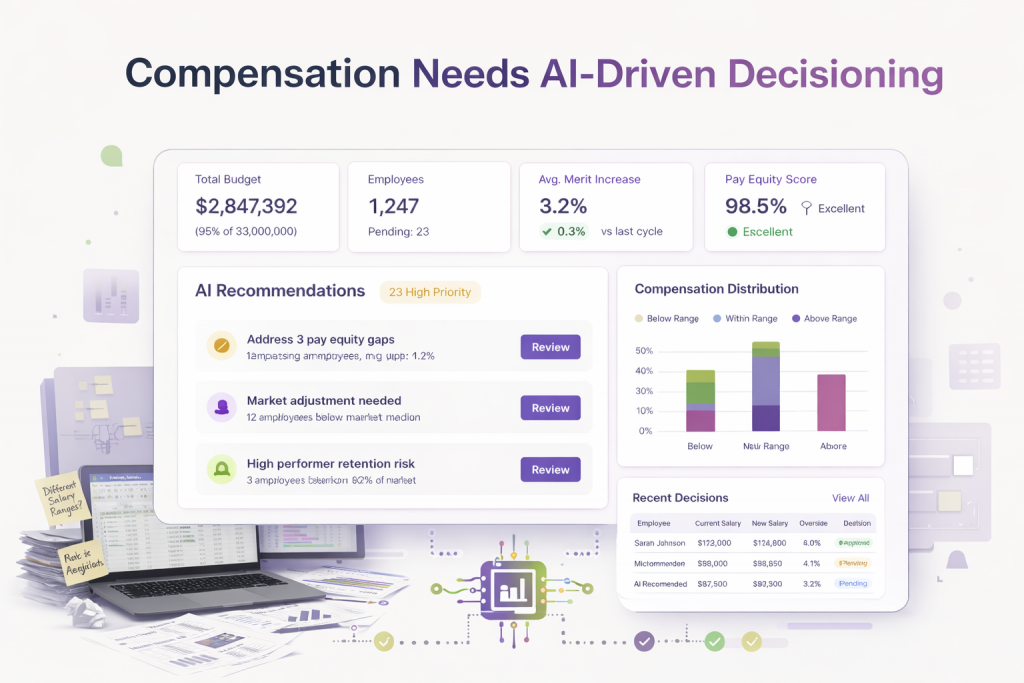
First, it brings together data that typically lives in silos. Market benchmarks, internal equity signals, performance ratings, tenure, and budget constraints are surfaced together, in context, rather than pulled from separate tools and reconciled manually.
Second, it flags risk before it becomes a problem. If a high performer is falling below market rate, or if a manager’s recommendations show a pattern that conflicts with comp policy, AI surfaces that in the workflow rather than after the cycle closes.
Third, it creates consistency. When compensation recommendations are generated from a defined set of parameters tied to the company’s own comp philosophy, every decision follows the same logic. That consistency is what makes compensation defensible, both internally and in the context of growing pay transparency regulations.
The comp team still owns the decisions. AI just makes sure those decisions are grounded.
Also read: What is Compensation Management Software? Guide for HR Teams
The Enterprise-Specific Case
The value of AI-driven decisioning scales with complexity, which is exactly why the enterprise case is so strong.
High-volume review cycles create time pressure that works against good decisions. When hundreds of compensation changes need to move through approval workflows in a matter of weeks, speed becomes the priority and rigor gets compressed. AI-driven systems handle the analytical load so that human review time is spent on exceptions and judgment calls, not on manually checking whether a number falls within band.
Cross-functional coordination is another friction point. Compensation decisions touch HR, Finance, and business leaders, often with different priorities and different definitions of what “fair” looks like. A shared decisioning layer gives every stakeholder visibility into the same data and the same logic, which shortens alignment cycles and reduces back-and-forth.
And increasingly, there’s a compliance dimension. Pay transparency laws across the US, EU, and beyond are raising the bar for documentation and defensibility. AI creates the audit trail that manual processes simply can’t.
Closing
Compensation has always required judgment. At enterprise scale, it also requires infrastructure.
AI-driven decisioning doesn’t replace the expertise of a comp team or the accountability of a manager. It gives both the data foundation they need to make decisions that are consistent, equitable, and aligned with where the market is moving, not where it was six months ago.
For enterprises managing complex workforces across geographies and business units, that foundation isn’t a nice-to-have. It’s what separates a compensation strategy that holds up from one that quietly erodes over every review cycle.
That’s what Stello AI is built to deliver.

Stello acts as a centralized decisioning layer for enterprise compensation, bringing together market data, internal equity signals, performance inputs, and budget constraints into one intelligent system. Instead of relying on fragmented tools and manual analysis, teams can model scenarios, benchmark salaries, and run compensation cycles with real-time visibility and control.
With capabilities like AI-driven budget modeling, market pricing, and continuous pay equity monitoring, Stello doesn’t just automate workflows, it enables faster, more consistent, and defensible compensation decisions at scale.
FAQs-
Is AI-driven compensation decisioning only viable for large enterprises?
AI-driven decisioning delivers the most immediate ROI at enterprise scale, where review cycles are high-volume and inconsistency is harder to catch manually. That said, mid-sized companies with complex job architectures or multi-geography operations can benefit just as much. The core value, bringing together market data, internal equity signals, and budget constraints into one decisioning layer, is relevant any time compensation complexity outpaces what spreadsheets can handle.
Does AI-driven decisioning reduce the role of the compensation team?
No. It shifts the focus of their work. Instead of spending cycles reconciling data across systems or manually checking whether recommendations fall within band, comp teams can focus on strategy, exceptions, and the judgment calls that actually require human expertise. AI handles the analytical load. The comp team still owns the outcomes.
How does AI support pay equity goals specifically?
Pay equity gaps rarely appear overnight. They build across review cycles, often driven by inconsistent manager behavior or incomplete data visibility. AI-driven systems continuously monitor compensation patterns against internal equity benchmarks and flag outliers before they compound. That proactive visibility is something traditional comp processes, built around point-in-time audits, simply can’t replicate.