TL;DR
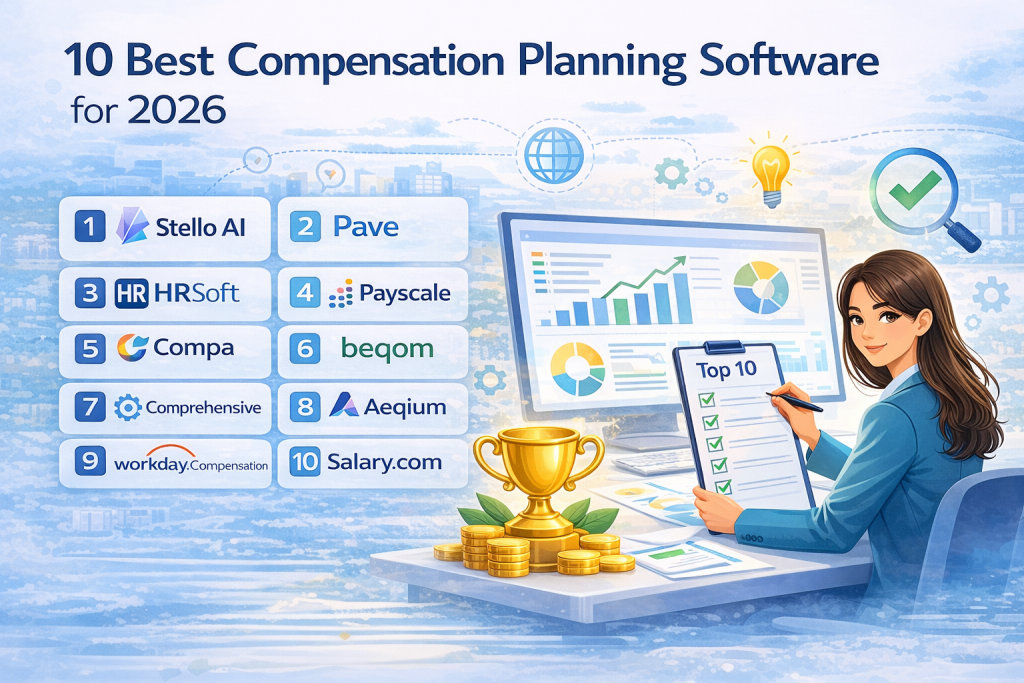
- → We reviewed 10 compensation planning platforms across AI capabilities, merit cycle management, market data, pay equity, integrations, and implementation speed.
- → Stello AI — Best overall for companies with 500–7,000 employees. AI compensation agent handles offers, merit cycles, and budget modeling. 2-week implementation. 180+ currencies.
- → Pave — Best for real-time market data. 8,700+ HRIS-connected companies in their benchmarking network. Strongest for tech companies with equity-heavy compensation.
- → HRSoft — Best for enterprise compensation lifecycle. Purpose-built for complex global organizations, especially financial services, with LTI, carried interest, and multi-country compliance.
- → The right platform depends on whether you need AI-powered speed, the deepest market data network, or enterprise-grade governance — full breakdown of all 10 platforms below.
How We Evaluated These Platforms
We looked at each platform across six criteria that matter most when you’re actually running a compensation cycle:
- AI capabilities — Can it generate offers, model budgets, and answer comp questions without manual analysis?
- Merit cycle management — Does it handle the full cycle from budget setting through manager approvals to communication?
- Market data and benchmarking — Where does the market data come from, how fresh is it, and how easy is job matching?
- Pay equity — Can it identify and surface pay gaps across gender, ethnicity, location, and level?
- Integrations — Does it connect to your HRIS, equity platform, and performance tools without a 6-month project?
- Implementation speed — How fast can you go from a signed contract to running your first cycle?
We also factored in real-world feedback from compensation professionals and our own experience building and evaluating compensation programs at companies ranging from 200 to 10,000+ employees.
Quick Comparison
| Platform | AI Agent | Merit Cycle | Market Data | Pay Equity | Best For | Price |
| Stello AI | ✓ Iconic | ✓ Full | ✓ AI | ✓ | 500–7K emp | Custom |
| Pave | ✓ Paige | ✓ | ✓ Real-time | Limited | Tech cos | Tiered |
| HRSoft | ✓ HRSoft AI | ✓ Full | Partner | ✓ | Enterprise | 3 tiers |
| Payscale | Limited | ✓ | ✓ 55M profiles | ✓ | Data-first | Tiered |
| Compa | ✓ 2 Agents | Limited | ✓ 9M+ obs | Limited | Fortune 500 | Custom |
| beqom | Limited | ✓ Full | Partner | ✓ | Global ent. | Enterprise |
| Comprehensive | Limited | ✓ | Import | ✓ | Mid-market | Custom |
| Aeqium | No | ✓ Custom | Import | Limited | Growing cos | Custom |
| Workday Comp | Limited | ✓ Full | Partner | ✓ | Workday users | Add-on |
| Salary.com | No | ✓ | ✓ Proprietary | ✓ | Data buyers | Tiered |
1. Stello AI — Best Overall for Growing Companies
Best for: Companies with 500–7,000 employees replacing spreadsheets with AI-powered compensation planning
Stello is the only compensation platform built entirely around an AI compensation agent. The agent, called Iconic, doesn’t just automate calculations — it answers questions. You can ask it to generate a new hire offer with market justification, model what a 4% merit pool looks like vs. 3.5%, or run a pay equity analysis across departments, and it comes back with a detailed answer in seconds.
The platform handles the full compensation cycle: merit increases, bonus allocation, equity grants (RSUs, options, ISOs, profit sharing), ad hoc raises, and total rewards statements. It connects to most major HRIS platforms — Workday, UKG, ADP, BambooHR, Rippling, Paylocity, and others — with data refreshing every two weeks.
What stood out in our evaluation is the implementation speed. Most compensation software takes 2–3 months to deploy. Stello targets 2 weeks. That’s not marketing spin — their engineering team handles the HRIS integration directly, and they run manager training before every cycle.
Key strengths:
- AI compensation agent (Iconic) built on Claude Sonnet 4.5 / Amazon Bedrock
- Full merit cycle with manager workflows and approval chains
- Budget modeling with real-time scenario comparison
- 180+ currency support for global teams
- Pay equity analysis across gender, ethnicity, location, and level
- Total Rewards Portal with year-round employee access
- 2-week implementation
- SOC-2 certified, SSO via Auth0/SAML/Azure AD
Where it falls short:
- Smaller market data network compared to Pave or Payscale — relies on AI-powered benchmarking rather than a massive survey dataset
- Best fit for mid-market (500–7,000 employees) — very large enterprises with 20,000+ employees may need more complex governance features
Pricing: Custom. Book a demo at getstello.ai
2. Pave — Best for Real-Time Market Data
Best for: Tech companies that need real-time compensation benchmarks from a large peer network
Pave’s core strength is market data. Their benchmarking network includes 8,700+ companies, and the data updates in real time because it’s pulled directly from connected HRIS systems rather than annual surveys. For companies that make a lot of hiring decisions and need to know what the market is paying right now — not what it was paying when a survey closed six months ago — this is a significant advantage.
They’ve also launched Paige, an AI analyst that answers compensation questions using your company data and Pave’s market benchmarks. The compensation planning module handles merit cycles, and the total rewards portal helps communicate equity-heavy packages to employees.
Key strengths:
- Real-time market data from 8,700+ HRIS-connected companies
- Paige, AI analyst for comp questions
- Strong equity visibility and total rewards communication
- Free tier (Market Data Lite) for startups with 1–200 employees
- Transparent tiered pricing
Where it falls short:
- Market data coverage is strongest in US tech, with less depth in non-tech industries and outside North America
- No interactive product tour or self-service demo
- The compensation planning module is newer than the benchmarking product
Pricing: Tiered plans starting from free (Market Data Lite). Full platform pricing on request at pave.com/pricing
3. HRSoft — Best for Enterprise Compensation Lifecycle
Best for: Large organizations, especially financial services, that need a unified platform across the full compensation lifecycle
HRSoft positions itself as the only unified compensation lifecycle platform, and the product scope backs that up. It covers total compensation management, long-term incentive management, carried interest, variable compensation, milestone bonuses, pay-for-performance, and total rewards communication. For financial services firms managing carried interest and complex LTI structures, HRSoft is one of very few platforms that handle this natively.
They’ve added HRSoft Intelligence, an AI layer that provides smart modeling, data cleansing, and a chatbot for implementation assistance. The ROI calculator on their site claims organizations save 600+ hours per cycle. They process over $30B in compensation annually across 30+ countries.
Key strengths:
- Broadest feature set across the compensation lifecycle
- Industry-specific pages for financial services, investment management, healthcare, retail, and manufacturing
- HRSoft Intelligence AI for modeling and data cleansing
- Interactive product tour available
- 3-tier pricing with buyer descriptions
- ROI calculator for lead generation
Where it falls short:
- Enterprise-heavy — can feel heavy for mid-market companies under 1,000 employees
- No free tier or startup program
- Implementation timeline not publicly stated
Pricing: Three tiers: Emerging, Established, Enterprise. Custom pricing at hrsoft.com/pricing
4. Payscale — Best for Compensation Data Depth
Best for: Data-first organizations that need the largest salary database
Payscale operates the largest compensation database with 55 million salary profiles. They run two product lines: Payfactors for mid-market and MarketPay for enterprise. The annual Compensation Best Practices Report (3,595 participants) is widely cited. Their 235% ROI claim is backed by a third-party Total Economic Impact study. If your primary need is market data with planning bolted on, Payscale has the deepest dataset.
- 55M salary profiles — largest in the industry
- Two product lines for different company sizes
- Annual CBPR research report earns significant backlinks and citations
- Weakness: A complex product portfolio can create buyer confusion. No AI compensation agent.
5. Compa — Best for Enterprise AI Intelligence
Best for: Fortune 500 companies needing real-time offer intelligence across 50+ countries
Compa raised $35M Series B in January 2026, signaling strong investor confidence. They offer two AI agents: an Analyst Agent for compensation teams and a Partner Agent for recruiters. Their dataset covers 9M+ observations across 50+ countries. Workday Platinum Partner. Used by OpenAI and Micron. If you’re a large enterprise that lives in Workday and needs AI-powered offer intelligence, Compa is worth evaluating.
- Two purpose-built AI agents
- 9M+ data observations across 50+ countries
- Workday Platinum Partnership
- Weakness: Enterprise-only. No mid-market or startup offering. Minimal SEO content — almost entirely sales-driven.
6. beqom — Best for Complex Global Enterprises
Best for: Global enterprises with layered approval structures and complex LTI programs
beqom covers merit planning, annual and discretionary bonuses, long-term incentives, executive compensation, and pay equity analysis. It supports large organizations with complex governance requirements. The platform is highly configurable but comes with enterprise-level implementation complexity and cost. Best suited for companies with 5,000+ employees operating across multiple regions with sophisticated comp programs.
- Full compensation lifecycle, including executive comp and LTI
- Strong governance and approval workflows
- Weakness: Long implementation cycles. High cost. Not suitable for mid-market.
7. Comprehensive — Best for Mid-Market Flexibility
Best for: Mid-market companies wanting configurable planning with quick time to value
Comprehensive focuses on speed and flexibility for companies that need compensation planning without the weight of enterprise platforms. Strong manager experience and fast rollout. They blend benchmarking with planning, which reduces the need for a separate data provider. Good option for companies that have outgrown spreadsheets but don’t need the full enterprise feature set yet.
- Fast implementation and flexible configuration
- Combined benchmarking and planning
- Weakness: Less depth in AI capabilities. Smaller market data network than Pave or Payscale.
8. Aeqium — Best for Customizable Merit Cycles
Best for: Growing companies that want total control over how their compensation cycle is configured
Aeqium’s pitch is that it matches your exact compensation process rather than forcing you into a template. You choose data sources, review chains, custom calculations, and budget distribution methods. Customers like Braze and dbt Labs highlight the configurability. They position directly against Pave on cost, claiming less than half the price. No AI agent, but the planning flexibility is strong.
- Highly configurable — matches your existing process
- Strong customer quotes from recognizable brands
- Weakness: No AI compensation agent. No proprietary market data — relies on imported surveys.
9. Workday Compensation — Best If You’re Already on Workday
Best for: Large enterprises already using Workday HCM that want compensation planning within their existing system
If your HRIS is Workday, the built-in compensation module avoids the integration overhead of a third-party tool. It supports complex global structures and integrates deeply with performance and payroll. The downside is implementation complexity — users report needing expensive consultants and 3–6 month timelines. No proprietary AI agent for compensation. Best when you’re committed to the Workday ecosystem and have the resources to implement.
Dee integration with Workday HCM, performance, and payroll
- Supports complex multi-country structures
- Weakness: Long and expensive implementation. No standalone AI agent. Not practical for companies not already on Workday.
10. Salary.com — Best for Survey-Based Compensation Data
Best for: Organizations that need proprietary survey data and traditional compensation benchmarking
Salary.com provides compensation data, analytics, and planning tools. CompAnalyst is their job pricing and benchmarking platform; CompXL is the planning module. Their data is survey-based and proprietary, covering a wide range of industries and geographies. They’re more of a data provider with planning capabilities than a full compensation management platform. Good for organizations that want to buy data and layer planning on top.
- Proprietary survey-based compensation data
- CompAnalyst for benchmarking + CompXL for planning
- Weakness: No AI compensation agent. Dated user interface. The planning module is secondary to data.
How to Choose the Right and Best Compensation Planning Software
The right platform depends on where you are today and what’s actually slowing your compensation process down. Here’s a simple framework:
If you’re replacing spreadsheets for the first time and need something live in weeks, not months: Stello AI or Aeqium. Both prioritize fast implementation and ease of use over enterprise complexity.
If market data quality is your top priority and you make hiring decisions that depend on knowing what competitors pay right now: Pave (for real-time HRIS-connected data) or Payscale (for the largest survey dataset).
If you’re a large enterprise with complex global comp, including LTI, carried interest, and layered governance: HRSoft or beqom. Both handle the full lifecycle at scale.
If you’re already on Workday and want to minimize integration overhead, Workday Compensation is the path of least resistance, if you can handle the implementation timeline.
If AI is the deciding factor, you want an agent that can answer questions, generate offers, and model scenarios in natural language: Stello AI (Iconic) or Compa (Analyst Agent + Partner Agent). These are the two most advanced AI implementations in the space.
Frequently Asked Questions
What is compensation planning software?
Compensation planning software is a platform that helps HR teams manage salary increases, bonuses, equity grants, and pay equity across an organization. It replaces spreadsheet-based processes with structured workflows, budget controls, and market data to ensure pay decisions are fair, competitive, and aligned with company strategy.
How much does compensation planning software cost?
Costs range widely. Entry-level tools start around $3–10 per employee per month. Mid-market platforms typically cost $10K–$50K annually. Enterprise solutions can reach six figures. Most vendors offer custom pricing based on headcount and feature requirements.
Can compensation planning software replace spreadsheets?
Yes, and that’s the primary use case for most buyers. Compensation planning software eliminates version control issues, formula errors, and the security risks of emailing spreadsheets with sensitive salary data. Most platforms offer migration support to help transition from spreadsheets.
What integrations should I look for?
At minimum, your compensation software should integrate with your HRIS (Workday, UKG, ADP, BambooHR, etc.). Integrations with equity management platforms (Carta, Fidelity), performance tools (Lattice, Culture Amp), and payroll systems are also valuable for reducing manual data entry.
How long does implementation take?
Implementation timelines vary significantly. Some platforms like Stello AI and Aeqium target 2–4 weeks. Enterprise platforms like Workday and beqom can take 3–6 months. Ask vendors for average implementation timelines with comparable customers before committing.
What’s the difference between compensation planning software and payroll software?
Payroll software processes payments. Compensation planning software is where you decide what to pay. It handles the strategic side: setting merit budgets, modeling scenarios, running pay equity analysis, managing approval workflows, and communicating total rewards. Many organizations use both.
Do I need compensation planning software if I have fewer than 500 employees?
It depends on complexity. If you have multiple managers making independent salary decisions, run annual merit cycles, or manage equity grants, compensation software adds value even at 100–200 employees. Some platforms, like Pave, offer free tiers for smaller companies, and programs like Stello’s startup program provide extended trials.