Compensation is rarely just a paycheck. Employees weigh the full picture when they accept a job offer, negotiate a raise, or decide whether to stay. Yet many HR and compensation teams still treat direct pay as the headline and benefits as an afterthought.
That approach has real costs. When employees do not understand the value of what they receive, engagement drops. When organizations do not design the right mix, they lose talent to competitors who do.
This guide breaks down the difference between direct and indirect compensation, shows how each type works in practice, and explains how to structure both for maximum impact.
TL;DR
- Direct compensation is cash employees receive: salary, hourly wages, bonuses, and commission.
- Indirect compensation is non-cash value: health benefits, retirement plans, PTO, equity, and perks.
- Direct pay attracts candidates. Indirect compensation retains them.
- Employees often underestimate the value of their indirect benefits, creating a perception gap.
- The strongest compensation strategies benchmark and communicate both sides of the package.
What is Direct Compensation?
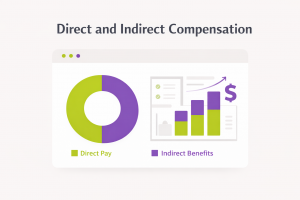
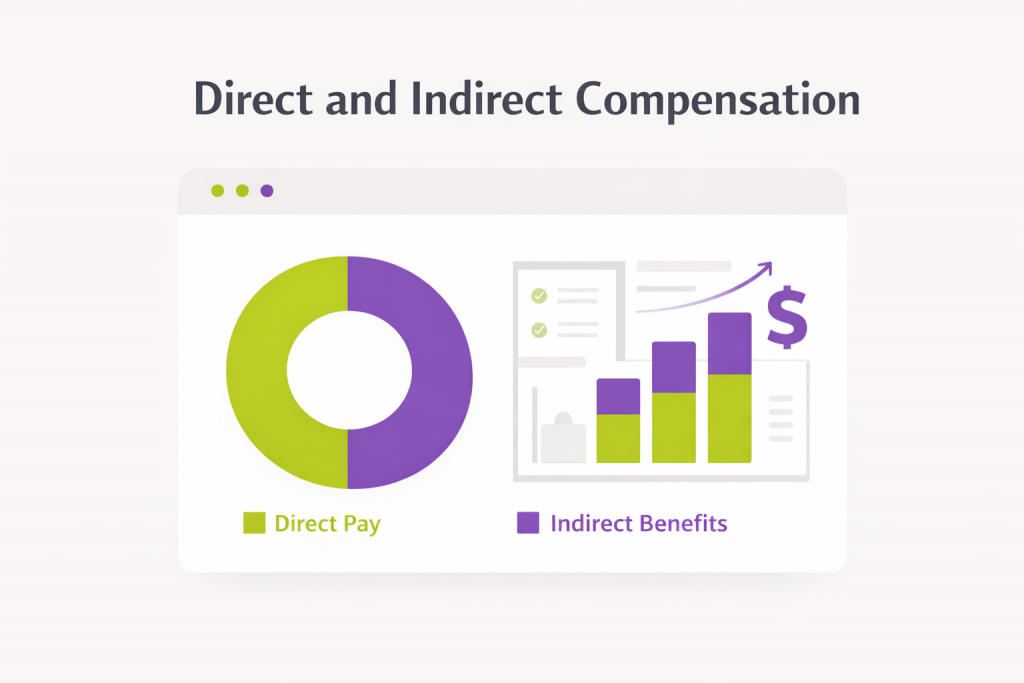
Direct compensation is any payment made to an employee in cash or its equivalent. It is the most visible part of a compensation package and the number most people think of first when they hear the word “salary.”
It comes in four main forms:
Base salary is the fixed annual amount an employee earns regardless of company performance or individual output. It is the foundation of most compensation packages and the benchmark against which other pay elements are measured.
Hourly wages work the same way but are calculated per hour worked. They are common in roles with variable schedules or part-time arrangements and typically include overtime pay for hours beyond the standard workweek.
Bonuses are one-time or periodic cash payments tied to performance, tenure, or a specific event. Performance bonuses reward hitting targets. Signing bonuses incentivize candidates to accept an offer. Retention bonuses encourage employees to stay through a critical period.
Commission is pay tied directly to sales or revenue generated. It is the primary pay structure in sales roles and can be structured as straight commission, a base salary plus commission, or a tiered model that increases the payout rate as targets are exceeded.
All four types share one defining trait: the employee receives the money directly and can use it however they choose.
Also read: What is Compensation Planning? A Complete Guide for HR Leaders
What is Indirect Compensation?
Indirect compensation covers everything of value an employer provides that does not show up as cash in an employee’s paycheck. These benefits still cost the company money, often significantly, but employees receive them as services, protections, or time rather than dollars.
Indirect compensation typically falls into five categories:
Health and wellness benefits include medical, dental, and vision insurance, as well as mental health coverage, gym memberships, and employee assistance programs. For many employees, employer-sponsored health coverage is one of the most valuable parts of their total package.
Retirement plans help employees build long-term financial security. The most common structure in the US is a 401(k) with an employer match, but some organizations still offer defined benefit pension plans. The employer contribution is a direct financial benefit, even if employees do not feel it the same way they feel a raise.
Paid time off includes vacation days, sick leave, parental leave, and public holidays. Generous PTO policies have become a meaningful differentiator, particularly for companies competing for talent in flexible or remote-first markets.
Equity and stock options give employees a stake in the company’s growth. These are especially common in startups and tech companies, where equity can represent a significant portion of total compensation even when base salaries are modest.
Perks and allowances cover a wide range of extras: remote work stipends, learning and development budgets, commuter benefits, childcare support, and more. While individually smaller in value, perks signal how a company treats its people and contribute to overall job satisfaction.
The key distinction from direct compensation is that employees cannot simply pocket these benefits as cash. Their value is real, but it is delivered differently.
Direct vs Indirect Compensation: Key Differences
Understanding the difference between direct and indirect compensation goes beyond the cash vs. non-cash distinction. The two types serve different purposes, affect employees differently, and require different strategies to manage well.
Here is how they compare across six key dimensions:
| Dimension | Direct Compensation | Indirect Compensation |
| Form | Cash or cash equivalent | Non-cash value |
| Visibility | Highly visible in every paycheck | Often undervalued by employees |
| Tax treatment | Fully taxable as ordinary income | Partially or fully tax-advantaged |
| Primary role | Attracts candidates | Drives retention |
| Benchmarking | Compared against market salary data | Benchmarked against industry benefit norms |
| Employee choice | Spend it however they want | Defined by employer policy |
One practical note worth highlighting: indirect compensation is often where the perception gap lives. An employee earning $80,000 in base salary may not realize their total package is closer to $110,000 once health coverage, retirement contributions, and PTO are factored in. That gap is both a communication problem and a retention risk.
Why Both Matter for a Total Compensation Strategy
Direct and indirect compensation are not competing priorities. They work together, and a gap in either one creates problems that the other cannot fix.
A high base salary with weak benefits will attract candidates but struggle to retain them. Generous benefits paired with below-market pay will lose candidates before they ever reach the offer stage. The strongest compensation strategies treat both as essential levers, not trade-offs.
There are three reasons this matters in practice.
Employees evaluate total value, not just salary. When a candidate compares two offers, they weigh health coverage, flexibility, retirement contributions, and growth opportunities alongside the paycheck. Organizations that communicate only base salary are underselling their actual investment in employees.
Different employee segments prioritize different things. A recent graduate may weight cash compensation heavily. A mid-career professional with a family may prioritize health benefits and PTO. A senior leader may care most about equity upside. A well-designed compensation strategy accounts for this variation rather than applying a single formula across the workforce.
Total compensation statements close the perception gap. When employees can see the full dollar value of their package, including benefits, employer retirement contributions, and paid leave, their sense of being fairly compensated improves. This is a low-cost intervention with a measurable impact on engagement and retention.
The practical takeaway: direct compensation gets people in the door. Indirect compensation keeps them there. Both need to be competitive, clearly communicated, and regularly reviewed against market data.
Direct vs Indirect Compensation Examples
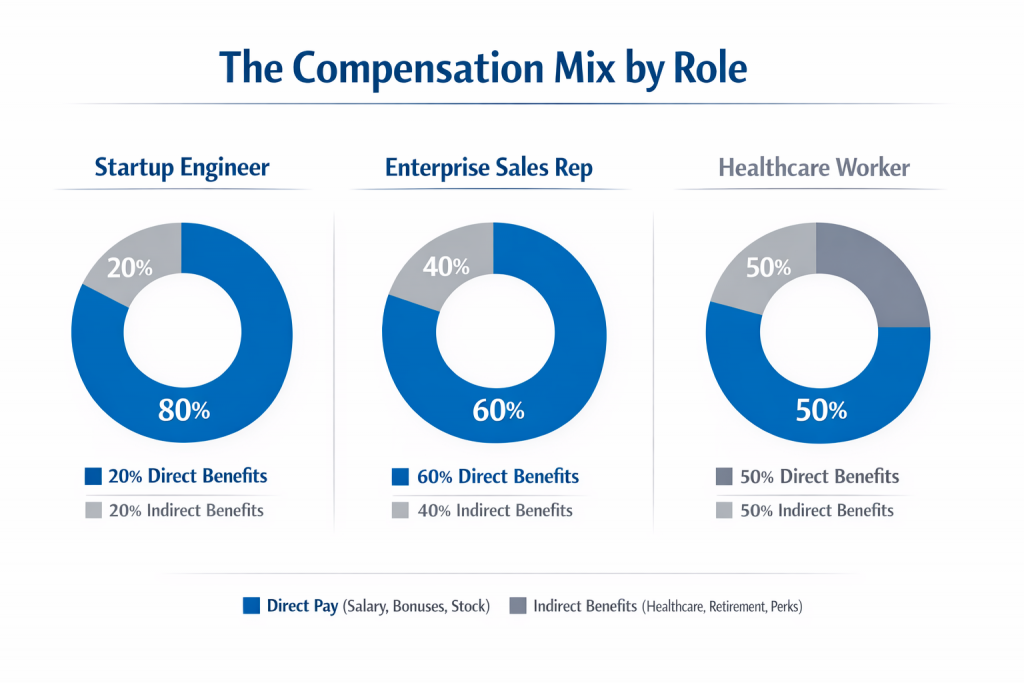
The right compensation mix looks different depending on the role, the industry, and where the company is in its growth journey. Here are three scenarios that illustrate how organizations structure direct and indirect compensation in practice.
Early-stage startup
Cash is constrained, so startups lean heavily on indirect compensation to compete for talent. A software engineer joining a Series A company might receive a modest base salary, well below what a large tech company would offer, but the package includes meaningful equity in the form of stock options, flexible remote work, an unlimited PTO policy, and a learning and development stipend. The equity is the bet. If the company grows, the indirect compensation converts into significant financial value.
Enterprise sales role
Sales compensation is direct compensation heavy by design. A quota-carrying account executive at a mid-size SaaS company might earn a $80,000 base salary with an on-target earnings of $160,000, meaning half their expected pay comes from commission. Indirect compensation still matters here: strong health benefits, a 401(k) match, and a car or travel allowance are table stakes in competitive sales hiring. But the direct pay structure is what drives performance and attracts top sales talent.
Healthcare or operations role
Frontline roles in healthcare and operations often sit in the middle. Base wages are fixed and benchmarked tightly against local market rates. The indirect compensation package carries significant weight: comprehensive health coverage, shift differentials, pension or retirement contributions, tuition reimbursement, and paid parental leave. For many employees in these roles, benefits represent a larger share of total compensation than they would in a corporate office setting.
How to Structure the Right Compensation Mix
There is no universal formula for balancing direct and indirect compensation. The right mix depends on four factors: your compensation philosophy, your workforce profile, your industry benchmarks, and your budget constraints.
Start with your compensation philosophy. Before deciding how much to spend on benefits versus base pay, define what your organization is trying to achieve with compensation. Are you paying at the 50th percentile of the market and differentiating on culture? Are you a pay leader trying to win on salary alone? Are you offering below-market cash in exchange for equity upside? Your philosophy shapes every decision that follows.
Know your workforce. Compensation preferences vary significantly by life stage, role type, and geography. Survey your employees regularly to understand what they actually value. Many organizations discover they are overspending on perks employees do not use while underfunding the benefits that drive real satisfaction, such as parental leave or mental health coverage.
Benchmark both sides of the package. Most companies benchmark base salary rigorously but treat benefits benchmarking as an afterthought. Both deserve the same level of attention. Use compensation survey data to compare your total package against competitors, not just your cash pay. This is especially important in industries where indirect compensation is a primary recruiting tool.
Account for budget constraints honestly. If cash is limited, indirect compensation can bridge the gap, but only if employees understand and value what they are receiving. A robust total compensation statement, shared annually or at the time of any offer, ensures employees see the full picture rather than comparing only their take-home pay to a competitor’s headline salary.
Review the mix regularly. Compensation strategy is not a one-time exercise. As your workforce grows, as market rates shift, and as employee priorities evolve, the right balance between direct and indirect compensation will change. Build in a structured review cadence, at minimum once a year, to keep the strategy current.
Conclusion
Direct and indirect compensation serve different but equally important roles. Direct pay attracts talent and establishes market credibility. Indirect compensation builds loyalty, supports employee wellbeing, and adds value that a paycheck alone cannot deliver.
The organizations that get this right are the ones that treat total compensation as a strategy, not just a budget line. They benchmark both sides of the package, communicate the full picture to employees, and revisit the mix as their workforce and market conditions evolve.
Getting the balance right is not a one-time decision. It is an ongoing process, and it is one of the highest-leverage things a compensation team can do.
FAQs-
Is equity direct or indirect compensation?
Equity is indirect compensation. Stock options, restricted stock units (RSUs), and employee stock purchase plans do not pay out as cash in the present moment. Their value is realized over time, typically through vesting schedules, and depends on company performance. That said, equity can become a substantial part of total compensation, particularly in startups and high-growth tech companies.
Are bonuses direct or indirect compensation?
Bonuses are direct compensation. They are cash payments made to employees, whether tied to individual performance, company results, or a specific event like joining or staying through a retention period. Because the employee receives the money directly and can use it without restriction, bonuses fall squarely in the direct compensation category.
How do I communicate indirect compensation to employees?
The most effective approach is a total compensation statement that translates every element of the package into dollar terms. This includes the employer’s contribution to health premiums, the value of the retirement match, the dollar equivalent of PTO days, and any other benefits the company funds. Sharing this statement at the time of an offer, after a raise, and during annual reviews helps employees understand the full value of what they receive, not just their take-home pay.