Poor compensation planning costs more than most HR leaders realize. A misaligned pay structure drives top performers out the door, blows through headcount budgets, and creates pay gaps that are increasingly hard to defend — legally and culturally.
Yet for many organizations, compensation planning still happens in reactive bursts: a raise here, a competing offer there, a spreadsheet scramble before annual reviews.
This guide breaks down what compensation planning actually is, what it involves, and how HR leaders can approach it as the strategic function it deserves to be.
TL;DR
- Compensation planning is the strategy behind what employees are paid, not just how they are paid.
- It covers base salary, variable pay, equity, benefits, and merit increases as one total package.
- Poor comp planning drives turnover, blows budgets, and creates pay gaps that are hard to defend.
- A compensation philosophy is the foundation — it defines how your organization thinks about pay before any numbers are set.
- Pay bands create guardrails for offers, raises, and promotions, and are the primary tool for internal equity.
- Market benchmarking should happen at least annually, and more often in competitive talent markets.
- Comp planning must align with finance and headcount plans — it does not happen in isolation.
- Pay transparency laws are making structured, documented comp plans a legal necessity, not just best practice.
- Clear employee communication turns a comp plan from an internal document into an organizational trust-builder.
- Compensation planning is not an annual event — it is an ongoing strategic function.
What is Compensation Planning?
Compensation planning is the process of designing, managing, and adjusting how an organization pays its employees, structured around business goals, market data, and internal equity.
It is often confused with payroll, but the two are distinct. Payroll is execution: making sure employees get paid accurately and on time. Compensation planning is strategy: deciding what employees should be paid, why, and how that changes over time.
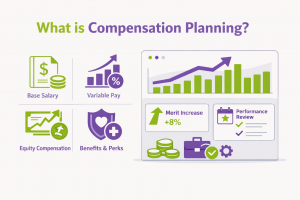
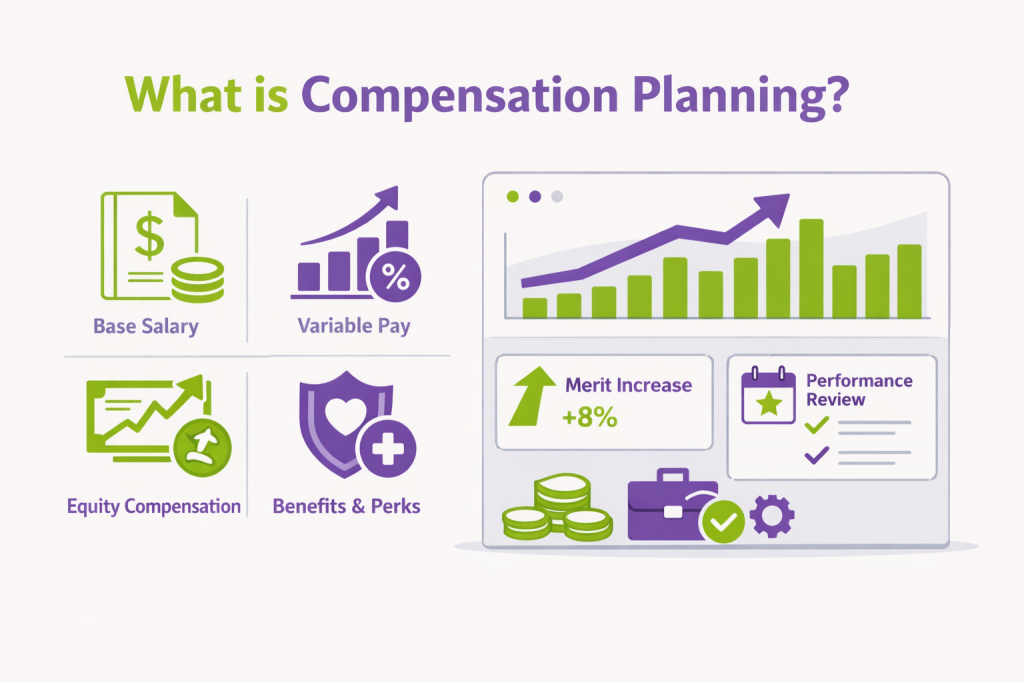
A complete compensation plan typically covers:
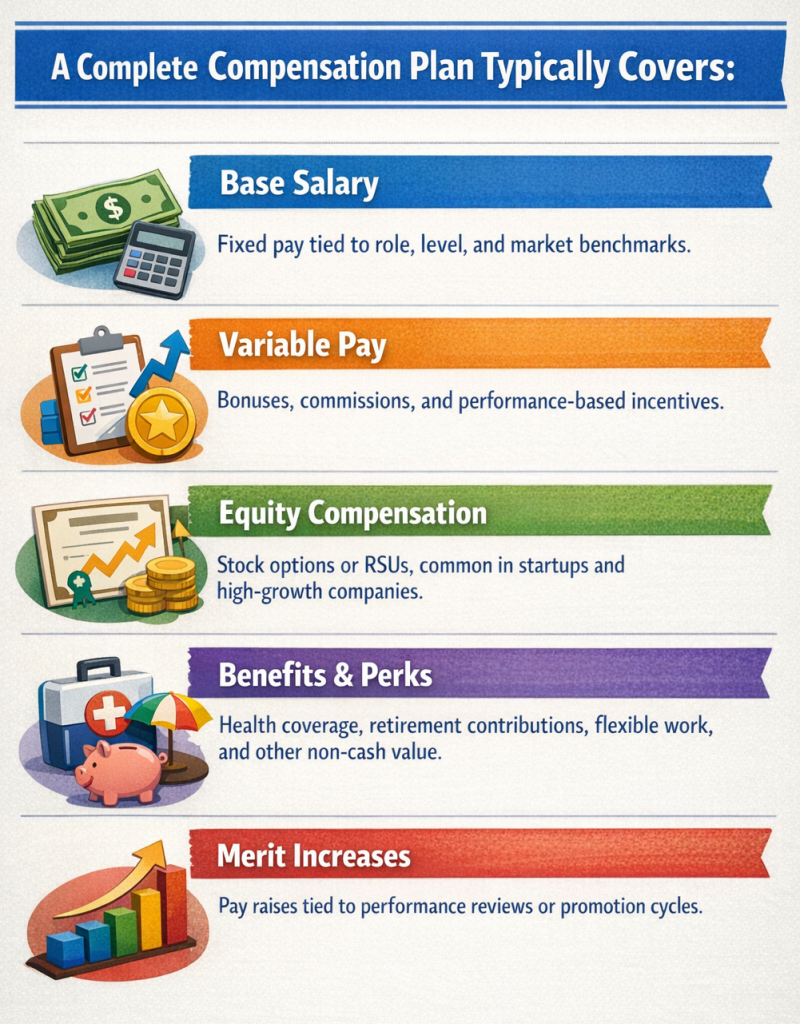
- Base salary — fixed pay tied to role, level, and market benchmarks
- Variable pay — bonuses, commissions, and performance-based incentives
- Equity compensation — stock options or RSUs, common in startups and high-growth companies
- Benefits and perks — health coverage, retirement contributions, flexible work, and other non-cash value
- Merit increases — structured pay raises tied to performance reviews or promotion cycles
Together, these elements form the total compensation package an employee receives — and the framework HR uses to make pay decisions consistently across the organization.
Also read: What is Compensation Management Software? Guide for HR Teams
Why Compensation Planning Matters for Organizations
Compensation is typically the largest line item in any company’s operating budget. How that money gets allocated, and whether it’s allocated fairly, has a direct impact on business performance.
Here’s what structured compensation planning enables:
Better talent acquisition and retention
Candidates evaluate total compensation before accepting offers. Employees reassess it every time they get a recruiter message. Without a clear pay structure, organizations either overpay to close deals or lose people to companies that can articulate their value better.
Pay equity and legal defensibility
Pay disparities across gender, race, and other demographics are under growing scrutiny. Several US states now require pay range disclosures in job postings. A structured comp plan gives HR the documentation and consistency needed to stay compliant and close gaps before they become liabilities.
Budget predictability
Ad hoc pay decisions compound quickly. When raises, promotions, and offers happen without a framework, finance loses visibility and HR loses credibility. Comp planning ties people spend to headcount strategy and business performance, so there are fewer surprises at the end of the fiscal year.
Organizational trust
Employees who understand how pay decisions are made, even at a high level, report higher engagement and lower intent to leave. Compensation planning creates the structure that makes transparency possible.
Key Components of a Compensation Plan
A compensation plan is more than a salary number. It is a framework that covers every form of value an organization delivers to its employees. Most comp plans are built around five core components.
Key components of a compensation plan
Total compensation goes beyond salary
| 1 |
Base salary The fixed amount an employee earns for their role, set within a pay band tied to job level and market benchmarks. |
| 2 |
Variable pay Performance-linked compensation including bonuses, sales commissions, and spot awards tied to individual or team outcomes. |
| 3 |
Equity compensation Stock options, RSUs, or other ownership-based incentives. Especially common in startups and high-growth companies. |
| 4 |
Benefits and perks Non-cash components including health insurance, retirement contributions, paid time off, and flexible work arrangements. |
| 5 |
Merit increases Structured pay adjustments tied to performance reviews, promotion cycles, or tenure milestones. |
Base salary
The fixed amount an employee earns for their role, typically set within a pay band tied to job level and market benchmarks. Base salary is the foundation everything else is built on.
Variable pay
Performance-linked compensation that sits on top of base salary. This includes annual bonuses, sales commissions, and spot awards. Variable pay ties individual or team outcomes to business results.
Equity compensation
Stock options, restricted stock units (RSUs), or other ownership-based incentives. Equity is especially common in startups and high-growth companies as a way to attract talent when cash compensation is constrained.
Benefits and perks
Non-cash components of total compensation, including health insurance, retirement contributions, paid time off, and flexible work arrangements. Benefits are often underweighted in comp planning despite being a significant part of total spend.
Merit increases
Structured pay adjustments tied to performance reviews, promotion cycles, or tenure milestones. Without a defined process for merit increases, pay decisions default to gut feel or whoever negotiates hardest.
Together, these components make up an employee’s total compensation. A strong comp plan defines how each element is structured, what drives changes to it, and how it holds up against the market over time.
The Compensation Planning Process: How It Works
Compensation planning is not a one-time project. It is a recurring cycle that runs alongside headcount planning, performance reviews, and budget seasons. While every organization approaches it differently, most effective comp processes follow a common set of steps.
1. Audit Current Compensation Data
Before making any changes, HR needs a clear picture of where things stand. This means pulling together salary data across roles, levels, and departments, and identifying any gaps, inconsistencies, or outliers. You cannot plan from a baseline you do not trust.
2. Define or Revisit Your Compensation Philosophy
A compensation philosophy is a formal statement of how your organization thinks about pay. It answers questions like: Do you pay at the market median or above it? How do you weight base versus variable pay? What role does equity play? This philosophy should drive every decision that follows.
3. Benchmark Against Market Data
Internal data alone is not enough. HR needs external benchmarks from compensation surveys, labor market data, or dedicated comp tools to understand how their pay structures compare to competitors. Market data should be refreshed at least annually, and more frequently in fast-moving talent markets.
4. Build or Update Pay Bands
Pay bands define the minimum, midpoint, and maximum salary for each role and level. They create the guardrails for offers, raises, and promotions, and are the primary tool for maintaining internal equity across the organization.
5. Align With Budget and Headcount Plans
Compensation decisions do not happen in isolation. HR needs to work with finance to ensure that planned increases, new hires, and equity grants fit within approved budgets. This step is where people strategy meets financial reality.
6. Communicate to Employees
A comp plan that lives only in HR’s systems does not deliver its full value. Employees should understand the framework behind their pay, even if not every detail. Clear communication builds trust and reduces the perception that pay decisions are arbitrary.
Conclusion
Compensation planning is not an annual checkbox. It is an ongoing strategic function that shapes how your organization attracts talent, retains people, and spends its most significant budget line.
HR leaders who treat it that way, with a clear philosophy, consistent pay bands, and regular market benchmarking, build organizations where pay decisions are defensible, equitable, and trusted.
The tools and data available to comp teams today make that level of rigor more accessible than ever. Stello AI helps HR leaders bring structure, speed, and confidence to every stage of the compensation planning process.
FAQs
What is the difference between compensation planning and payroll?
Payroll is the process of paying employees accurately and on time. Compensation planning is the strategy behind what employees are paid, why, and how that changes over time. One is operational, the other is strategic.
How often should compensation plans be reviewed?
Most organizations review compensation annually, typically tied to performance review cycles and budget planning seasons. However, pay bands and market benchmarks should be revisited more frequently in competitive or fast-moving talent markets.
What is a compensation philosophy?
A compensation philosophy is a formal statement that defines how an organization approaches pay. It covers decisions like whether to pay at, above, or below market rate, how to balance base versus variable pay, and what role equity plays in total compensation.
What are pay bands and why do they matter?
Pay bands define the minimum, midpoint, and maximum salary for a given role and level. They give HR and managers a consistent framework for making offers, approving raises, and managing promotions without defaulting to gut feel or negotiation pressure.
How does compensation planning support pay equity? A structured comp plan creates documented, consistent criteria for pay decisions across the organization. This makes it easier to identify and close gaps across gender, race, and other demographics before they become compliance risks or cultural liabilities.