Compensation management has always been a complex responsibility for HR and compensation teams. But in recent years, the process has become significantly more challenging.
Organizations now operate in highly competitive talent markets where salary expectations change quickly. At the same time, companies face growing pressure to ensure pay equity, transparency, and competitive compensation practices across the workforce.
Managing compensation decisions today involves analyzing multiple data points — market benchmarks, internal pay structures, performance ratings, location-based pay differences, and budget constraints. For many HR teams, these decisions still rely heavily on spreadsheets, manual analysis, and periodic compensation reviews.
This is where artificial intelligence (AI) is beginning to transform compensation management.
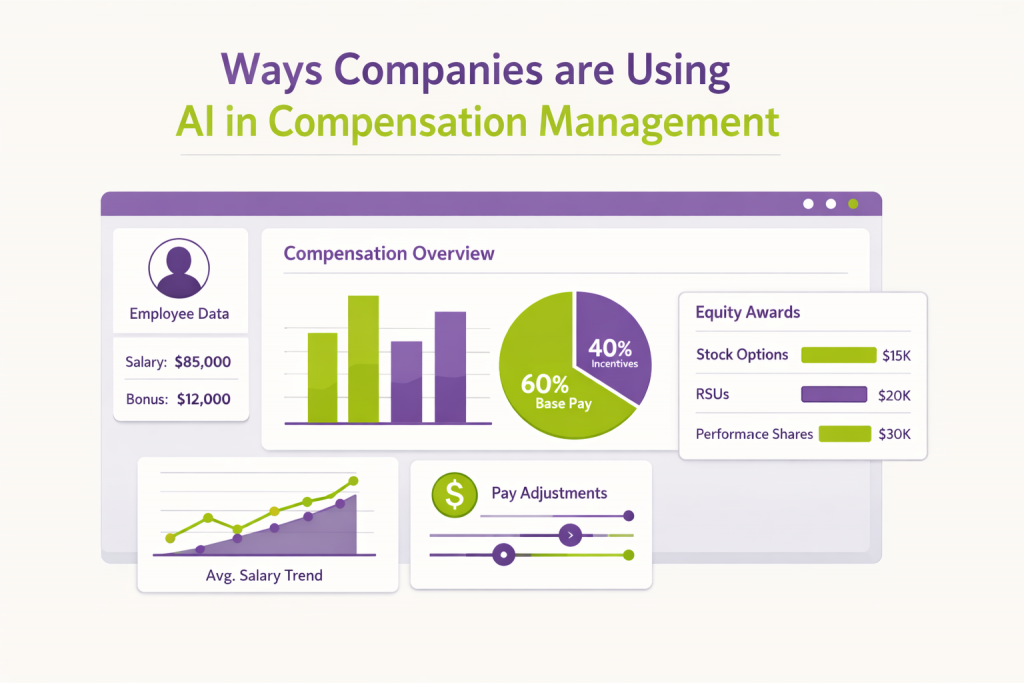
By analyzing large volumes of compensation data, AI systems can help HR leaders identify pay gaps, benchmark salaries against market data, generate data-driven offer packages, and support compensation planning. Instead of relying solely on manual processes, organizations can use AI to make faster, more consistent, and more informed compensation decisions.
In this article, we explore how organizations are using AI in compensation management and examine the key use cases that are helping HR teams design fairer and more competitive pay strategies.
- Compensation management is becoming more complex due to market competition, pay transparency, and growing data volumes.
- AI helps HR teams analyze compensation data faster and make more consistent pay decisions.
- Organizations are using AI for salary benchmarking, offer creation, pay equity analysis, and merit planning.
- AI can also detect pay compression, retention risks, and internal pay disparities.
- Scenario modeling allows compensation leaders to evaluate the budget impact of pay changes before implementing them.
- Instead of replacing HR professionals, AI acts as a decision-support system for compensation teams.
- As compensation strategies become more data-driven, AI will play a larger role in designing fair and competitive pay programs.
Why Compensation Teams Are Turning to AI
Compensation decisions today involve far more complexity than they did a decade ago. HR and compensation leaders must balance market competitiveness, internal equity, regulatory compliance, and organizational budgets—all while supporting hiring and retention goals.
At the same time, the volume of compensation data has grown significantly. Organizations now rely on multiple sources of information, including salary surveys, market benchmarking platforms, internal pay data, and performance metrics.
Managing this data manually can make compensation decisions slow and inconsistent.
For example, creating a new hire offer may require reviewing market benchmarks, checking internal pay ranges, evaluating team-level equity, and ensuring the offer aligns with company compensation policies. Similar complexity appears during merit cycles, promotion reviews, and pay equity analysis.
As organizations scale, these processes often become increasingly difficult to manage using spreadsheets and periodic reviews.
This is why many companies are beginning to use AI to support compensation management. AI systems can analyze large compensation datasets, detect patterns, and generate recommendations that help HR teams make faster and more consistent pay decisions.
Rather than replacing compensation leaders, AI acts as a decision-support layer—helping organizations manage compensation data more effectively and identify insights that might otherwise go unnoticed.
The AI-Powered Compensation Workflow
How artificial intelligence drives smarter, fairer, and more strategic compensation management
Market Data Analysis
AI analyzes salary surveys, market benchmarks, job demand, and industry salary trends in real time.
Data IngestionSalary Benchmarking
AI recommends competitive salary ranges based on role, location, and experience level.
Market InsightOffer Package Creation
AI generates compensation offers including base salary, bonuses, and equity components.
Offer DesignPay Equity Monitoring
AI detects pay disparities across job levels, teams, and demographic groups.
Equity AnalysisMerit and Bonus Planning
AI recommends salary increases and bonus allocations during annual review cycles.
Review PlanningRetention Risk Detection
AI identifies employees at risk of leaving due to compensation gaps and market misalignment.
Risk IntelligenceKey Use Cases of AI in Compensation Management
Organizations are increasingly using AI to support different stages of the compensation lifecycle—from salary benchmarking to pay equity monitoring and compensation planning. By analyzing large volumes of compensation and workforce data, AI systems can help HR teams make faster, more consistent, and more data-driven compensation decisions.
Below are several practical ways companies are applying AI in compensation management.
1. Market Salary Benchmarking
Benchmarking salaries against the market is one of the most time-consuming responsibilities for compensation teams. Organizations typically rely on salary surveys, benchmarking platforms, and internal data to determine competitive pay ranges for different roles.
However, market data changes quickly. Relying on static salary surveys or periodic reviews can make it difficult for companies to keep compensation aligned with current labor market conditions.
AI can help by continuously analyzing multiple compensation data sources and identifying up-to-date market benchmarks for specific roles, locations, and experience levels. Instead of manually compiling and analyzing survey data, compensation teams can receive recommended salary ranges based on real-time market insights.
For example, when a company is hiring for a senior software engineer in a specific location, an AI-powered system can analyze market compensation data, hiring demand, and industry benchmarks to recommend a competitive salary range.
This allows organizations to make faster compensation decisions while ensuring their pay ranges remain competitive in the market.
2. Generating Data-Driven Offer Packages
Creating new hire compensation offers often requires balancing multiple factors. Recruiters and compensation teams must consider market benchmarks, internal salary bands, candidate experience, and internal equity before finalizing an offer.
In many organizations, this process involves multiple rounds of manual review and approvals, which can slow down hiring decisions.
AI can help streamline this process by generating data-driven compensation recommendations for new hires. By analyzing internal compensation structures and market data, AI systems can recommend offer packages that align with company compensation policies.
For instance, when a recruiter prepares an offer for a candidate, an AI system can suggest an appropriate combination of base salary, signing bonus, and equity while ensuring the offer remains within the company’s salary band and budget constraints.
This helps HR teams create consistent and competitive offers while reducing the time required to finalize compensation decisions.
Also read: Compensation Planning for Finance: A CFO’s Playbook (2026)
3. Pay Equity Analysis
Ensuring fair and equitable pay is a growing priority for organizations. In many regions, companies face increasing pressure from regulators, employees, and investors to demonstrate that their compensation practices are fair and unbiased.
However, identifying pay disparities across an organization can be difficult. Compensation teams must analyze large datasets across departments, job levels, locations, and demographic groups. When done manually, this process can be time-consuming and often happens only once or twice a year.
AI can make pay equity analysis more continuous and scalable.
By analyzing compensation data across the workforce, AI systems can identify patterns that may indicate potential pay gaps. These systems can compare employees performing similar roles while accounting for factors such as experience, job level, location, and performance.
For example, an AI system may detect that employees within a specific job family are consistently paid below internal benchmarks or market ranges. The system can flag these discrepancies and provide compensation teams with insights that help them investigate and address potential gaps.
This allows organizations to move from reactive pay equity audits to more proactive compensation monitoring, helping ensure fair pay practices across the workforce.
4. Detecting Pay Compression and Internal Inequities
Pay compression occurs when new hires are offered salaries that are close to—or even higher than—the salaries of existing employees in similar roles. This situation often arises in competitive hiring markets where companies must increase offers to attract talent.
While higher offers may help secure new hires, they can also create internal compensation imbalances that affect employee morale and retention.
AI can help organizations detect these issues before they become larger problems.
By analyzing internal compensation structures and proposed salary offers, AI systems can flag situations where a new hire’s compensation may exceed the pay of existing employees with similar experience or job levels. This allows compensation teams to review and adjust offers before they are finalized.
For instance, when a hiring manager proposes a salary for a new employee, the system may alert HR that the offer would place the new hire above several current employees in the same role. Compensation teams can then evaluate whether adjustments are needed to maintain internal equity.
This type of real-time analysis helps organizations maintain balanced compensation structures while remaining competitive in the talent market.
5. Supporting Merit and Bonus Planning
Annual compensation reviews are one of the most complex processes for HR and compensation teams. During merit cycles, organizations must determine salary increases, bonuses, and promotion adjustments across the workforce while staying within defined budgets.
Managers are typically asked to make these decisions based on multiple factors, including employee performance, internal pay structures, and market competitiveness. Without strong data support, this process can lead to inconsistent decisions across teams.
AI can help organizations make merit planning more structured and data-driven.
By analyzing employee performance data, current compensation levels, internal pay ranges, and budget constraints, AI systems can generate recommendations for salary increases and bonus allocations. These recommendations help managers understand how different compensation decisions affect team budgets and internal equity.
For example, during the annual review cycle, an AI system may recommend merit increases that align with company guidelines while ensuring high-performing employees remain competitively compensated. If a proposed increase exceeds the allocated budget or creates internal pay imbalances, the system can flag the issue before final decisions are made.
This helps compensation teams maintain consistency across departments while simplifying a process that is often administratively complex.
6. Providing Real-Time Compensation Guidance to Managers
Many compensation decisions occur at the manager level. Hiring managers often need to determine appropriate salary offers, recommend promotions, or adjust compensation for high-performing employees.
However, most managers are not compensation experts. They may be unfamiliar with salary bands, internal equity considerations, or market benchmarks, which can lead to inconsistent or policy misaligned decisions.
AI-powered systems can provide real-time compensation guidance to managers as they make these decisions.
Instead of relying on multiple documents or HR consultations, managers can receive immediate recommendations based on company compensation policies and market data. For example, when preparing an offer for a candidate, a manager could receive suggested salary ranges, bonus recommendations, and policy guidance within the same system.
Similarly, if a manager proposes a salary increase that exceeds recommended ranges, the system can flag the decision and provide alternative suggestions that align with compensation guidelines.
This type of guidance helps ensure that compensation decisions remain consistent across the organization while reducing the administrative burden on HR teams.
7. Compensation Scenario Modeling
Compensation leaders often need to evaluate the financial impact of potential pay changes before implementing them. Decisions such as adjusting salary bands, correcting pay gaps, or increasing compensation for specific roles can have significant budget implications.
Traditionally, these analyses require extensive spreadsheet modeling and manual calculations. As organizations grow and compensation data becomes more complex, this approach can make strategic planning slow and difficult.
AI can help compensation teams model different compensation scenarios more quickly.
By analyzing workforce data, salary structures, and budget constraints, AI systems can simulate the impact of different compensation strategies. HR leaders can evaluate questions such as how much it would cost to increase salary bands for a specific role, adjust compensation to address pay equity gaps, or implement targeted retention increases.
For example, if an organization wants to raise salaries for engineering roles to remain competitive with the market, an AI system can estimate the total budget impact across departments and employee levels.
This type of scenario modeling helps compensation leaders make more informed decisions by understanding the financial and organizational implications before implementing changes.
8. Predicting Compensation-Driven Attrition
Compensation plays an important role in employee retention. When employees believe they are underpaid relative to the market or compared to their peers, they may be more likely to explore other job opportunities.
However, identifying compensation-related retention risks can be difficult. HR teams often discover these issues only after employees begin leaving the organization.
AI can help identify potential attrition risks earlier.
By analyzing factors such as compensation levels, market benchmarks, performance ratings, and historical turnover patterns, AI systems can detect employees who may be at higher risk of leaving due to compensation concerns.
For example, an AI system may identify high-performing employees whose salaries fall significantly below market benchmarks. These insights allow HR teams to proactively review compensation and consider adjustments before retention risks escalate.
This proactive approach helps organizations retain valuable employees while ensuring compensation remains competitive and aligned with market conditions.
Conclusion
Compensation management is becoming increasingly complex as organizations balance market competitiveness, internal equity, regulatory expectations, and evolving workforce dynamics. Relying solely on manual processes and periodic reviews can make it difficult for compensation teams to keep pace with these demands.
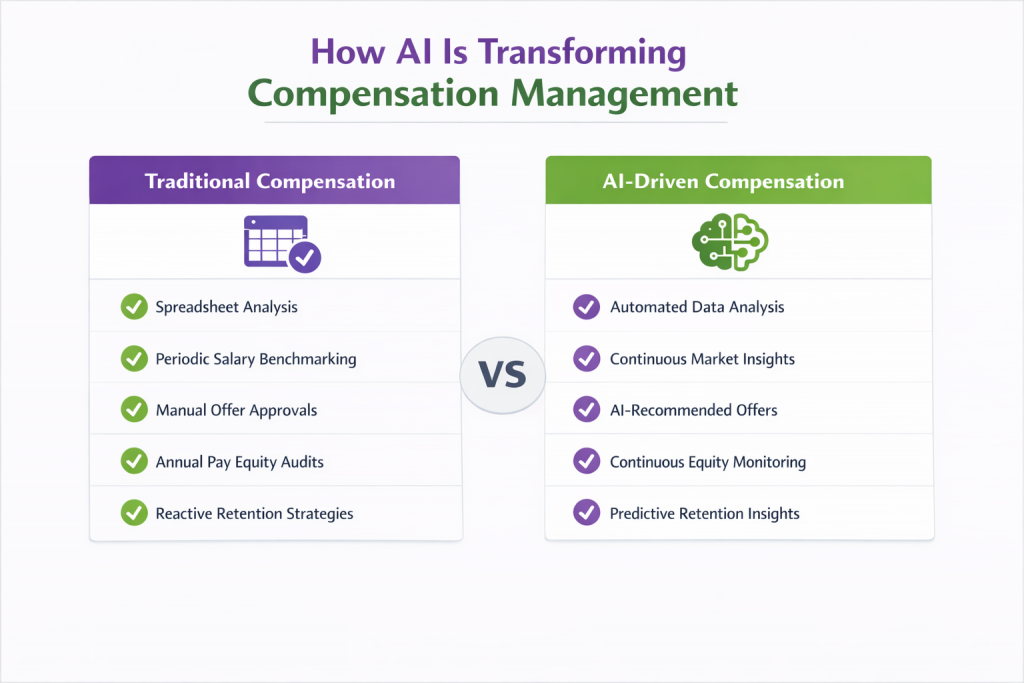
AI is helping organizations manage this complexity by enabling more data-driven and scalable compensation practices. From salary benchmarking and offer creation to pay equity analysis and merit planning, AI can support compensation teams across multiple stages of the compensation lifecycle.
By analyzing large datasets and identifying patterns that may otherwise go unnoticed, AI helps HR leaders make faster, more consistent, and more informed compensation decisions.
As organizations continue to adopt more data-driven HR strategies, AI will play an increasingly important role in how companies design, monitor, and optimize their compensation programs. Rather than replacing compensation professionals, AI acts as a powerful support system—helping teams focus less on manual analysis and more on building fair, competitive, and sustainable pay strategies.
FAQs-
1. How is AI used in compensation management?
AI is used in compensation management to analyze compensation data and support pay-related decisions. Organizations use AI to benchmark salaries against market data, generate data-driven offer packages, identify pay equity gaps, support merit and bonus planning, and detect compensation-related retention risks.
By analyzing large datasets, AI helps compensation teams make faster and more consistent pay decisions.
2. Can AI help improve pay equity?
Yes. AI can analyze compensation data across job levels, departments, and demographic groups to identify potential pay disparities. By detecting patterns in pay structures, AI systems help HR teams identify and address potential equity issues earlier.
This allows organizations to move from periodic pay equity audits to more continuous monitoring of compensation fairness.
3. What are the benefits of using AI in compensation management?
Using AI in compensation management can help organizations:
- Improve pay equity and transparency
- Make faster compensation decisions
- Reduce manual analysis and spreadsheet work
- Maintain competitive salary benchmarks
- Support more consistent pay practices across teams
These benefits allow compensation leaders to focus more on strategy rather than administrative processes.
4. Will AI replace compensation professionals?
No. AI is designed to support compensation teams rather than replace them. While AI can analyze data and generate recommendations, human judgment remains essential for making final compensation decisions.
HR and compensation leaders still play a critical role in interpreting insights, aligning compensation strategies with business goals, and ensuring fair and responsible pay practices.