Every year, companies lose top talent not because of bad culture or poor management, but because of pay. A study by Payscale found that employees who feel they are paid unfairly are nearly twice as likely to look for a new job within six months. And yet, many organizations are still running compensation cycles on spreadsheets, disconnected systems, and gut instinct.
That’s a serious problem, especially at the enterprise level, where a single miscalculation can ripple across thousands of employees, multiple geographies, and several regulatory frameworks all at once.
Compensation management software solves this by centralizing, automating, and bringing intelligence to one of HR’s most complex and high-stakes responsibilities. But not all platforms are built the same. The right solution doesn’t just digitize your existing process. It transforms how your organization thinks about pay, equity, and total rewards.
This guide breaks down the top features to look for in compensation management software, so HR leaders, compensation teams, and HR tech buyers can make a confident, well-informed decision. Whether you’re evaluating your first dedicated platform or replacing a legacy system, these are the capabilities that separate a basic tool from an enterprise-grade solution.
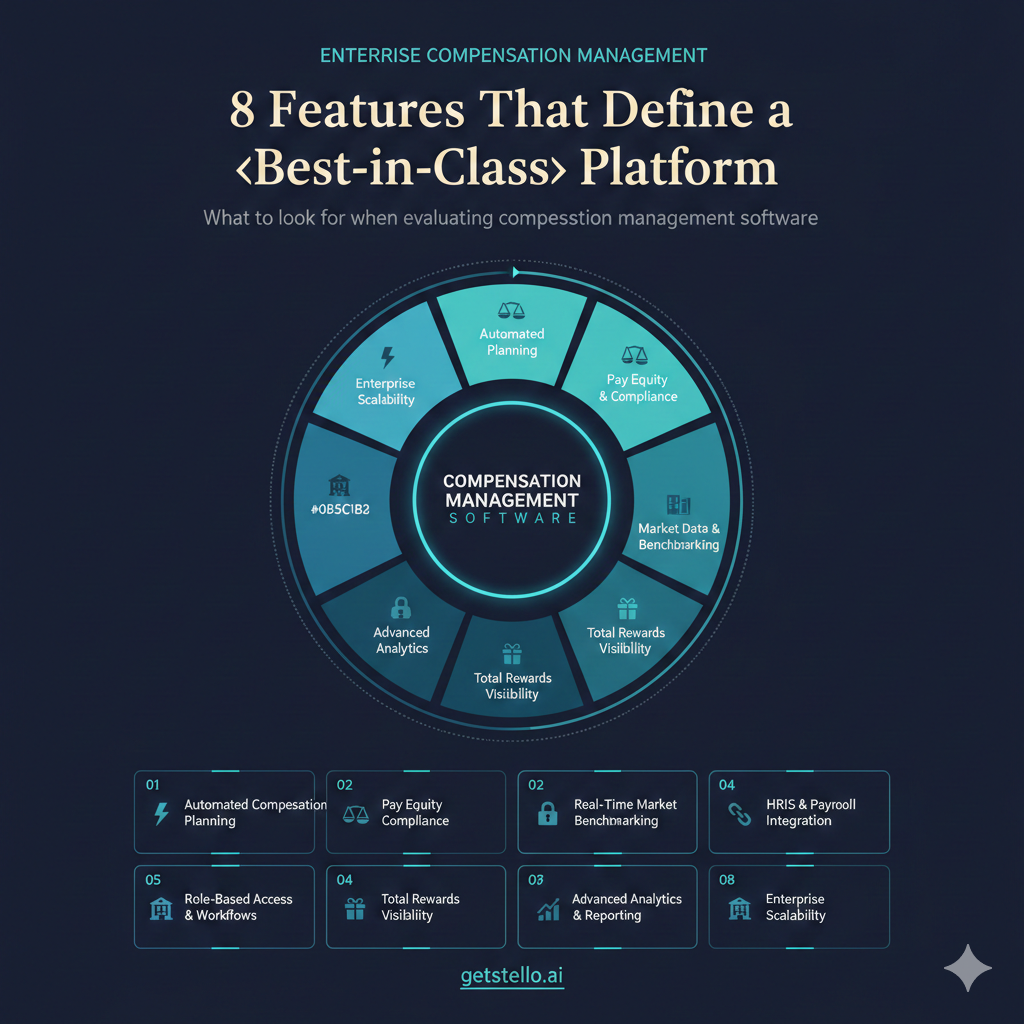
For most organizations, compensation planning season is one of the most stressful times of the year. HR teams are juggling merit cycles, bonus calculations, and salary adjustments across departments, often coordinating through a maze of spreadsheets and back-and-forth emails. The margin for error is high, and the cost of getting it wrong, whether that’s overspending a budget or missing a promotion cycle, is higher.
Automated Compensation Planning & Budgeting
Automated compensation planning eliminates that chaos. Instead of building plans from scratch every cycle, HR and finance teams work from a centralized system that carries forward employee data, applies predefined rules, and flags anomalies before they become problems. Budget thresholds are tracked in real time, so managers always know exactly how much they have to work with and where they stand.
Scenario modeling is another critical piece of this. The best compensation management software lets teams run multiple planning scenarios side by side, comparing the financial impact of different merit increase strategies, promotion rates, or bonus structures before any decisions are finalized. This turns compensation planning from a reactive exercise into a proactive, strategic one.
For enterprise organizations managing thousands of employees across multiple business units, this level of automation is not optional. It’s what makes the entire compensation cycle manageable, auditable, and aligned with business goals.
Pay Equity & Compliance Tools
Pay equity is no longer just a moral imperative. It’s a legal and business one. Governments across the world are introducing stricter pay transparency and reporting requirements, from the EU Pay Transparency Directive to expanding state-level regulations in the US. Organizations that can’t demonstrate equitable pay practices are facing regulatory fines, reputational damage, and an increasingly skeptical talent pool.
The right compensation management software makes pay equity analysis a built-in part of the process, not an afterthought. This means giving HR teams the ability to slice compensation data by gender, ethnicity, tenure, role, and level, and surface gaps before they become liabilities. The goal isn’t just to identify where disparities exist, but to understand why they exist and build a clear remediation path.
Compliance tools go hand in hand with this. Enterprise organizations operating across multiple regions need a platform that understands jurisdictional differences, whether that’s minimum wage thresholds, pay reporting obligations, or local bonus regulations. A good system flags compliance risks automatically and maintains a detailed audit trail of every compensation decision, who made it, when, and why. That documentation is invaluable during internal reviews, board-level discussions, or external audits.
This is an area where GetStello.ai is particularly strong. Built with enterprise compliance complexity in mind, Stello gives HR and compensation teams the visibility and controls they need to stay ahead of pay equity obligations without slowing down the planning cycle.
Also read: AI Compensation Agent: How Enterprises Are Automating Compensation Decisions
Real-Time Market Data & Benchmarking
One of the most common reasons organizations lose competitive talent is not that they’re unwilling to pay fairly. It’s that they don’t have a clear, current picture of what “fairly” actually means in the market. Salary expectations shift constantly, and a compensation band that was competitive 18 months ago may already be undermarket today.
Real-time market data and benchmarking capabilities give HR and compensation teams a live, data-backed view of where their pay ranges stand relative to the external market. The best compensation management software integrates directly with trusted sources like Radford, Mercer, and Willis Towers Watson, pulling current market rates into the platform so teams are always working with relevant numbers.
Benchmarking also needs to account for distributed and global workforces. Enterprise-grade platforms allow organizations to build geo-specific compensation bands, ensuring pay is both competitive and financially sustainable across every location they operate in.
Also read: Top 10 Enterprise Compensation Management Tools
Seamless HRIS & Payroll Integration
Compensation management doesn’t happen in isolation. It sits at the intersection of HR, finance, and payroll, and when those systems don’t talk to each other, the cracks show quickly. Duplicate data entry, syncing delays, and version mismatches are not just inefficiencies. They’re risks that can lead to incorrect payouts, compliance gaps, and frustrated employees.
Seamless integration with your existing HRIS and payroll infrastructure is therefore one of the most practical features to evaluate when choosing compensation management software. Whether your organization runs on Workday, SAP, ADP, BambooHR, or any other major platform, your compensation tool should connect natively, pulling employee data in automatically and pushing approved compensation changes back out without manual intervention.
For enterprise organizations, this also means a single source of truth across departments. When HR, finance, and payroll are all working from the same data in real time, decisions get made faster, errors get caught earlier, and the compensation cycle runs significantly smoother from planning all the way through to execution.
Role-Based Access & Approval Workflows
Compensation data is among the most sensitive information an organization holds. Who can see it, who can change it, and who needs to sign off on it are not just operational questions. They are governance ones. Without proper controls in place, even well-intentioned decisions can create legal exposure, employee relations issues, or budget overruns.
Role-based access ensures that every person in the compensation process sees exactly what they need to see, and nothing more. A frontline manager should be able to submit merit recommendations for their direct reports without seeing what their peers earn. An HR business partner should have visibility across their client group without accessing executive compensation. A finance lead should be able to review budget impact without editing individual employee records.
Approval workflows bring structure to this further. Rather than decisions being made informally or outside the system, multi-step workflows route every compensation change through the right chain of review, whether that’s a manager submitting, an HR partner reviewing, and a finance lead approving, or a more complex sequence depending on the organization’s structure. Every step is logged, timestamped, and auditable.
For enterprise organizations with complex hierarchies and strict governance requirements, this isn’t a secondary feature. It’s foundational to running a compensation process that is both efficient and defensible.
Total Rewards Visibility
Base salary is only one part of what an employee earns. When you factor in bonuses, equity, health benefits, retirement contributions, paid time off, and other perks, the true value of an employee’s compensation package is often significantly higher than their paycheck suggests. The problem is that most employees don’t see it that way, because most organizations never show them the full picture.
This is a retention problem hiding in plain sight. Employees who don’t understand the total value of their compensation are far more likely to feel underpaid, even when they aren’t. Total rewards visibility solves this by giving employees a clear, consolidated view of everything they receive, not just their base pay.
The best compensation management software generates total compensation statements that break down every component of an employee’s package in a format that is easy to understand. These statements can be shared during review cycles, onboarding, or any time an employee has questions about their pay, turning what is often an awkward conversation into a transparent and straightforward one.
For HR and compensation leaders, total rewards visibility also serves a strategic purpose. It connects compensation investment directly to employee engagement and retention outcomes, making it easier to justify compensation budgets to leadership and demonstrate the return on every dollar spent on people.
Advanced Analytics & Reporting
Good compensation decisions are only as strong as the data behind them. Without robust analytics, HR and finance leaders are left making high-stakes pay decisions based on incomplete information, gut feel, or reports that take days to pull together manually. In an enterprise environment, that’s not a sustainable way to operate.
Advanced analytics and reporting capabilities turn compensation data into actionable insight. At the most basic level, this means real-time dashboards that surface key metrics like compensation spent by department, compa-ratios across levels, and pay distribution across the organization. But the best platforms go further, offering predictive analytics that help leaders anticipate compensation-related risks before they materialize, whether that’s identifying employees who are flight risks due to below-market pay or forecasting the budget impact of an upcoming merit cycle.
Custom reporting is equally important, particularly for enterprise organizations where different stakeholders need different views of the same data. HR business partners need granular employee-level reports. Finance needs budget variance analysis. The executive team and board need high-level summaries tied to business outcomes. A strong compensation management platform makes it easy to generate all of these without needing a data analyst in the room.
GetStello.ai brings this to life with an analytics layer built specifically for enterprise compensation complexity, giving every stakeholder the visibility they need to make faster, smarter, and more confident pay decisions.
Scalability for Enterprise Needs
Every feature covered in this guide only delivers its full value if the platform can scale with your organization. A compensation management solution that works well for 500 employees but struggles at 5,000 is not an enterprise solution. It’s a stopgap.
Scalability in compensation management software means more than just handling a large headcount. It means supporting complex organizational structures with multiple business units, geographies, and legal entities. It means configurable compensation frameworks that can accommodate different pay philosophies across divisions without requiring a separate system for each one. And it means maintaining performance and reliability even during the most demanding periods of the compensation cycle, when hundreds of managers are submitting recommendations simultaneously.
Security and data governance scale with complexity too. Enterprise-grade platforms need to meet rigorous standards including SOC 2 Type II certification, GDPR compliance, and support for single sign-on and multi-factor authentication. These aren’t just IT requirements. They are the baseline for any organization that takes the security of its people data seriously.
This is where GetStello.ai stands out as the enterprise compensation management software of choice. Built from the ground up to handle the scale, complexity, and compliance demands of large organizations, Stello brings together every feature in this guide into a single, cohesive platform. From automated planning and pay equity to total rewards visibility and advanced analytics, it is designed to grow with your organization and support every stage of the compensation lifecycle.
Conclusion
Choosing the right compensation management software is one of the most consequential technology decisions an HR or finance leader can make. Pay touches every part of the employee experience, from the moment a candidate evaluates an offer to the moment a tenured employee decides whether to stay or leave.
The features covered in this guide are not a wishlist. They are the baseline for any organization serious about using compensation as a strategic lever rather than an administrative burden. As you evaluate your options, look beyond the feature checklist. Ask how each platform handles the complexity your organization actually faces, how it scales as your workforce grows, and what the implementation experience looks like in practice.
For enterprise organizations looking for a platform that brings all of this together, GetStello.ai was built with exactly that in mind. It is the enterprise compensation management software designed to handle the scale, nuance, and compliance complexity that large organizations deal with every day.
See how Stello approaches enterprise compensation- book a demo.
FAQ-
What is Compensation Management Software?
Compensation management software is a digital platform that helps organizations plan, administer, analyze, and optimize employee pay, including base salary, bonuses, equity, and total rewards. It replaces manual processes with automated workflows, real-time data, and compliance controls, giving HR and finance teams a single source of truth for all compensation decisions.
What is Automated Compensation Planning?
Automated compensation planning is the use of software to streamline and systematize the process of determining employee pay adjustments, bonuses, and promotions. It replaces manual spreadsheet-based workflows with rule-driven automation, real-time budget tracking, and scenario modeling, reducing errors and giving HR teams more time to focus on strategy rather than administration.
How does compensation management software help with pay equity compliance?
Compensation management software helps with pay equity compliance by continuously analyzing pay data across employee demographics, flagging statistically significant gaps, generating audit-ready reports, and maintaining a documented record of all compensation decisions. This allows organizations to identify and address disparities proactively rather than reactively.
Why is real-time market data important in compensation management software?
Real-time market data ensures that compensation decisions are based on current salary trends rather than outdated benchmarks. This helps organizations stay competitive in talent acquisition, reduce flight risk among existing employees, and make a stronger, evidence-based case for compensation budgets internally.
Why is real-time market data important in compensation management software?
Real-time market data ensures compensation decisions are based on current salary trends rather than outdated benchmarks, helping organizations stay competitive in hiring, reduce flight risk, and build stronger internal cases for compensation budgets.