For much of the last century, compensation was treated as a back-office function, a payroll problem, not a business priority. That thinking is no longer viable.
U.S. companies spent nearly $900 billion replacing employees who quit in 2023.Replacing a single employee can cost anywhere from 33% to 200% of their annual salary, depending on seniority and function. And yet, most organizations still manage compensation reactively, without a clear strategy behind it.
Strategic compensation management shifts the conversation from “what are we paying?” to “why are we paying this way, and is it working?” It treats pay as a business instrument that signals what the organization values, drives the behaviors it needs, and positions the company to compete for critical talent. Companies with comprehensive retention strategies achieve 87% higher retention rates and 67% lower recruitment costs outcomes that flow directly from a coherent compensation philosophy.
This guide covers the framework, models, and best practices senior leaders need to build compensation strategies that are aligned, equitable, and built for what comes next.
What is Strategic Compensation Management?
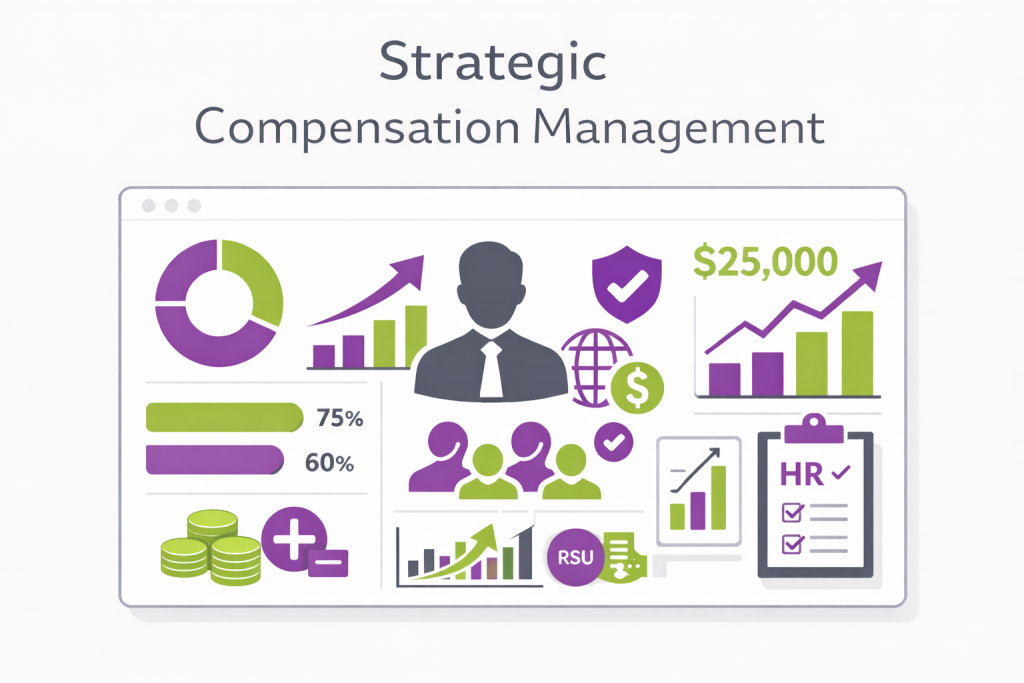
Strategic compensation management is the deliberate design and ongoing governance of how an organization pays its people, aligned to business objectives, talent priorities, and market realities.
It is distinct from traditional compensation administration, which focuses on processing payroll, maintaining pay scales, and ensuring compliance. Strategic compensation goes further. It asks what behaviors the organization needs to drive, what talent it needs to attract and retain, and whether current pay programs are actually delivering those outcomes.
The difference shows up in how decisions get made. Traditional compensation is reactive, adjusting pay when problems arise. Strategic compensation is proactive, building structures that support performance, equity, and growth before issues surface.
This approach requires collaboration across HR, Finance, and senior leadership. HR brings market intelligence and people data. Finance brings budget discipline and forecasting capability. Leadership brings the business context that determines what the compensation strategy ultimately needs to achieve.
When these functions align around a shared pay philosophy, compensation becomes more than a cost to manage. It becomes a lever for competitive advantage.
Also read: Components of Compensation: A Complete Breakdown for Employers
The Strategic Compensation Framework
A compensation strategy is only as strong as the structure underneath it. The framework below outlines the six pillars that define how leading organizations design and manage pay.
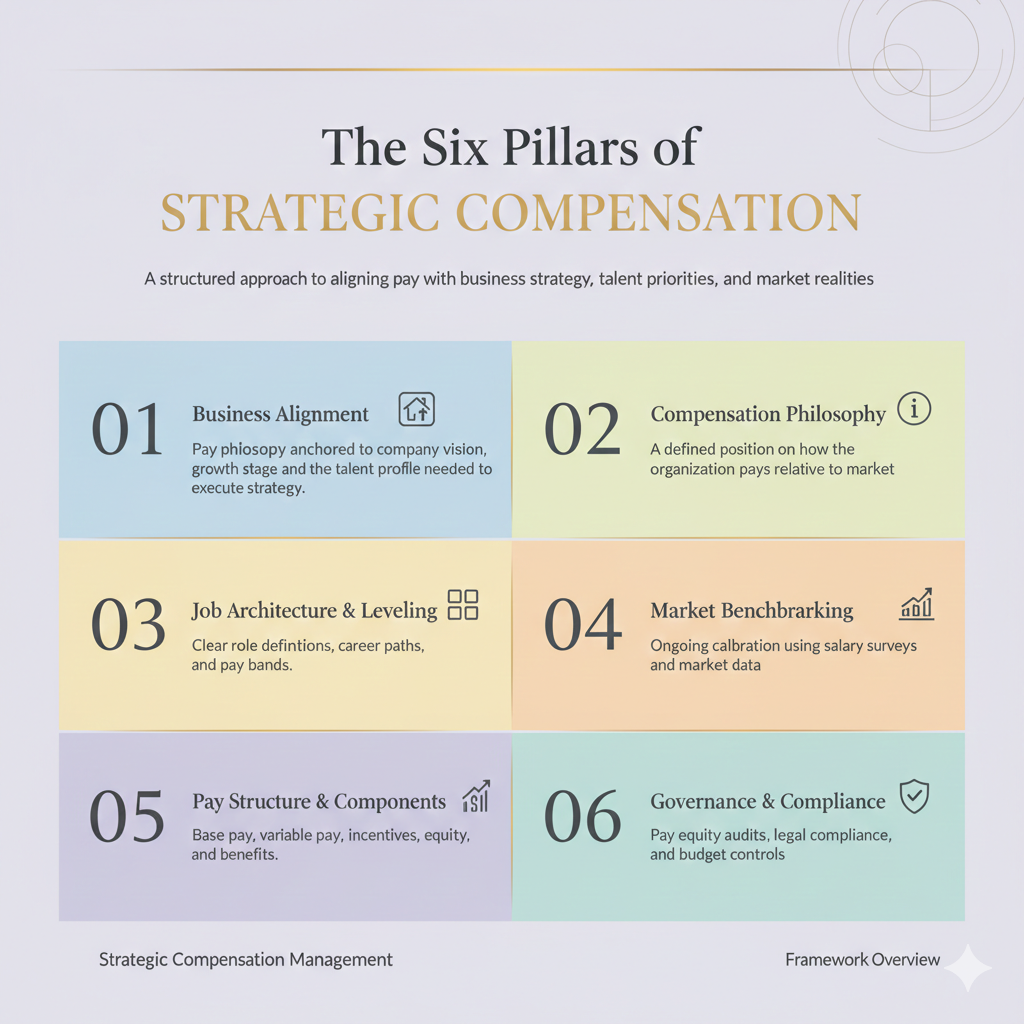
Business Alignment
Every compensation decision should trace back to business strategy. A high-growth company competing for scarce technical talent will pay differently than a mature organization focused on cost efficiency. Pay philosophy must reflect the company’s stage, priorities, and the talent profile it needs to execute its goals.
Compensation Philosophy
This is the organization’s stated position on pay. It determines whether the company leads, matches, or lags the market, and how it balances internal equity with external competitiveness. Without a defined philosophy, pay decisions become inconsistent and difficult to defend.
Job Architecture and Leveling
Clear role definitions, leveling structures, and career paths are the foundation of a fair and functional pay system. They also determine pay transparency readiness. 33% of companies acknowledge their pay programs are simply not ready for pay transparency, often because job architecture has not kept pace with organizational growth.
Market Benchmarking
Compensation must be calibrated against real market data. This means leveraging salary surveys, third-party benchmarking tools, and geographic adjustments to ensure pay remains competitive across roles, levels, and locations.
Pay Structures and Components
A complete compensation program spans base pay, variable pay, incentives, equity, and benefits. How these components are weighted signals what the organization values, and what behaviors it is trying to drive.
Governance and Compliance
Pay equity audits, legal compliance, and budget controls are not optional. 57% of organizations now have pay equity analysis as a current or planned initiative, up from just 38% in 2020. Governance ensures that compensation decisions are consistent, defensible, and aligned with regulatory requirements.
Also read: Guide to Compensation Management Systems
Strategic Compensation Models
No single compensation model fits every organization. The right approach depends on business strategy, workforce composition, and growth stage. Here are the five models most commonly deployed today.
- Market-Based Model: Pay is anchored to external market data. Roles are priced against benchmark surveys and competitive intelligence. This model works well for organizations that need to stay competitive in talent-dense markets, but it can undervalue unique internal roles that have no clean market equivalent.
- Performance-Based Model: Pay is tied to individual, team, or business outcomes through merit increases, bonuses, and incentive structures. This model drives accountability and differentiates high performers, but requires robust performance management infrastructure to work fairly and consistently.
- Skill-Based Model: Employees are compensated for the capabilities they develop, not just the role they hold. This model supports reskilling and internal mobility, making it increasingly relevant as organizations navigate rapid technological change and shrinking external talent pipelines.
- Total Rewards Model: Compensation is viewed holistically, combining monetary pay with non-monetary value such as flexibility, development, recognition, and wellbeing. This model strengthens the employee value proposition beyond what base salary alone can offer.
- Hybrid Model: Most modern enterprises combine elements of the above. A hybrid model offers the flexibility to reward market competitiveness, individual performance, and capability growth simultaneously. It requires more sophisticated governance but delivers the most nuanced and effective outcomes.
The right model is not static. As business priorities shift, compensation models should evolve with them.
Best Practices in Strategic Compensation Management
Effective compensation strategy is not set once and forgotten. It requires ongoing discipline, the right tools, and a commitment to making decisions based on evidence rather than intuition.
Data-Driven Decision Making
61% of professionals cite compensation as the number one factor when deciding whether to stay at a job. Despite this, many organizations still rely on outdated pay scales and gut instinct. When HR teams apply compensation analytics effectively, patterns emerge earlier, decisions become easier to explain, and pay actions connect more clearly to real business outcomes. Analytics also surfaces pay compression and equity risks before they become expensive problems.
Pay Transparency and Communication
Pay transparency is no longer optional in many markets. As of 2025, multiple U.S. states have implemented pay range disclosure requirements, and the EU Pay Transparency Directive further elevates expectations around documentation and decision logic globally. Beyond compliance, how organizations communicate pay philosophy to managers and employees directly affects trust and engagement.
Budget Optimization and Planning
Merit cycles, promotion budgets, and off-cycle adjustments need to be planned with scenario modeling, not managed reactively. Organizations that plan compensation budgets with forward-looking data avoid the compression and inequity that accumulate when pay decisions are made in isolation.
Technology-Enabled Compensation Planning
Spreadsheets create version control risks, slow down approvals, and obscure the full picture. Modern compensation platforms automate workflows, provide real-time market data, and give leaders the visibility they need to make faster, better-informed decisions.
Continuous Review and Adaptation
Annual compensation cycles are no longer sufficient in fast-moving talent markets. Leading organizations build in regular market recalibration, monitor pay equity continuously, and treat compensation as a living program rather than a fixed structure.
Also read: AI Compensation Agent: How Enterprises Are Automating Compensation Decisions
Common Challenges and How to Overcome Them
Even well-designed compensation strategies run into execution challenges. These are the most common, and what it takes to address them.
Pay Compression
When external hiring rates rise faster than internal pay adjustments, newer employees end up earning close to or equal to longer-tenured colleagues in more senior roles. Left unaddressed, this erodes morale and drives attrition among experienced talent. The fix requires regular market recalibration and a structured process for identifying and correcting compression before it compounds.
Bias in Performance-Linked Pay
Merit and bonus decisions are vulnerable to unconscious bias, particularly across gender, ethnicity, and tenure. Without structured calibration processes and pay equity audits, performance-based pay can reinforce existing disparities rather than reward genuine contribution.
Global Compensation Complexity
Managing pay across multiple geographies introduces currency risk, regulatory variation, and significant differences in market rates and benefits expectations. Organizations operating globally need localized benchmarking data and governance frameworks that can flex across markets without losing coherence.
Budget Constraints
Compensation budgets are rarely sufficient to address every gap at once. Prioritization frameworks, scenario modeling, and phased correction plans allow organizations to make meaningful progress within real financial constraints rather than deferring action indefinitely.
Data Fragmentation
When compensation data lives across disconnected systems, accurate analysis becomes difficult and slow. Consolidating data into a single source of truth is a prerequisite for the kind of real-time decision making that effective compensation management requires.
How AI Is Transforming Strategic Compensation
Artificial intelligence is moving compensation management from periodic and reactive to continuous and predictive. The shift is significant, and adoption is accelerating fast. According to SHRM research, 43% of organizations now use AI for HR tasks, up from 26% in 2024, with compensation planning among the fastest-growing use cases.
The impact shows up across four areas.
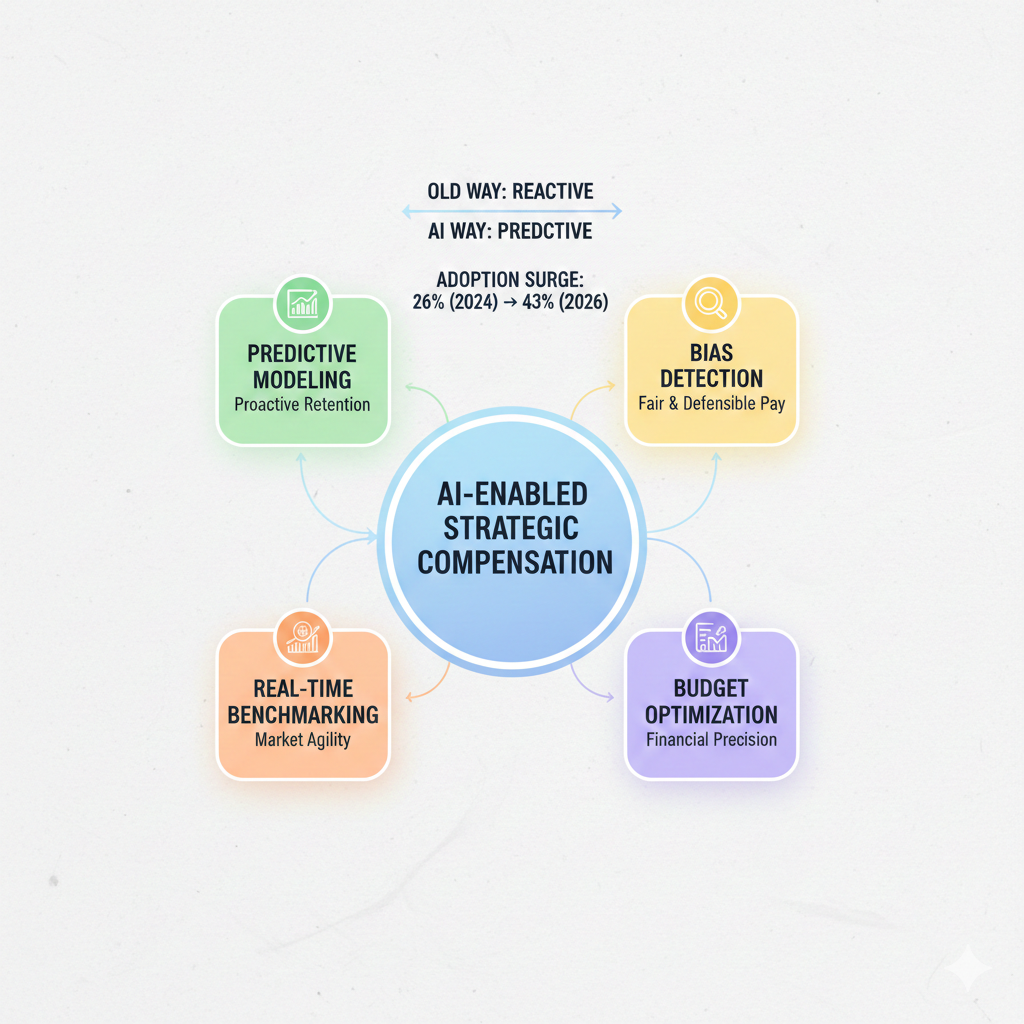
Predictive Compensation Modeling
AI can analyze workforce data, performance trends, and market signals to forecast where pay gaps will emerge before they surface as attrition. This gives leadership the ability to act proactively rather than respond after talent has already walked out the door.
Bias Detection
Traditional merit and bonus cycles carry the risk of compounding historical bias. AI-driven analysis flags pay disparities across gender, ethnicity, and tenure at a scale and speed that manual audits cannot match, enabling more consistent and defensible pay decisions.
Real-Time Market Benchmarking
Static annual salary surveys are giving way to live market data. Real-time benchmarking allows organizations to adjust pay structures dynamically as market conditions shift, rather than discovering they are out of position only at the next annual review cycle.
Budget Optimization
AI-powered scenario modeling allows compensation leaders to test the financial impact of merit increases, promotions, and structural adjustments before committing a budget, bringing a level of precision to planning that spreadsheets simply cannot deliver.
The organizations moving fastest on AI-enabled compensation are not just gaining efficiency. They are building a structural advantage in how they attract, retain, and reward talent.
Conclusion
Compensation has always mattered. What has changed is the sophistication required to manage it well.
Organizations that treat pay as a strategic function, built on clear philosophy, rigorous market data, and continuous review, are better positioned to attract the talent they need, retain the people they have, and drive the performance outcomes their business demands. Those that continue to manage it reactively will feel the cost, in turnover, inequity, and lost competitive ground.
The framework, models, and practices covered in this guide are not theoretical. They reflect how leading organizations are approaching compensation right now, and the direction the discipline is heading as AI and pay transparency reshape expectations from all directions.
The question for senior leaders is not whether to build a more strategic approach to compensation. It is how quickly they can close the gap between where their program is today and where it needs to be.
That starts with an honest assessment of current maturity, a clear philosophy aligned to business strategy, and the right tools to execute with consistency and confidence.
FAQs
What is the difference between compensation management and strategic compensation management?
Traditional compensation management focuses on administering pay, processing payroll, and maintaining compliance. Strategic compensation management goes further by aligning pay decisions to business objectives, talent priorities, and market positioning. It treats compensation as a driver of performance and retention, not just an operational cost.
How often should a compensation strategy be reviewed?
At minimum, annually. However, leading organizations build in continuous monitoring, particularly for market benchmarking and pay equity. In fast-moving talent markets, waiting for an annual cycle to identify and correct pay gaps is often too slow.
What is the first step in building a strategic compensation framework?
Define a compensation philosophy. Before benchmarking data or pay structures can be built effectively, the organization needs a clear, agreed-upon position on how it wants to pay relative to the market, what it values in its workforce, and what behaviors it is trying to drive through compensation.
How does AI improve compensation decision making?
AI brings speed, scale, and objectivity to compensation planning. It can detect pay equity issues across large workforces, model budget scenarios in real time, and provide continuous market benchmarking that static annual surveys cannot match. The result is faster, more defensible, and more consistent pay decisions.