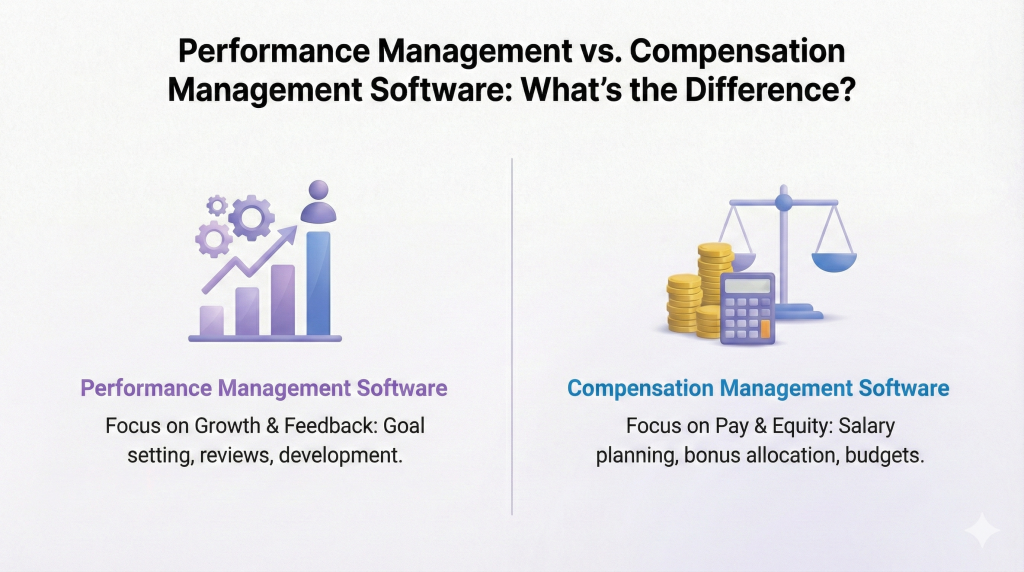
Performance management software and compensation management software solve different problems, even though they’re often mentioned in the same breath. One tracks how employees perform. The other determines what they get paid.
The confusion makes sense. Both systems touch employee data, both involve HR, and both come up during annual review cycles. But assuming one can do the other’s job leads to gaps in your talent strategy. This guide breaks down what each system does, where they overlap, and how to decide what your organization actually needs.
What Is Compensation Management Software
Compensation management software handles the financial side of people management. It focuses on planning, executing, and auditing pay decisions across your organization. Performance management tools, on the other hand, track how employees work and develop over time. The two serve distinct purposes, though they often share data during annual cycles.
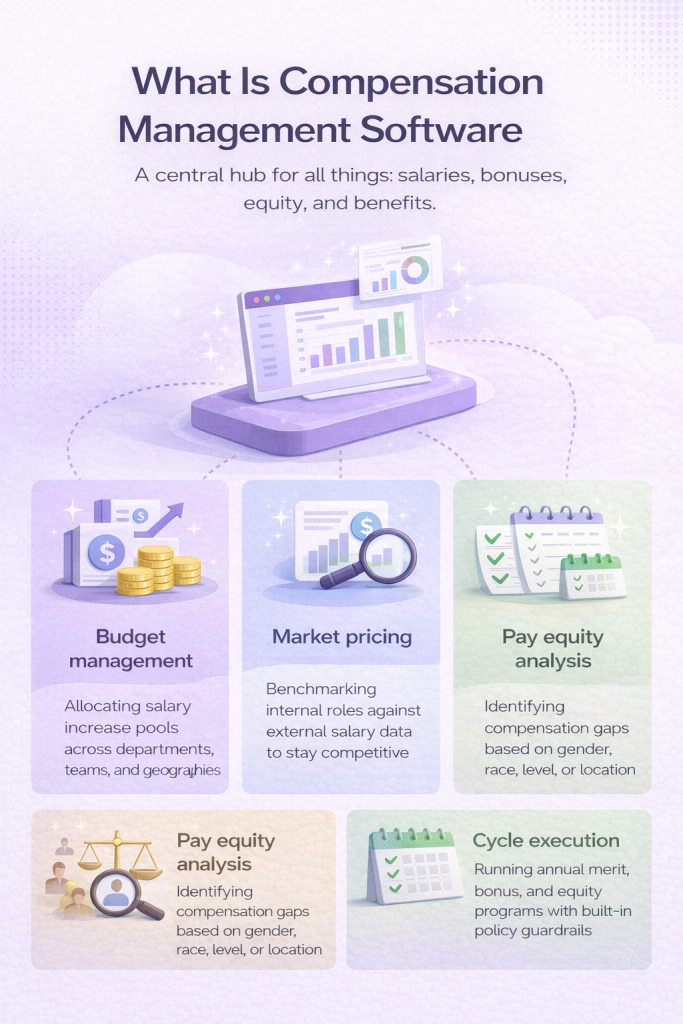
At its core, compensation management software centralizes everything related to pay: base salaries, bonuses, equity grants, and benefits. It replaces the spreadsheets and manual processes that typically slow down compensation cycles.
- Budget management: Allocating salary increase pools across departments, teams, and geographies
- Market pricing: Benchmarking internal roles against external salary data to stay competitive
- Pay equity analysis: Identifying compensation gaps based on gender, race, level, or location
- Compensation cycle execution: Running annual merit, bonus, and equity programs with built-in policy guardrails
Platforms like Stello AI take this further by using AI to generate recommendations that stay within budget while maintaining pay equity. What used to take weeks of manual analysis now happens in seconds.
What Is Performance Management Software
Performance management software tracks, evaluates, and develops employee contributions over time. It’s where goals get set, feedback gets documented, and reviews get conducted.
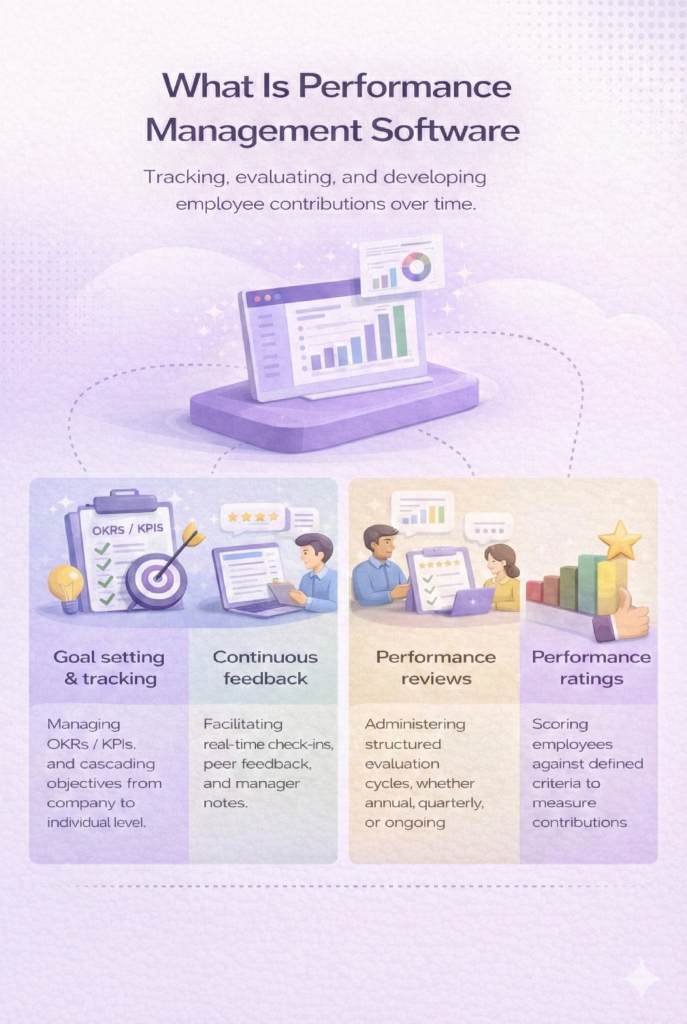
The primary function is aligning individual work with company objectives. Rather than managing pay, performance tools manage the ongoing conversation between managers and employees about expectations, progress, and growth.
- Goal setting and tracking: Managing OKRs (Objectives and Key Results), KPIs (Key Performance Indicators), and cascading objectives from company to individual level
- Continuous feedback: Facilitating real-time check-ins, peer feedback, and manager notes
- Performance reviews: Administering structured evaluation cycles, whether annual, quarterly, or ongoing
- Performance ratings: Scoring employees against defined criteria to measure contributions
Popular tools in this space include Lattice, 15Five, and PerformYard. They’re designed for daily use by managers and employees, not just HR teams during annual cycles.
Key Differences Between Performance and Compensation Management Software
Understanding where performance and compensation systems diverge helps you evaluate what your organization actually needs. Are you trying to solve a performance problem or a compensation problem? The answer shapes which tool deserves your attention first.
– Primary Purpose and Focus
Performance software measures and develops employee capabilities. It answers questions like: Is this person meeting their goals? Where do they need coaching?
Compensation software manages pay decisions and budgets. It answers: What’s the right salary for this role? How do we allocate our merit increase pool fairly?
– Core Features and Capabilities
The feature sets reflect different purposes entirely. Performance tools include goal libraries, review templates, and feedback workflows. Compensation tools include budget modeling, market data integration, and pay equity dashboards.
– Users and Stakeholders
Performance tools see daily use from managers and employees setting goals, giving feedback, and preparing for reviews. Compensation tools are primarily used by Total Rewards, HR, and Finance teams managing sensitive financial data and company-wide pay cycles.
– Data Inputs and Outputs
Performance software outputs ratings, goal achievement percentages, and qualitative feedback. Compensation software takes that performance data as an input, combines it with budget constraints and market benchmarks, then outputs concrete pay recommendations.
– Timing and Cycle
Performance management often runs continuously with weekly check-ins, quarterly reviews, and ongoing feedback. Compensation planning typically happens annually, with defined windows for merit increases, bonus calculations, and equity grants.
| Factor | Performance Management | Compensation Management |
|---|---|---|
| Primary purpose | Measure and develop performance | Plan and execute pay decisions |
| Core features | Goals, reviews, feedback, ratings | Budgets, market pricing, pay equity |
| Primary users | Managers, employees, HR | Total Rewards, Finance, HR |
| Data flow | Outputs performance ratings | Inputs ratings to generate pay recommendations |
| Cycle timing | Continuous or quarterly | Annual compensation cycle |
Where Performance and Compensation Management Overlap
While performance and compensation systems serve different purposes, they connect at several critical points. Understanding where data flows between them helps you build a cohesive talent management strategy.
– Merit Increase Recommendations
Performance ratings are a primary input for salary increase percentages. Compensation software ingests ratings and applies your merit matrix, automatically calculating increases based on rating, budget, and internal equity.
– Bonus and Incentive Calculations
Goal attainment and performance scores often determine bonus payouts. Compensation tools apply your bonus formulas to performance data, calculating individual awards while staying within budget.
– Employee Data and Records
Both systems pull from your HRIS (Human Resources Information System). Shared data includes job level, department, tenure, location, and compensation history. This integration ensures consistency and eliminates duplicate data entry.
How Performance Management and Compensation Work Together
Think of performance management as providing the “why” behind pay decisions. It offers the data-backed justification for rewarding employees. Compensation management provides the “how much,” executing decisions within budget and policy constraints.
The typical flow looks like this: performance review data moves from your performance tool into your compensation platform during annual planning. Managers see ratings alongside market data and internal benchmarks, then make informed recommendations.
Modern platforms like Stello integrate directly with performance management tools, automatically pulling ratings into compensation worksheets. This eliminates manual data transfers and ensures recommendations reflect the latest performance data.
What Is Pay-for-Performance Compensation
Pay-for-performance ties financial rewards directly to measured outcomes. It makes the connection between contribution and compensation explicit. High performers earn more than average performers.
Common pay-for-performance elements include:
- Merit increases: Base salary adjustments tied to annual performance ratings
- Variable bonuses: Payouts based on individual, team, or company goal achievement
- Spot awards: Immediate bonuses recognizing specific achievements
- Long-term incentives: Equity grants linked to sustained high performance
This approach works best when performance measurement is objective, transparent, and consistently applied. Without those foundations, pay-for-performance can create more problems than it solves.
The Impact of Incentives on Employee Performance
Financial incentives can motivate certain behaviors, but the design matters as much as the incentive itself.
Well-designed programs tap into extrinsic motivation, driving goal-oriented behavior and rewarding results. However, poorly designed incentives can backfire. They might encourage gaming metrics, discourage collaboration, or undermine intrinsic motivation, which is the internal drive to do good work for its own sake.
The key is balance. Reward results without discouraging creativity, teamwork, or long-term thinking. This usually means combining financial incentives with non-financial recognition and clear career development paths.
Benefits of Linking Performance Management and Compensation
When done well, integrating performance and compensation systems creates meaningful organizational benefits.
Aligns Pay with Business Outcomes
Financial rewards flow to employees driving results. This reinforces a performance culture where contributions matter.
Reinforces Accountability Across Teams
A clear connection between performance and pay creates ownership. People understand that their work directly affects their compensation.
Increases Transparency in Pay Decisions
Employees understand why they received a specific raise when it’s tied to documented performance. This reduces perceptions of favoritism.
Improves Employee Motivation and Retention
Fair, performance-based pay helps retain top performers. When high achievers see their contributions recognized financially, they’re more likely to stay.
Risks of Tying Compensation to Performance Management
The integration isn’t without challenges. Understanding potential pitfalls helps you design a more effective approach.
Undermines Intrinsic Motivation
Over-reliance on financial rewards can diminish internal drive. Employees may focus on the reward rather than the work itself.
Creates Unintended Behavioral Incentives
People optimize for what’s measured. If your metrics don’t capture everything that matters, employees might ignore important but unmeasured work like mentoring or cross-team collaboration.
Increases Complexity for Managers
Managers who know ratings affect pay may inflate scores to avoid difficult conversations. This undermines the integrity of your performance data.
Introduces Potential Bias in Ratings
Subjective reviews can perpetuate unconscious bias. When biased ratings flow into compensation decisions, they create or worsen pay inequities.
Tip: Regular pay equity audits help catch bias that creeps into performance-linked compensation. Platforms like Stello include pay equity analysis directly in budget modeling, flagging potential issues before they become systemic.
Factors to Consider Before Integrating Performance Compensation Management Systems
If you’re evaluating this integration, consider a few practical criteria first.
What Behaviors You Want to Motivate
Define the outcomes, skills, and behaviors you want to incentivize. Individual sales? Team collaboration? Innovation? Your answer shapes how tightly you link performance to pay.
How You Will Determine Pay Increases and Bonuses
Establish clear rules for how ratings translate to recommendations. What rating corresponds to what percentage increase? Document this in a merit matrix that’s consistently applied.
What Data Integrations You Need
Identify all systems that connect: HRIS, performance tool, compensation platform, equity management software. Seamless data flow eliminates manual work and reduces errors.
How You Will Communicate the Connection to Employees
Transparency is critical. Develop a communication plan ensuring every employee understands how performance affects pay and that the process is fair.
How AI Is Transforming Compensation and Performance Management
AI is reducing manual work and improving decision quality in both domains.
Automated Recommendations and Scenario Modeling
AI generates initial pay recommendations based on performance data, budget constraints, and market benchmarks. Stello’s intelligent recommendations stay in-policy automatically, letting leaders model different scenarios and see budget impacts instantly.
Real-Time Pay Equity Analysis
AI continuously monitors for pay gaps across demographics like gender, level, location, and department. It flags issues before they become systemic.
Intelligent Data Integration Across Systems
AI-powered platforms connect to HRIS, performance tools, and market data sources in seconds. Stello’s trusted integrations include out-of-the-box connections to performance management tools, equity systems, and Excel files.
How to Choose the Right Performance Compensation Software
Most organizations benefit from both types of software, connected through robust integrations. When choosing, consider:
- Define your primary problem: Are you solving for performance tracking first, or is complex compensation planning more urgent?
- Evaluate integration capabilities: Ensure systems share data seamlessly with your existing HR tech stack
- Consider your compensation complexity: Global operations, multiple bonus plans, and equity programs (RSUs, Options, NQs, ISOs) require specialized compensation tools
- Assess AI and automation features: Modern platforms reduce manual cycle administration and provide data-driven insights
For organizations focused on streamlining compensation planning, Stello AI centralizes budgets, market pricing, and pay recommendations in one intelligent platform. It supports startups up to 250 employees through enterprises with 5,000+ employees.
FAQs About Compensation and Performance Management Software
1. What are the three types of performance management systems?
The three common types are traditional annual review systems, continuous feedback systems, and objectives-based systems like OKRs. They vary in frequency, structure, and how ratings are generated.
2. Can compensation management software work without a performance management system?
Yes. Compensation software can operate independently using market data, internal equity analysis, and budget constraints. However, integrating performance data enables more nuanced, merit-based decisions.
3. How do compensation and performance systems share employee data?
Compensation and performance systems typically integrate through HRIS connections or direct APIs, sharing performance ratings, job levels, and compensation history. Modern platforms like Stello offer out-of-the-box integrations with leading performance management tools.
4. What is the difference between compensation planning and compensation management?
Compensation planning refers to the specific, often annual, cycle of setting budgets and making pay decisions. Compensation management is the broader, ongoing administration of all pay programs, policies, and structures.