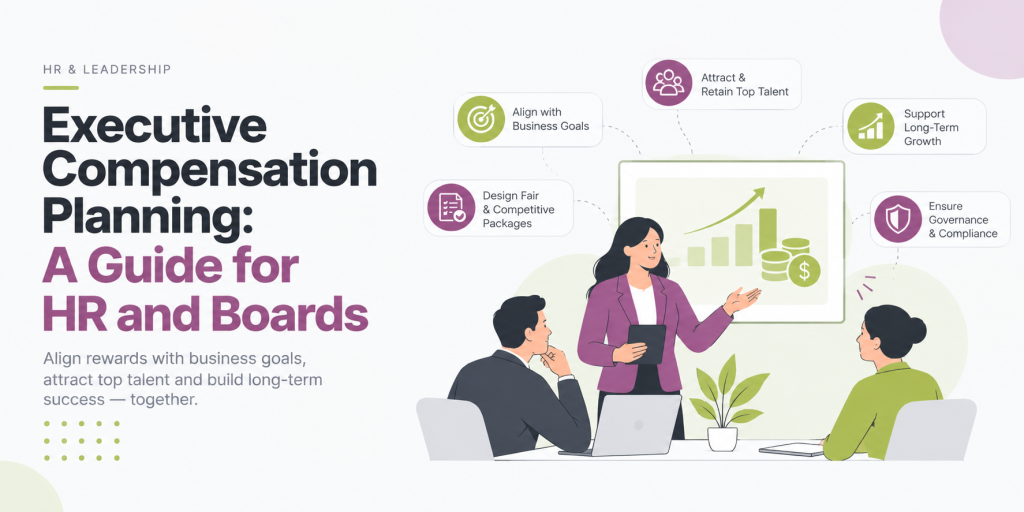
Executive compensation planning is the yearly process of setting pay for a company’s senior leaders, including base salary, annual bonus, long-term incentives and benefits. HR prepares the data and recommendations, and the board’s compensation committee approves the final packages. A good plan ties most executive pay to performance, stays competitive with a defined peer group, and can be explained clearly to shareholders and employees.
What Executive Compensation Includes
Executive pay has more moving parts than pay for the rest of the workforce. Most packages include five elements.
| Element | What it is | Typical purpose |
| Base salary | Fixed annual pay | Attract and retain; reflects role size |
| Annual incentive | Cash bonus tied to yearly goals | Rewards short-term results |
| Long-term incentives | Equity such as RSUs, stock options or performance shares, usually vesting over three to four years | Ties pay to shareholder value and retention |
| Benefits and perquisites | Retirement plans, deferred compensation, insurance, car or travel allowances | Rounds out the package |
| Severance and change-in-control terms | Pay if the executive leaves or the company is sold | Protects both sides in a transition |
For most senior executives, the variable parts are larger than base salary. The Conference Board’s 2027 survey found a median executive incentive target of 40% of base pay, and 100% of base pay for CEOs. Long-term incentives often add more than both.
Who Is Involved in Executive Compensation Planning
The compensation committee makes the decisions. At US public companies, stock exchange rules require this committee to be made up of independent directors.
HR and the total rewards team gather market data, model pay options, prepare committee materials and run the process each year.
An independent compensation consultant often advises the committee on market practice and peer group data.
The CEO usually recommends pay for the executives who report to them, but doesn’t take part in decisions about their own pay.
Shareholders have a say at public companies. Under the Dodd-Frank Act, public companies must hold a nonbinding “say-on-pay” shareholder vote on executive pay at least once every three years.
How to Plan Executive Compensation, Step by Step
1. Define your compensation philosophy
Decide what you want executive pay to achieve and where you want to position it against the market. Most companies target the median of their peer group for base salary, with the chance to earn above the median through strong performance.
2. Build a peer group
A peer group is a list of similar companies used to benchmark pay. Most include companies of similar size, industry and complexity, often 12 to 20 of them. Review it every year as your company grows or the market changes.
3. Benchmark each role
Compare each executive’s pay with peer group data and executive salary surveys, element by element. Look at base salary, target bonus, long-term incentive value and total direct compensation.
4. Set the pay mix
Decide how much of each executive’s pay is fixed and how much is at risk. A CEO’s package might be 15% to 25% base salary, with the rest in bonus and equity. Executives one level down usually have a higher share of fixed pay.
5. Design incentive plans
Choose the metrics, targets and payout ranges for the annual bonus and long-term incentives. Common annual metrics include revenue, operating profit and strategic goals. Long-term plans often use total shareholder return or earnings growth over three years.
6. Model the cost and outcomes
Before the committee approves anything, model what each plan pays out at threshold, target and maximum performance, and what it costs the company. Check how outcomes compare with peers if results are strong or weak.
7. Approve, communicate and disclose
The committee approves final pay. Public companies explain their decisions in the Compensation Discussion and Analysis (CD&A) section of the annual proxy statement.
The Executive Compensation Planning Calendar
Most companies follow a yearly rhythm tied to the fiscal year. For a calendar-year company:
| Timing | Activity |
| Q3 | Review peer group and compensation philosophy |
| Q4 | Benchmark roles, model next year’s pay and incentive plan design |
| Q1 | Certify last year’s incentive results, approve bonus payouts, base salary changes and equity grants |
| Q2 | Proxy disclosure and shareholder say-on-pay vote (public companies) |
Governance Rules to Know
US public companies face several rules that shape executive compensation planning:
- Say-on-pay votes let shareholders give a nonbinding vote on executive pay.
- Clawback policies have been required for companies listed on US exchanges since late 2023. They must recover incentive pay that was based on financial results later restated.
- Pay versus performance disclosure requires public companies to show how executive pay relates to company results.
- The $1 million deduction limit under Section 162(m) stops public companies from deducting pay above $1 million a year for certain senior executives.
Private companies aren’t bound by most of these rules. Many still follow similar practices, especially if they plan to go public or have outside investors.
Common Mistakes in Executive Compensation Planning
- Choosing a peer group of much larger companies, which pushes pay up
- Setting incentive targets that are too easy to reach
- Granting equity without modeling dilution or future cost
- Treating executive pay as separate from the rest of the workforce, which makes pay gaps harder to explain
- Running the process in spreadsheets with no record of who changed what
Where Software Helps
Executive pay is the most sensitive data a company holds, and the plans are often the most complex. Stello AI handles complex equity programs, including RSUs, stock options, ISOs, NQs, profit sharing and vesting schedules, alongside base pay and bonuses with performance multipliers. Role-based access keeps executive pay visible only to the people who should see it, and audit logs record every change and who made it.
HR teams can use Iconic, Stello AI’s AI compensation agent, to model scenarios before committee meetings, such as how different bonus targets or equity grants change total cost. See how Stello AI handles complex compensation plans.
Frequently Asked Questions
What is executive compensation planning?
Executive compensation planning is the yearly process of setting pay for senior leaders. It covers base salary, annual bonus, long-term incentives and benefits, and is approved by the board’s compensation committee.
Who decides executive compensation?
The board’s compensation committee makes the final decisions, usually based on recommendations from HR, the CEO and an independent compensation consultant. At public companies, shareholders also have an advisory say-on-pay vote.
How is executive pay benchmarked?
Companies compare each executive’s pay with a peer group of similar companies, plus executive salary surveys. They compare base salary, target bonus, long-term incentives and total pay.
What is a typical pay mix for a CEO?
Most US CEO packages are weighted heavily toward variable pay. Base salary is often a small share of total pay, with annual bonus and equity making up the rest.
Do private companies need an executive compensation plan?
They’re not bound by public company disclosure rules, but a clear plan still helps attract and keep leaders, and prepares the company for investors or an IPO.