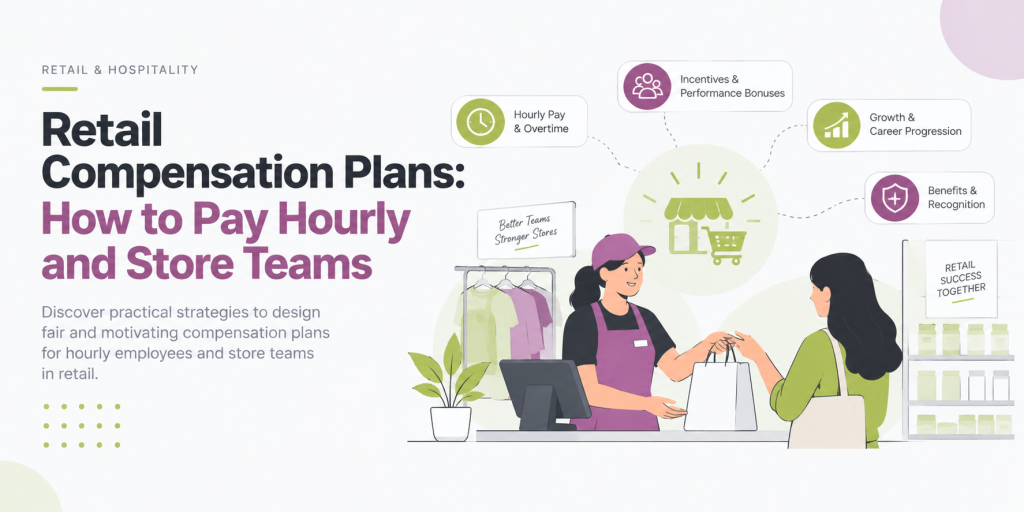
A retail compensation plan sets how a retailer pays its store teams. That usually means competitive hourly rates for associates, premiums for nights, weekends and overtime, and bonuses tied to store results.
Store managers usually get a salary plus a bonus based on sales, profit and shrink. The best retail compensation plans are simple enough for associates to understand and flexible enough to vary by location.
Why Retail Compensation Is Different
Retail pay works differently from pay at an office-based company:
- Most store employees are paid by the hour, not on a salary.
- Turnover is high, so starting pay matters a lot for hiring.
- Pay has to follow local minimum wage laws, which vary by state and city.
- Many employees work part-time or variable schedules.
- Store results, such as sales and shrink, are easy to measure, which makes team bonuses practical.
Retail also tends to have tighter budgets. Mercer’s 2027 survey puts retail merit budgets at 3.0%, among the lowest of any industry.
What Retail Workers Earn
National pay for the most common store roles is well below the all-jobs average. According to Bureau of Labor Statistics data for May 2025, retail salespersons earn an annual mean wage of $37,310, and cashiers $33,180. The mean for all US jobs is $69,770.
That gap explains why retailers compete hard on starting pay and why small differences in hourly rates can decide where people apply.
The Building Blocks of a Retail Compensation Plan
Base hourly pay
The hourly rate is the core of any retail pay plan. Set it from local market data for each role and location, not just the legal minimum. The federal minimum wage is still $7.25 an hour, but most large retailers pay well above it, and many states and cities set higher minimums.
Pay ranges by role and location
Give each role a pay range, such as associate, key holder, assistant manager and store manager. Then adjust by location. A cashier in San Francisco and a cashier in rural Texas shouldn’t be on the same rate.
Shift premiums
Many retailers add a premium for overnight shifts, weekends, holidays or hard-to-fill locations. A flat amount per hour, such as $1 or $2, is easier to explain than a percentage.
Overtime
Under the Fair Labor Standards Act, nonexempt employees must be paid 1.5 times their regular rate for hours over 40 in a workweek. Some states have stricter rules, such as daily overtime.
Commissions and spiffs
In stores that sell high-value products, such as electronics, furniture, cars or jewelry, associates often earn commission on sales or small one-off rewards, called spiffs, for selling specific products.
Store bonuses
Team bonuses reward the whole store for hitting targets. Common measures include sales against plan, shrink, customer satisfaction scores and labor cost. Quarterly bonuses keep the reward close to the work.
Store manager pay
Store managers are usually salaried, with an annual or quarterly bonus tied to store sales, profit and shrink. District and regional managers have similar plans based on the stores they oversee.
Example Retail Compensation Plan
| Role | Base pay | Variable pay |
| Sales associate | Hourly rate set by location | Quarterly store bonus, shift premiums |
| Key holder / shift lead | Hourly rate plus $1.50/hour lead premium | Quarterly store bonus |
| Assistant store manager | Hourly or salary, depending on duties | Quarterly bonus on sales and shrink |
| Store manager | Salary | Annual and quarterly bonus on sales, profit and shrink |
| District manager | Salary | Annual bonus on district results |
An illustration. Actual pay depends on your market, budget and the laws where you operate.
Rules That Shape Retail Pay
- Minimum wage laws vary by state and city, and many rise every January.
- Predictive scheduling laws in Oregon and in cities including New York City, San Francisco, Seattle and Chicago require advance notice of schedules for certain retail and food service workers, and extra pay for last-minute changes.
- Pay transparency laws in more than a dozen states require pay ranges in job postings, which includes store jobs.
- Exempt vs nonexempt classification decides who gets overtime. Assistant managers are a common risk area, because duties matter more than job title.
How to Keep Retail Compensation Plans Simple
Associates are more likely to stay when they understand how their pay works. A few rules help:
- Use as few bonus measures as possible, ideally two or three.
- Pay bonuses quarterly or monthly, so the link to results is clear.
- Show hourly employees their pay as an hourly rate, with the annual equivalent alongside.
- Publish pay ranges internally, so people know what the next role pays.
- Review pay rates at least once a year, and before each minimum wage increase.
How Stello AI Supports Retail Compensation Plans
Retailers often run thousands of hourly employees, many locations and several bonus plans at once. Stello AI is built for that kind of complexity:
- Quarterly bonus cycles can pay different plans to different employee groups, with company and individual factors and multipliers.
- Salary ranges can be kept by job family and, in the US, by geographic zone.
- Eligibility rules can include or exclude employees by type, hire date, department or job title.
- Bonus accruals are calculated monthly, with proration for new hires and automatic removal when someone leaves.
- Hourly employees get statements that show their hourly rate alongside the annual equivalent.
See how Stello AI handles complex pay plans.
Frequently Asked Questions
What is a retail compensation plan?
A retail compensation plan sets how a retailer pays its store employees. It covers hourly rates, pay ranges by role and location, premiums, overtime, commissions and bonuses.
How are retail store managers paid?
Most store managers earn a salary plus a bonus tied to store sales, profit and shrink. Bonuses are often paid quarterly or annually.
Should retail associates get bonuses?
Many retailers pay team bonuses based on store results such as sales, shrink and customer scores. Quarterly payouts help associates see the link between their work and the reward.
How do retailers set hourly pay rates?
They use local market data for each role and location, then check against minimum wage laws. Many set pay ranges by role, with location adjustments.
Do retail employees get overtime?
Nonexempt retail employees must be paid 1.5 times their regular rate for hours over 40 in a workweek, under federal law. Some states have stricter rules.