Compensation conversations get confusing fast, especially when HR, managers, and employees all use “raise,” “merit increase,” and “promotion” like they mean the same thing. They don’t. Each one has a different trigger, a different budget line, and a different message it sends to the employee.
Get the distinctions wrong and you end up with pay decisions that feel arbitrary, managers who can’t explain why one report got 3% and another got 8%, and employees who don’t understand what they’re actually being rewarded for. Here’s how to tell these three apart, and how to use each one the way it’s meant to be used.
TL;DR
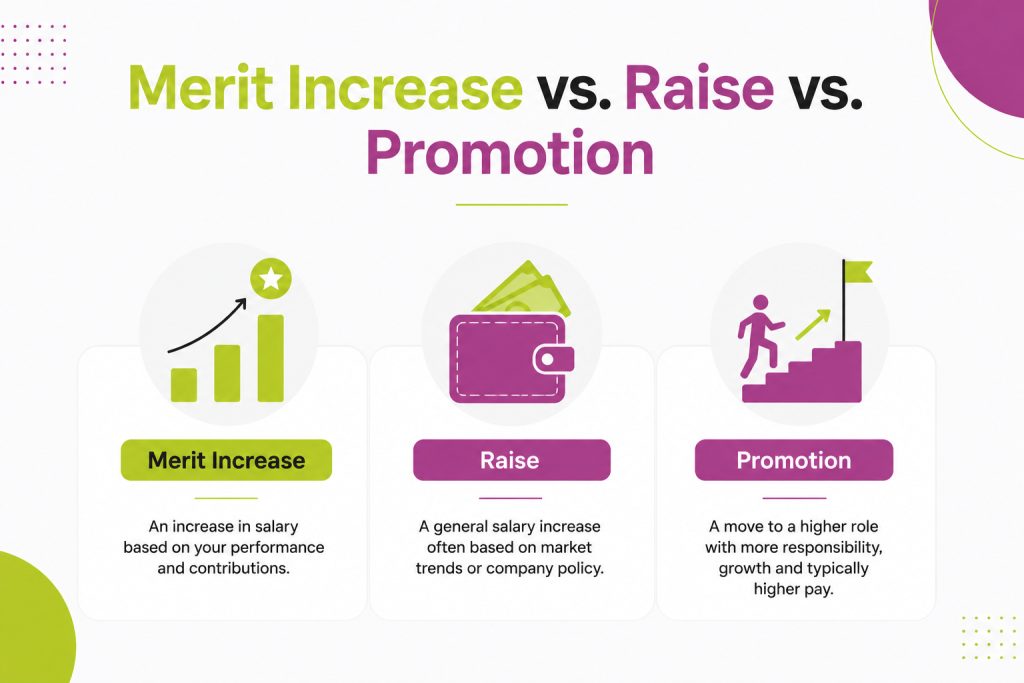
- Merit increase: tied to performance in an employee’s current role, awarded during the annual review cycle, typically 2-6% of base pay.
- Raise is the umbrella term for any base pay increase. The more useful category is an off-cycle raise, or market adjustment, which happens any time to fix a market gap, retention risk, or pay equity issue, typically 5-15%.
- Promotion: pay increase tied to a change in role, level, or title, not just performance in the old job. Typically 8-20%+, funded from a separate promotion budget.
- Mixing these budgets causes problems: promotions draining the merit pool, or market corrections being read as performance judgments.
- Keeping the three categories distinct makes compensation planning easier to audit and easier for managers to explain to employees.
What is a Merit Increase?
A merit increase is a pay bump tied directly to performance in the employee’s current role. It rewards someone for doing their existing job well, not for taking on a new one.
Merit increases are usually:
- Awarded annually, often during a performance review cycle
- Funded from a merit budget, a fixed percentage of total payroll set aside each year
- Distributed based on a rating scale, so a “meets expectations” employee might get 3% while a “significantly exceeds” employee gets 6%
- Applied as a percentage of base salary
The logic behind a merit increase is simple: pay should track performance over time so top performers don’t fall behind market rate just because they haven’t changed roles. It’s less about “you deserve more money” in the abstract and more about “your output this year justified this specific increase.”
Also read: HRIS vs HRMS: Which Do You Need?
What is a Raise?
“Raise” is the term most people reach for, but it’s really an umbrella word. Any increase to base pay is technically a raise, including merit increases, promotions, and market adjustments. When someone says “I got a raise,” they could mean any of these.
The more useful distinction is between a merit increase and what compensation teams call an off-cycle raise or market adjustment. This type of raise isn’t tied to the annual review calendar. It happens when:
- An employee’s pay has fallen behind market rate for their role and location
- A manager makes a retention counteroffer after the employee raises a competing offer
- A pay equity audit surfaces someone who’s underpaid relative to peers doing the same work
- Budget allows for a correction outside the normal cycle
The key difference from a merit increase: a market adjustment isn’t a verdict on performance. It’s a correction to bring pay in line with what the market or internal equity requires, regardless of how the employee’s last review went.
Also read: Pay Transparency Laws by State: What Changed for 2026
What is a Promotion?
A promotion is a change in role, level, or scope, and the pay increase that comes with it is secondary to that change. The person is being paid more because they’re now doing a different, typically bigger job, not because they did their old job especially well.
Promotion increases tend to be:
- Larger than merit increases, often 8 to 20%+ depending on the level jump
- Tied to a new job architecture band or salary range, not a percentage formula
- Paired with new title, responsibilities, and sometimes new reporting relationships
- Funded separately from the merit budget, often through a distinct promotion pool
A common mistake is trying to fund promotions out of the same pool as merit increases. When that happens, either the merit pool gets drained by a few big promotion jumps, or promotions get shortchanged because the budget was sized for smaller, performance-based bumps. Compensation teams that separate these budgets from the start avoid a lot of year-end scrambling.
Also read: Self-Service HRIS: Why Employee Self-Service Matters
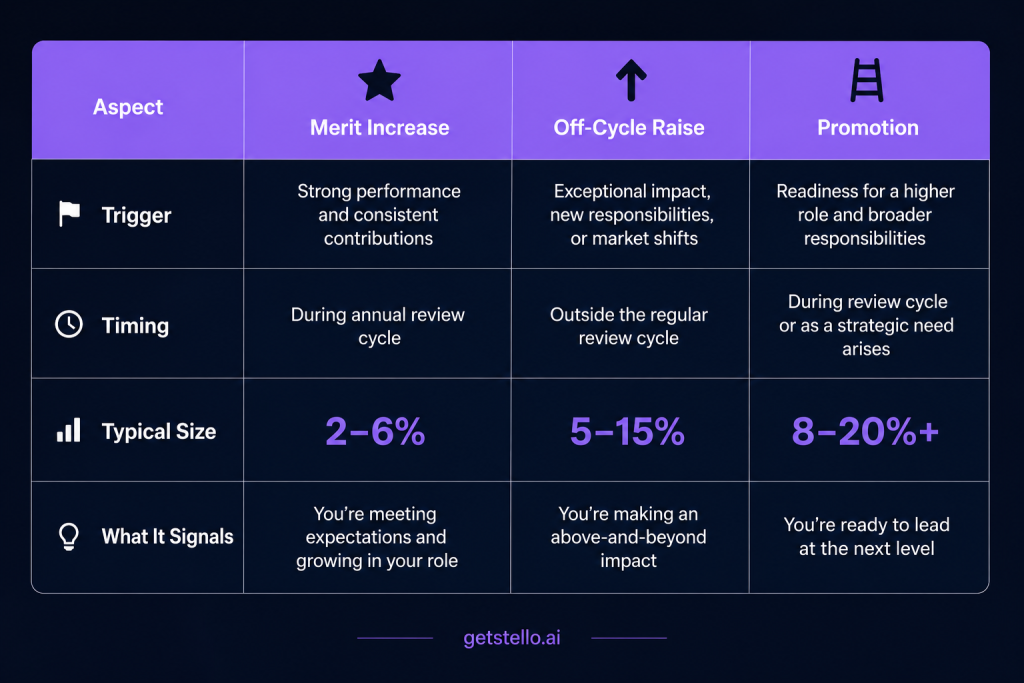
Merit Increase vs. Raise vs. Promotion: Side by Side
| Merit Increase | Off-Cycle Raise | Promotion | |
|---|---|---|---|
| Trigger | Annual performance rating | Market gap, retention risk, equity fix | Change in role or level |
| Timing | Fixed review cycle | Any time | Any time, often tied to org changes |
| Size | Typically 2-6% | Varies, often 5-15% | Typically 8-20%+ |
| Budget source | Merit pool | Off-cycle or retention budget | Promotion budget |
| What it signals | “You performed well in your current role” | “Your pay needed to catch up” | “You’re now doing a different job” |
Why This Distinction Matters for Compensation Planning
Mixing these up creates real problems. If managers treat every pay increase as a merit increase, they lose the ability to explain market adjustments without it looking like a performance judgment on everyone else. If promotions get funded from the merit pool, the whole team’s merit budget shrinks to cover a handful of role changes.
Clear categories also make compensation reviews easier to audit. When you can see exactly which increases were merit-driven, which were market corrections, and which were promotion-driven, you can check each category against its own logic. Did top performers actually get the highest merit increases? Are market adjustments closing real gaps? Are promotion increases consistent across similar level jumps?
None of that is possible if everything gets logged under one generic “raise” line.
Building Pay Increases Employees Actually Understand
The common thread across all three is transparency. Employees don’t need to know your exact compa-ratio formula, but they should understand why they got the increase they got. A merit increase should map to specific feedback from the review. A market adjustment should be explainable in terms of role and location benchmarks. A promotion increase should map to the new level’s salary range.
When compensation categories are clear internally, that clarity shows up in how managers talk to their teams, and that’s usually where trust in the pay process is won or lost.
FAQs-
Is a merit increase the same as a raise?
A merit increase is a type of raise, but not all raises are merit increases. A raise is the umbrella term for any bump to base pay. A merit increase is specifically tied to performance in the employee’s current role, usually during an annual review cycle.
What’s a typical merit increase percentage?
Most merit increases fall between 2% and 6%, depending on the employee’s performance rating and the company’s overall merit budget for that year. Top performers usually land at the higher end of that range.
Can you get a raise without a promotion?
Yes. Off-cycle raises and market adjustments happen without any change in title or role. They’re usually triggered by a pay gap versus market rate, a retention situation, or findings from a pay equity audit.
Why is my promotion increase bigger than my merit increase?
Promotion increases reflect a jump to a new role, level, or salary band, which is a bigger shift than an annual performance reward. That’s why promotion increases (often 8% to 20%+) are typically larger than merit increases (usually 2% to 6%).
Should merit increases and promotions come out of the same budget?
No. Compensation teams generally keep separate budgets for merit increases and promotions. Combining them makes it hard to fund either properly, since a few large promotion jumps can quickly drain a pool sized for smaller, performance-based increases.