Pay transparency laws keep expanding, and 2026 brought real changes, not just new states joining the list. If you hire across multiple states, this year’s updates affect how you write job postings, whether existing job postings are even legally sound anymore.
Here’s what actually changed, and what the current pay transparency laws require state by state.
No Federal Law, Still
Let’s start with what hasn’t changed. There is no federal law requiring salary range disclosure in job postings. A Salary Transparency Act was introduced in the House in 2023, which would require employers to disclose wage or wage ranges in public or internal job postings, but this bill remains pending.
The Equal Pay Act of 1963 prohibits wage discrimination based on sex, and the NLRA protects employees’ right to discuss wages with coworkers, but neither forces a company to publish a pay range. That job is left entirely to states, and increasingly, cities.
States That Require Salary Ranges in Job Postings
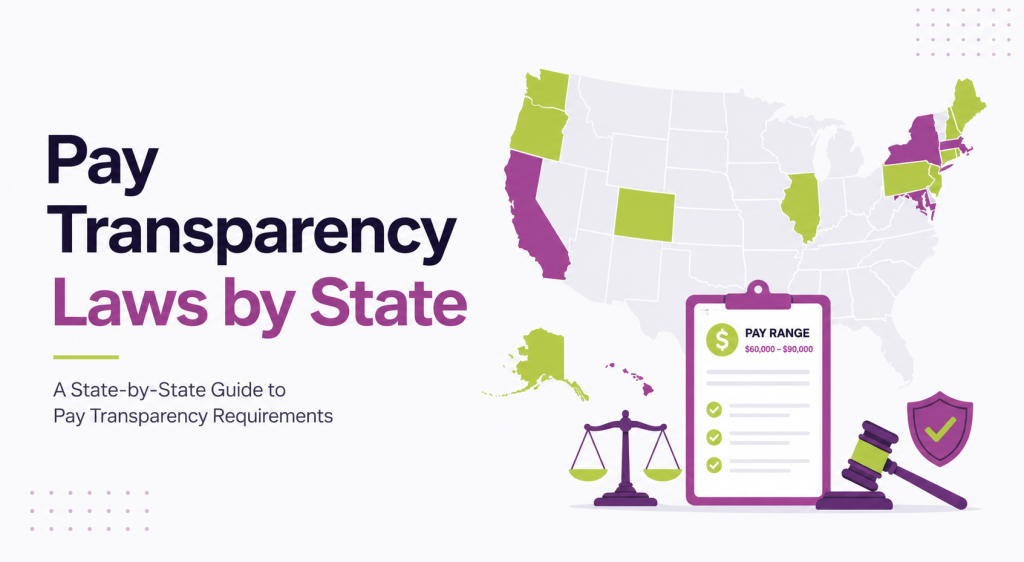
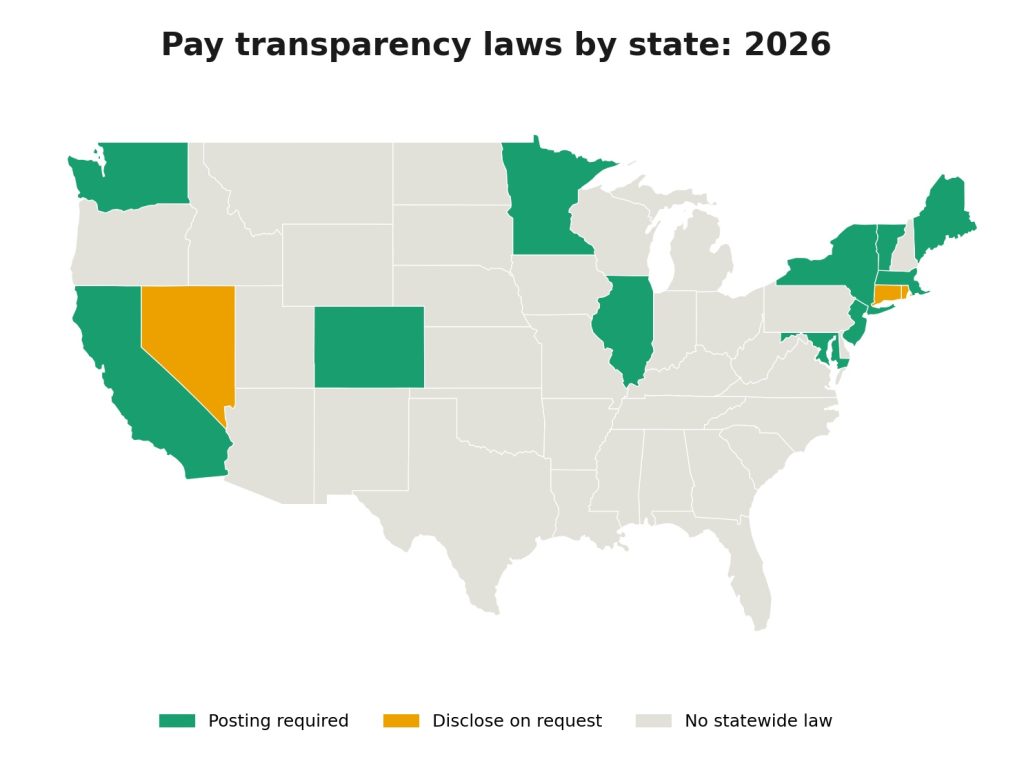
States requiring salary range disclosure in job postings as of 2026 include California, Colorado, Hawaii, Illinois, Maine, Maryland, Massachusetts, Minnesota, New Jersey, New York, Vermont, and Washington. Connecticut, Nevada, and Rhode Island require disclosure upon request. Washington D.C. also requires salary range disclosure.
Coverage thresholds vary widely. Vermont applies to employers with 5 or more employees, the lowest threshold among states requiring job posting disclosure, while other states set the bar at 10, 15, or 25 employees depending on jurisdiction. Penalties range from $100 to $250,000 per violation depending on the jurisdiction.
Remote roles complicate things further. Remote job postings are subject to pay transparency laws in most states where the work could be performed, meaning multi-state and remote-first employers may need to comply with the strictest applicable law across all hiring locations. If you post a fully remote role that a Colorado resident could take, Colorado’s rules likely apply even if your company has zero physical presence there.
What’s New for 2026
Three things actually shifted this year, separate from states simply joining the list.
California tightened its definition of “pay scale.” SB 642, known as the Pay Equity Enforcement Act, significantly amends California’s Equal Pay and Pay Transparency laws by broadening key definitions, extending the statute of limitations to three years, and specifying categories of unlawful practices under the act. SB 642’s amendments went into effect on January 1, 2026.
Before this, “pay scale” meant a general range for the position. Now the amended definition requires a “good faith estimate” of the salary or wage range “upon hire,” meaning the date the hired applicant actually starts work, not what the company might pay for the role generally over time. In practice, this closes a loophole where employers posted deliberately wide ranges to check a compliance box. A broad $50,000 to $200,000 range for a single role would likely fail a good faith test under the new standard, even though California hasn’t set a hard numeric limit.
SB 642 also widened what counts as pay in the first place. The bill expands the definition of “wages” to include nearly all forms of compensation, such as bonuses, equity, benefits, allowances and reimbursements, increasing exposure in pay equity claims.
Massachusetts moved from rollout to enforcement. The Massachusetts Pay Transparency law took effect October 29, 2025, and employers with more than 25 employees in the state must now disclose salary ranges. The reporting side is now live too. Employers with more than 100 employees in Massachusetts must submit annually their most recently filed federal EEO-1 reflecting Massachusetts employees, with the report due to the Secretary of the Commonwealth no later than February 1, 2026.
There’s a grace period worth knowing about. Until October 29, 2027, covered employers will have two business days to correct any violation upon receiving a notice to cure from the Attorney General’s Office. If the defect is cured within that timeframe, no penalty results. The Attorney General enforces the law exclusively, and there is no private right of action. First offenses draw a warning, second offenses a fine of not more than $500.
Maine’s law took effect January 1, 2026. Maine’s pay transparency law applies to employers with 10 or more employees and requires them to include the pay range for a position in all job postings, whether posted directly or through a third party. The pay range may be based on any applicable pay scale, a budgeted amount for the position, a previously determined range, or the actual wages of current employees in the same position.
Delaware is next in line, but not yet. Delaware enacted a pay transparency law, signed September 2025, requiring employers with 25 or more employees to include a good-faith pay range in job postings. The law takes effect September 26, 2027. Worth flagging on your compliance calendar now, since template and workflow updates take longer than most teams expect.
Other Notable State Details
A few states have rules that go beyond posted ranges:
New Jersey prohibits companies from using an applicant’s salary history as a reference for a job offer and bars retaliation against employees for discussing wages, with penalties from $1,000 to $10,000 per violation. New Jersey’s pay transparency law took effect June 1, 2025, and applies to employers with 10 or more employees.
Vermont’s law took effect July 1, 2025, applies to employers with 5 or more employees, requires the compensation range in all job advertisements, and also prohibits employers from asking about a candidate’s pay history or retaliating against employees for discussing wages.
Local ordinances add another layer. In Cincinnati, Ohio, employers with 15 or more employees must provide the pay range for a job upon request after a conditional offer and cannot ask about salary history, with job applicants able to sue for damages and legal fees.
The Multi-State Compliance Problem
If you hire in more than one state, patchwork compliance is the real headache, not any single state’s rules. Colorado, California, New York, Washington, Illinois, and Minnesota are the most commonly encountered pay transparency states, but states like Nevada, Connecticut, Rhode Island, and Maryland also have active requirements with distinct employer size cutoffs and trigger conditions.
The practical fix most compliance teams land on: build one job posting template strict enough to satisfy your toughest jurisdiction, then apply it everywhere you hire remotely. It’s more conservative than legally necessary in some states, but it removes the guesswork of tracking which posting needs which disclosure.
What to Do Before Your Next Posting Goes Live
- Confirm your employee count in each state where you hire, not just your total headcount. Thresholds range from 5 to 25+ employees depending on the state.
- Re-check any posting written before January 1, 2026, especially if you hire in California. SB 642’s “upon hire” language may make older ranges non-compliant even if nothing else about the role changed.
- Build in your Massachusetts EEO reporting deadline if you have 100+ Massachusetts employees. That February deadline is easy to miss since it’s separate from the posting requirement.
- Watch Delaware. 2027 sounds far off, but template rebuilds and internal training take longer than teams plan for.
- Default to your strictest state’s rules for any fully remote posting, since the applicant’s location generally controls, not your headquarters.
Pay transparency law is one of the fastest-moving areas of employment compliance right now, and state legislatures are still adding to the list. Treat this as a snapshot, not a permanent reference. Given how quickly these laws are shifting, it’s worth confirming current requirements with employment counsel before publishing new job postings, especially if you’re expanding into a state you haven’t hired in before.