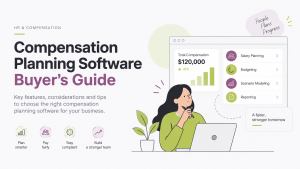
Compensation is one of the most consequential decisions a company makes, and also one of the most chaotic to manage.
HR teams are balancing salary bands, bonus cycles, equity grants, and benefits, often across departments, geographies, and job levels, all at once. When that process runs on spreadsheets and email threads, errors don’t just slow things down. They affect real people, real offers, and real retention.
That’s where compensation management software comes in.
This guide breaks down what compensation management software actually is, how it compares to the tools most teams are still using today, what to look for when evaluating a platform, and the top five tools worth considering in 2025.
Whether you’re running your first structured comp review or looking to replace a system that’s outgrown your needs, this will help you make the call with confidence.
TL;DR
- Compensation management software helps HR teams plan, administer, and optimize employee pay, including salaries, bonuses, and equity, in one system
- It replaces disconnected spreadsheets and email threads with structured, data-driven workflows
- Core features include salary benchmarking, pay equity analysis, compensation planning, approval workflows, and HRIS integration
- Spreadsheets break down at scale due to version control issues, formula errors, weak security, and no built-in equity analysis
- Compensation management software gives you a single source of truth, real-time data, and audit trails
- When evaluating platforms, prioritize market data integration, pay equity monitoring, budget visibility, and your existing HR stack compatibility
- The best tool isn’t the most feature-rich one. It’s the one that fits your company’s size, comp complexity, and current gaps
- Stello AI is built for mid-sized companies looking to mature their comp function with AI-powered recommendations
- Pave, Carta, Lattice, and Rippling round out the top 5, each strong in benchmarking, equity, performance-linked comp, and full HR suite respectively
- Start by identifying where your current process is breaking down and use that as your buying filter
What is Compensation Management Software?
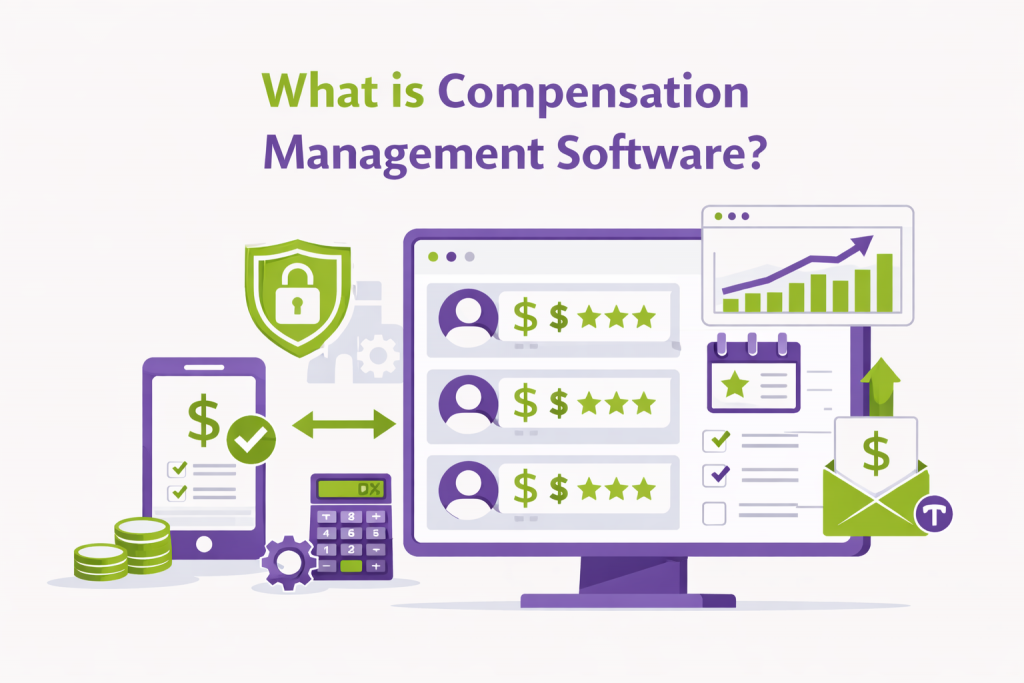
Compensation management software is a dedicated platform that helps HR and compensation teams plan, administer, and optimize how employees are paid across the entire organization.
This includes base salaries, merit increases, bonuses, equity compensation, and benefits, all managed within a single system rather than scattered across files and inboxes.
At a functional level, these platforms typically handle:
- Compensation planning and budgeting — allocating pay budgets across teams and departments with visibility into how decisions roll up
- Salary benchmarking — comparing internal pay against external market data to stay competitive
- Pay equity analysis — identifying and addressing gaps across gender, race, tenure, and other dimensions
- Equity and total rewards management — tracking stock options, RSUs, and other non-cash compensation alongside base pay
- Approval workflows — routing comp decisions through the right managers and stakeholders before anything gets finalized
The bigger value, though, isn’t just the feature list. It’s the shift from reactive to proactive. Instead of discovering a pay equity issue during an audit or losing a candidate because your offer was off-market, you’re working from accurate, real-time data at every stage of the compensation cycle.
For growing companies especially, compensation management software is what makes it possible to scale pay decisions without scaling the risk of getting them wrong.
How Compensation Management Software Works
A continuous 6-stage lifecycle — from market data to pay decisions
Also read: Top 5 AI Compensation Software for Mid-Market HR Teams
Compensation Management Software vs Spreadsheets
Spreadsheets aren’t inherently the problem. For a 10-person team with a straightforward pay structure, they do the job. The problem is that most companies don’t stay that simple for long.
Here’s where the cracks start to show:
Version control is a constant liability. When multiple people are working across different copies of the same file, it’s only a matter of time before someone makes decisions based on outdated data. There’s no single source of truth, and no audit trail when something goes wrong.
Formulas break at scale. A compensation model that works cleanly for 50 employees starts failing in unpredictable ways at 200. Manual inputs compound errors, and the more complex the logic, the harder it is to catch mistakes before they affect payroll or offers.
There’s no built-in equity analysis. Identifying pay gaps in a spreadsheet means building your own analysis from scratch, every time, with no guarantee of consistency or completeness.
Collaboration is clunky. Comp planning involves managers, HR business partners, finance, and leadership. Coordinating approvals and feedback through shared spreadsheets creates bottlenecks and version chaos.
Sensitive data is hard to protect. Compensation data is among the most confidential information a company holds. Spreadsheets offer limited access controls, and one accidental share can expose the entire file.
Here’s a side-by-side look at how the two compare across the areas that matter most:
| Spreadsheets | Compensation Management Software | |
| Data accuracy | Prone to manual errors and broken formulas | Automated calculations with real-time updates |
| Version control | Multiple conflicting copies | Single source of truth |
| Pay equity analysis | Manual, inconsistent | Built-in, continuous monitoring |
| Collaboration | Email threads, messy handoffs | Structured workflows and approvals |
| Market benchmarking | Requires manual research | Integrated market data |
| Data security | Limited access controls | Role-based permissions and audit trails |
| Scalability | Breaks down at scale | Built to grow with your org |
Compensation management software solves each of these by design. Access controls, approval workflows, real-time data, and equity analysis are built into the system, not bolted on through workarounds.
The switch isn’t about abandoning a familiar tool. It’s about recognizing when that tool is creating more risk than it’s worth.
Also read: The Complete Guide to Equity Compensation: RSUs, Stock Options, and Strategic Target Setting
How to Choose the Right Compensation Management Software
Not every platform is built for the same company. The right choice depends on your team size, comp complexity, and where your current process is breaking down. That said, there are a few capabilities that separate a solid platform from one you’ll outgrow in a year.
Here’s what to evaluate:
Salary benchmarking and market data integration
The platform should connect to reliable, up-to-date market data so you can benchmark roles without pulling data manually from third-party surveys. Look for integrations with sources like Radford, Mercer, or Levels.fyi, or platforms that have proprietary benchmarking built in.
Pay equity analysis
This isn’t optional anymore. Your platform should surface pay gaps across gender, ethnicity, tenure, and job level automatically, not just when you run a one-off report. Bonus if it tracks remediation over time.
Compensation planning and budget management
Look for tools that let you run merit cycles, bonus rounds, and promotion reviews within the platform, with real-time visibility into how individual decisions affect the overall budget.
Approval workflows and manager access
Comp decisions rarely happen in a vacuum. The platform should support multi-level approval flows and give managers a controlled view of their team’s comp data without exposing information they shouldn’t see.
HRIS integration
Your compensation tool needs to talk to your existing HR stack. Weak integrations mean manual data syncing, which brings you right back to spreadsheet problems. Check for native integrations with platforms like Workday, BambooHR, Rippling, or HiBob.
Equity and total rewards visibility
If your company offers stock options or RSUs, the platform should factor those into total compensation views, not treat them as a separate conversation.
Reporting and audit trails
Every comp decision should be logged and traceable. Strong reporting features make it easier to defend pay decisions internally and stay compliant with pay transparency regulations.
Also read: 8 Ways Companies are Using AI in Compensation Management
Top 5 Compensation Management Software Tools in 2025
With dozens of platforms on the market, narrowing down your options can feel overwhelming. These five tools consistently stand out for their depth of features, ease of use, and ability to scale with your compensation needs.
1. Stello AI

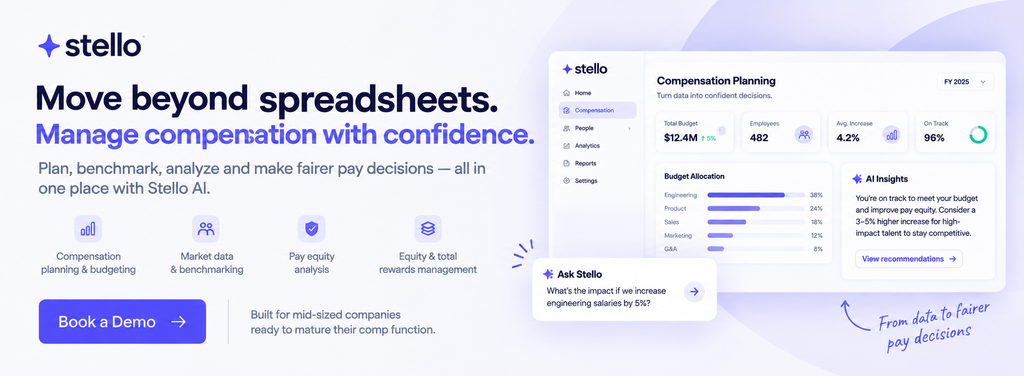
Stello AI is built for companies that want to bring structure and intelligence to their compensation programs without the complexity of enterprise-grade tools. It combines salary benchmarking, pay equity analysis, and compensation planning in one platform, with AI-powered recommendations that help HR teams make faster, more defensible pay decisions. It’s particularly well-suited for mid-sized companies building or maturing their comp function.
2. Pave
Pave is a strong choice for companies that want real-time market benchmarking at the center of their comp strategy. It pulls from a live dataset of compensation information shared by participating companies, giving HR teams an up-to-date view of where their pay stacks up. It also handles total rewards visualization, making it easier to communicate the full value of a comp package to employees and candidates.
3. Carta
Carta is best known for equity management, and for good reason. If your company offers stock options or RSUs, Carta gives you a clean, compliant way to manage cap tables, equity grants, and employee equity education in one place. It’s especially relevant for startups and growth-stage companies where equity is a significant part of total compensation.
4. Lattice
Lattice sits at the intersection of performance management and compensation. It’s a solid pick for companies that want to tie pay decisions directly to performance reviews and goal-setting, keeping those workflows connected rather than siloed. Its compensation planning module works best when used alongside the rest of the Lattice platform.
5. Rippling
Rippling takes a broader approach, combining HR, payroll, and IT management under one roof. Its compensation tools are part of a larger workforce management system, making it a strong fit for companies that want to consolidate vendors and manage pay alongside payroll processing, benefits, and headcount planning in a single platform.
Conclusion
Compensation management is too important to run on systems that weren’t built for it. Spreadsheets get you started, but they can’t keep up with the complexity of a growing org, the scrutiny of pay equity requirements, or the speed that modern hiring demands.
The right compensation management software gives your HR team the structure, data, and confidence to make pay decisions that are fair, competitive, and defensible. Whether you’re running your first formal comp cycle or replacing a tool that’s no longer cutting it, the platforms covered in this guide are a strong place to start.
Start by identifying where your current process is breaking down, and use that as your filter. The best tool isn’t always the most feature-rich one. It’s the one that solves your specific problem and grows with you from there.
FAQs-
What is the main purpose of compensation management software?
Compensation management software helps HR and compensation teams plan, administer, and optimize employee pay, including salaries, bonuses, and equity, within a single system. The goal is to replace manual, error-prone processes with accurate, data-driven workflows that scale with the organization.
Who typically uses compensation management software?
It’s primarily used by HR leaders, compensation managers, and HR business partners. During active comp cycles, hiring managers and finance teams are also looped in through approval workflows and budget tracking features.
Is compensation management software only for large companies?
No. While enterprise platforms exist for complex, global organizations, many tools today are built specifically for mid-sized and growth-stage companies that are formalizing their comp programs for the first time. The right platform scales with your headcount and complexity.
How does compensation management software support pay equity?
Most platforms include built-in pay equity analysis that surfaces gaps across dimensions like gender, ethnicity, and tenure. Unlike manual audits, these tools monitor equity continuously and help teams track remediation over time, making it easier to stay ahead of compliance requirements.
How long does it take to implement compensation management software?
Implementation timelines vary by platform and company size, but most mid-market tools can be up and running within a few weeks. The biggest factor is data readiness, specifically how clean and structured your existing employee and compensation data is before migration.