Most companies have a pay equity policy. Far fewer have a pay equity process.
The policy is easy: a statement in the employee handbook, a line in the DEI report, a commitment made during hiring season. The process is harder. It requires consistent data, structured decision-making, and the discipline to apply both even when there’s pressure to close a candidate fast.
That gap between policy and process is exactly where pay inequity lives. And for most organizations, it doesn’t show up in a discrimination lawsuit or a viral employee post. It shows up quietly, in offer letters, in promotion cycles, in the slow drift of salaries across a team that no one audited until it was too late.
This article breaks down what pay equity actually means, where gaps typically originate, and why fixing them requires more than an annual compensation review.
TL;DR
- → Pay equity and equal pay are not the same thing. Equal pay covers identical roles. Pay equity covers fairness across the entire organization.
- → Most gaps are not intentional. They come from inconsistent leveling, unstructured negotiation, and benchmarking that does not move fast enough.
- → The offer stage is where inequity gets baked in, before an employee even starts.
- → Audits fix gaps after the fact. Prevention requires consistency at the offer stage.
- → Pay equity is an ongoing process, not a once-a-year exercise.
Pay Equity vs. Equal Pay: The Distinction Most People Miss
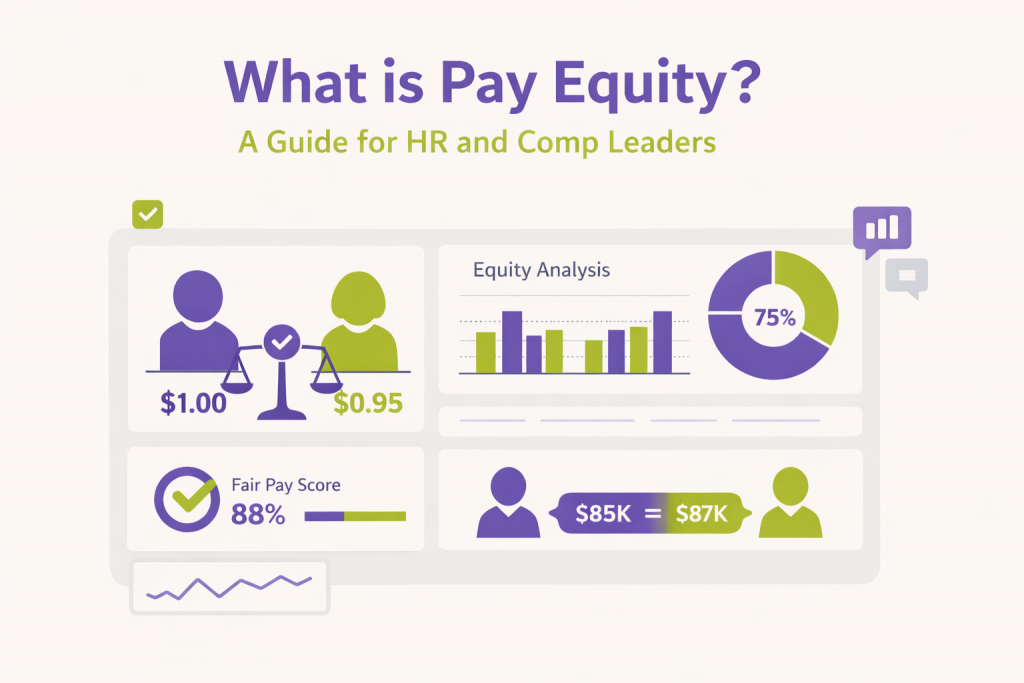
Equal pay and pay equity are often used interchangeably. They mean different things, and conflating them is one reason so many compensation efforts fall short.
Equal pay is straightforward: two people doing the same job should earn the same wage. It’s the principle behind the Equal Pay Act of 1963, and it’s largely what comes to mind when people talk about gender or racial wage gaps.
Pay equity is broader. It asks whether compensation is fair across the organization when you account for role, level, experience, location, and performance. Two employees can have different salaries and still be paid equitably, as long as the difference is tied to legitimate, documented factors.
Compensation Fundamentals
Equal Pay vs. Pay Equity
Two related concepts. One critical distinction.
Equal Pay
The principle that employees performing the same job must receive the same wage, regardless of gender, race, or background.
Pay Equity
The broader standard that compensation is fair across the organization, accounting for role, level, experience, location, and performance.
The key insight: A company can pass an equal pay audit and still have a significant equity problem. Gaps often form at the offer stage, before an employee’s first day, and compound with every raise and promotion that follows.
The distinction matters because a company can pass an equal pay audit and still have a significant equity problem. If your senior engineers in the same city, doing comparable work, with similar tenure are sitting at different points in the salary range with no clear rationale, that’s an equity issue. No law was broken, but the internal logic is broken.
Most pay equity efforts focus on identifying and closing gaps after they’ve formed. That’s necessary, but it’s reactive. The more important question is how those gaps got there in the first place.
Also read: AI Compensation Agent: How Enterprises Are Automating Compensation Decisions
Where Pay Gaps Actually Come From
Pay gaps rarely come from a single decision. They accumulate over time, across dozens of small process failures that individually seem harmless but compound into a real problem.
A few of the most common sources:
Inconsistent job leveling
When there’s no clear framework for what “Senior” versus “Lead” means in practice, managers make judgment calls. Those calls vary by department, by manager, and sometimes by candidate. Two people doing equivalent work end up with different titles and different pay bands.
Unstructured negotiation
Candidates who negotiate aggressively get more. Candidates who don’t, get less. Research consistently shows that negotiation behavior varies across gender and cultural lines, which means unstructured negotiation quietly encodes bias into starting salaries.
Benchmarking that happens once a year
Market data goes stale fast. Companies that refresh compensation benchmarks annually are often making offer decisions on data that’s already 6 to 12 months old, particularly in high-demand roles.
Manager discretion without guardrails
Giving managers flexibility in comp decisions isn’t inherently wrong. But flexibility without structure means outcomes depend on who your manager is, how they advocate for you, and how informed they are about the broader compensation landscape.
None of these are malicious. But together, they create the conditions for inequity to take root quietly and stay there.
The Offer Stage: Where Inequity Gets Baked In
If you trace most pay equity problems back far enough, they often start at the offer letter.
By the time a new hire signs, a number of variables have already been set in motion: the salary they were quoted, how much they negotiated, whether the recruiter had room to move, and whether anyone checked that offer against what existing employees in the same role are actually earning. In most companies, that last step either happens inconsistently or not at all.
The typical offer process looks something like this: a recruiter pulls the salary band, checks with the hiring manager, maybe looks at a benchmarking tool, and builds a number. If the candidate pushes back, the offer moves, sometimes because there’s genuine room, and sometimes because the recruiter wants to close. The final number reflects a mix of market data, internal politics, and negotiation dynamics, not a clean read of what’s equitable.
That creates a problem that’s structural from day one. The new hire earns more than a peer with two extra years of tenure. Or less than someone hired six months ago when the market looked different. Neither scenario is intentional. Both are inequitable.
The compounding effect is what makes this hard to fix retroactively. Every raise, bonus, and promotion that follows is often calculated as a percentage of base. An inequitable starting salary doesn’t stay contained to year one. It follows an employee through their entire tenure at the company.
This is why pay equity can’t be solved by audits alone. If the offer process is generating inconsistent starting points, the gap is being rebuilt faster than any annual review can close it.
What a Consistent Offer Process Actually Looks Like
Standardizing the offer process doesn’t mean removing human judgment. It means giving that judgment the right inputs before a number gets put on the table.
At minimum, a structured offer process should pull from three sources: internal incumbent data for the same role and location, current market benchmarks, and a clear read of the candidate’s experience relative to the level being hired for. When all three are present, the offer range narrows considerably, and the decision becomes easier to defend internally and externally.
Negotiation also needs structure, not just the offer number itself. Recruiters benefit from knowing where to anchor the offer, what movement is reasonable, and at what point an offer becomes inequitable relative to the existing team. Without that context, negotiation defaults to gut feel, and gut feel is where bias enters.
Some companies are starting to operationalize this more systematically. Stello’s AI Compensation Agent, for example, does exactly this: it analyzes internal employee data, reviews market benchmarks, evaluates the candidate’s experience, and generates both a recommended offer and a negotiation strategy for the recruiter, including where to start, how much room exists, and what the internal equity ceiling looks like for that role.
The goal isn’t to eliminate recruiter involvement. It’s to make sure every offer decision starts from the same foundation, regardless of who’s doing the hiring.
Consistency at the offer stage is the most underleveraged lever in pay equity. Most companies invest heavily in auditing gaps after the fact. Fewer invest in preventing them from forming in the first place.
Pay Equity Isn’t a One-Time Audit
Even with a cleaner offer process, pay equity requires ongoing attention. Compensation landscapes shift, teams grow unevenly, and market rates move faster than most annual review cycles can track. A snapshot audit tells you where gaps exist today. It doesn’t prevent new ones from forming tomorrow.
The companies that manage equity well tend to treat it as a continuous process rather than a periodic exercise. That means reviewing compensation at regular intervals, not just once a year, and flagging anomalies as they appear rather than waiting for them to accumulate.
It also means being clear about what to do when gaps are found. Identifying inequity is the easier part. The harder part is building a remediation process that’s fair, financially sustainable, and communicated well. Employees who find out they’ve been underpaid relative to peers don’t just want a correction. They want to understand how it happened and what’s changed to prevent it going forward.
A few practices that support ongoing equity:
Regular band reviews
Salary bands should be reviewed at least twice a year in fast-moving markets, with adjustments made proactively rather than reactively.
Promotion and raise audits
Percentage-based increases can widen gaps over time. Periodic audits of promotion and raise decisions help catch drift before it becomes structural.
Manager education
Managers who understand how compensation decisions compound over time make better decisions in the moment. Equity isn’t just an HR responsibility.
The through line across all of this is consistency. Consistent offer decisions, consistent review cycles, consistent criteria for raises and promotions. Equity doesn’t require perfection. It requires a system that applies the same logic to everyone.
Conclusion
Pay equity is not a policy problem. Most companies already have the right language in place. It’s a process problem, and it starts earlier than most organizations think.
The offer stage is where compensation logic either holds or begins to break down. When offers are built on inconsistent inputs, negotiated without guardrails, and never checked against internal equity, the gap is structural before the employee finishes onboarding.
Fixing that requires moving upstream. Audits matter, but they’re a lagging indicator. The companies that will have the strongest equity outcomes over the next few years are the ones building consistency into how compensation decisions get made in the first place, not just how they get reviewed after the fact.
Pay equity is ultimately about trust. Employees who believe their pay is fair are more engaged, more loyal, and more likely to perform. That’s not just an ethical outcome. It’s a business one.
FAQs-
What is the difference between pay equity and equal pay?
Equal pay means employees doing the same job receive the same wage. Pay equity is broader — it asks whether compensation is fair across the organization when accounting for role, level, experience, location, and performance. A company can comply with equal pay laws and still have meaningful equity gaps.
Is pay equity legally required?
Equal pay is legally mandated in most countries. Pay equity requirements vary by region and are evolving. Several US states now require pay transparency and equity reporting, and more legislation is expected in the coming years. Beyond legal compliance, pay equity is increasingly a factor in employer brand and talent retention.
How often should companies conduct a pay equity audit?
At minimum, once a year. In fast-moving markets or during periods of rapid hiring, twice a year is more appropriate. Audits are most effective when paired with proactive measures at the offer and promotion stages, rather than used as a standalone fix.
Can small companies have pay equity problems?
Yes, and they’re often harder to detect at a smaller scale because there’s less data to compare. Inconsistent offer decisions and unstructured negotiation affect companies of all sizes. In fact, early-stage companies that don’t build compensation structures early often inherit equity problems that become expensive to fix as they scale.
What’s the fastest way to identify a pay equity problem?
Start with your internal incumbent data. Group employees by role, level, and location, then look at the spread within each group. If the range is wide and you can’t explain the variance with documented performance or experience differences, you likely have an equity issue worth investigating further.