Choosing compensation benchmarking software should be simple. You need market data. You need a way to match your jobs against that data. You need the results in a format that actually helps you make pay decisions. That is the entire job description.
In practice, the decision is complicated by the fact that “compensation benchmarking software” means very different things depending on who is selling it. Some vendors are survey providers that have added a software layer on top of their data. Some are compensation planning platforms that include benchmarking as one feature among many. Some are real-time data aggregators that pull pay information directly from HRIS systems. And some are broad HCM suites where benchmarking is buried three menus deep inside a module that was designed for something else entirely.
Each approach has trade-offs. The right choice depends on your data strategy, your compensation maturity, and whether you need a benchmarking tool or a benchmarking capability embedded in a broader compensation workflow. This guide walks through how to evaluate your options and avoid the most common buying mistakes.
TL;DR
- → Compensation benchmarking software falls into two categories: data-first tools that provide proprietary market datasets and workflow-first platforms that help you apply trusted survey data inside compensation cycles.
- → The right choice depends on whether you need new market data or better execution of data you already have — most organizations ultimately require both.
- → Evaluation criteria should prioritize data relevance, content-based job matching accuracy, aging and multi-source blending controls, total compensation benchmarking, and integration into merit cycles and budget modeling.
- → Common buying mistakes include purchasing duplicate datasets, prioritizing dashboards over data integrity, overlooking the job matching workflow, and selecting a standalone benchmarking tool when a full compensation planning platform is required.
- → Workflow-first platforms like Stello AI automate job matching using existing survey sources, embed benchmarking directly into pay decisions, and connect market data to merit recommendations, scenario modeling, and total compensation analysis in real time.
The First Question: Data Tool or Workflow Tool?
Before comparing specific products, you need to answer one foundational question. Are you looking for compensation benchmarking software that provides market data, or are you looking for software that helps you act on market data you already have?
This distinction matters because it determines the category of tool you should be evaluating.
Data-first tools provide proprietary or aggregated compensation data and give you ways to access, filter, and analyze it. Platforms like Pave and Ravio fall into this category. So do traditional survey providers like Radford, Mercer, and Willis Towers Watson that have built digital interfaces for accessing their survey results. The primary value is the data itself. The software is the delivery mechanism.
Workflow-first tools assume you have data sources and focus on helping you apply that data to compensation decisions. These platforms handle job matching, salary range construction, merit cycle management, budget modeling, and pay equity analysis. Compensation benchmarking is one capability within a broader workflow. Stello AI and platforms like Comprehensive and Aeqium fall into this category.
Hybrid tools try to do both. Some do it well. Some spread themselves thin. Pave has expanded from pure benchmarking into compensation planning. Beqom offers workflow capabilities alongside benchmarking integration. The question with hybrids is always whether both sides of the product receive equal investment and attention.
Most companies need both data and workflow. The decision is whether you get them from one vendor or two.
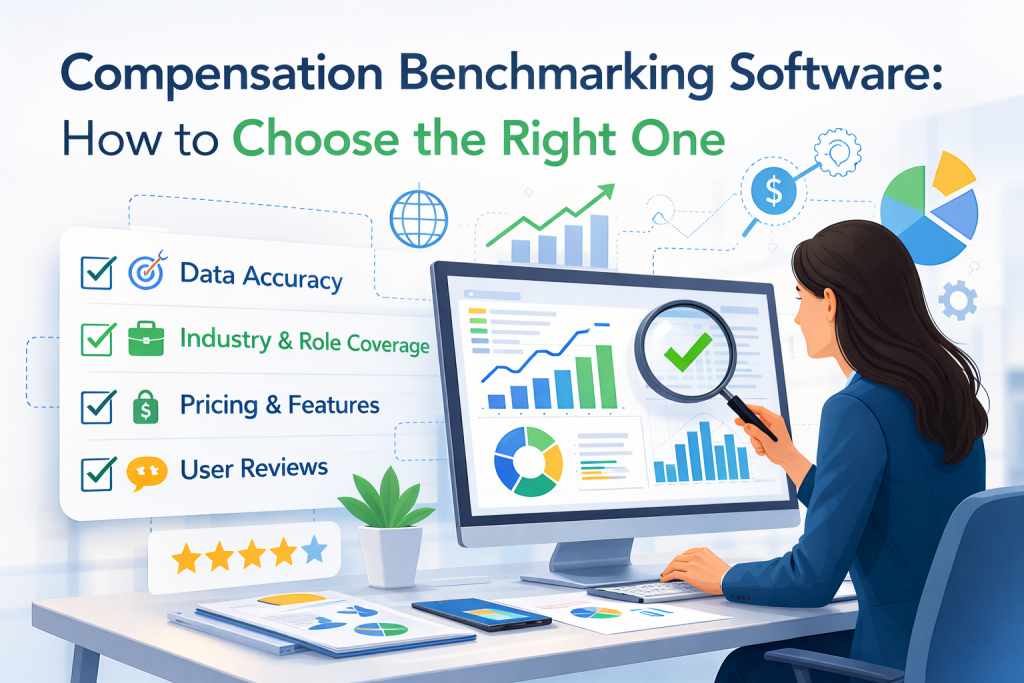
What to Evaluate in Compensation Benchmarking Software
Regardless of which category you are shopping in, there are specific criteria that separate good compensation benchmarking software from tools that look good in a demo but create problems in practice.
Data Quality and Relevance
If the tool provides its own data, you need to understand where that data comes from, how it is validated, how frequently it updates, and whether it covers your specific roles, industries, and geographies.
Ask how many companies contribute data and in which industries. Ask what the median company size is in the dataset. Ask whether data comes from verified HRIS records or self-reported submissions, which tend to be less reliable. Ask about geographic coverage, especially if you have employees outside the United States.
A compensation benchmarking dataset that covers 8,000 US tech companies is excellent if you are a US tech company. It is nearly useless if you are a manufacturing firm benchmarking plant managers in Germany. Coverage relevance matters more than coverage volume.
Job Matching Methodology
Job matching is where compensation benchmarking either produces trustworthy results or falls apart. The tool should support matching based on job content, responsibilities, scope, and level rather than relying solely on title matching.
Some platforms still use manual matching, where an analyst maps each role one by one. This is accurate but slow. Others use AI-powered matching that reads job descriptions and suggests matches based on content similarity. The AI approach is faster and more consistent, especially for companies with hundreds of roles, but it still requires human validation.
Ask vendors to demonstrate their matching process with a few of your actual roles. If the matching quality is poor for your specific jobs, the rest of the tool’s capabilities are irrelevant because every downstream analysis will be built on unreliable foundations.
Integration with Your Compensation Workflow
Compensation benchmarking data is only valuable if it reaches the people making pay decisions at the moment they are making them. If benchmarking lives in one system and merit planning lives in another, the data gets stale, the handoff is manual, and managers make recommendations without seeing market context.
The best compensation benchmarking software either includes full compensation cycle management or integrates deeply with the platform where your cycles run. Benchmarking data should flow directly into manager worksheets as compa-ratios and market positioning indicators, not sit in a separate report that someone has to download and interpret.
Aging and Blending Capabilities
If you use survey data, the software should support aging factors that adjust historical data to current market estimates. If you use multiple data sources, it should support systematic blending with configurable source weighting. These are table-stakes capabilities for any serious compensation benchmarking process, but not every tool offers them.
Ask whether the platform can apply different aging factors to different surveys. Ask whether you can weight one source more heavily than another for specific job families. Ask whether the blended result is transparent so you can explain to leadership where a particular benchmark came from.
Total Compensation Benchmarking
Base salary benchmarking alone is increasingly insufficient. Candidates compare total compensation packages, including equity, bonuses, benefits, and other non-cash rewards. Your compensation benchmarking software should support total compensation comparisons, not just base pay.
This is particularly important for technology companies and any organization where equity represents a significant portion of compensation. A platform that can only benchmark base salary gives you an incomplete and potentially misleading view of your competitive position.
Common Mistakes When Choosing Compensation Benchmarking Software

Buying Data You Already Have
If you already participate in Radford and Mercer surveys, you do not need a new tool that provides its own proprietary dataset. You need a tool that helps you use the data you are already paying for more efficiently. Buying another data source on top of existing survey subscriptions adds cost without necessarily adding accuracy.
Prioritizing Dashboard Aesthetics Over Data Integrity
Modern compensation benchmarking software comes with polished dashboards and impressive visualizations. These matter for stakeholder communication, but they should not be the primary evaluation criterion. A beautiful dashboard built on poorly matched data produces confidently wrong answers. Evaluate matching quality and data integrity first. Evaluate the interface second.
Ignoring the Job Matching Experience
Some vendors gloss over the matching process in demos because it is the least glamorous part of the product. But job matching is the foundation of every benchmark. If the matching experience is clunky, manual, or inaccurate, every number the tool produces is suspect. Insist on seeing the matching workflow during your evaluation and test it with your actual roles.
Choosing a Standalone Tool When You Need a Platform
A pure compensation benchmarking tool solves the data problem. It does not solve the workflow problem. If you also need merit cycle management, budget modeling, pay equity monitoring, and total rewards communication, buying a standalone benchmarking tool means you still need a separate compensation planning platform. Evaluate whether a platform that combines benchmarking with planning capabilities would be more efficient and cost-effective than maintaining two separate systems.
How Stello AI Approaches Compensation Benchmarking
Stello AI takes a workflow-first approach to compensation benchmarking. Rather than building a proprietary benchmarking dataset, Stello’s AI Market Pricing module accelerates the job matching and salary benchmarking process by using AI to match internal roles against external survey data based on role content rather than title alone. This means companies can continue using the survey sources they already trust while dramatically reducing the time and inconsistency of the matching process.
The benchmarking data feeds directly into Stello’s compensation cycle management. Managers see compa-ratios and AI-powered salary increase recommendations based on merit matrix calculations alongside current market positioning. There is no gap between when benchmarks are set and when pay decisions are made. This is the integration between benchmarking and workflow that standalone tools cannot replicate.
Stello’s AI Budget Modeling lets HR and finance teams model the cost of closing market gaps across different scenarios while maintaining pay equity. When compensation benchmarking reveals that a department is eight percent below the 50th percentile, the team can immediately model what it costs to close that gap and compare it against other budget priorities.
The AI Compensation Agent answers compensation benchmarking questions on demand. An HRBP can ask how a specific team’s pay compares to the market and get an answer in seconds rather than waiting for a custom report. This democratizes benchmarking data across the organization instead of keeping it locked behind analyst queues.
The platform manages the full compensation picture, including base salary, bonuses, and equity with support for RSUs, stock options, profit sharing, and complex vesting schedules. This enables total compensation benchmarking rather than base-only comparisons. Stello integrates with existing HRIS, performance management tools, equity platforms, benefits systems, and Excel files, so benchmarking data flows seamlessly into every compensation workflow.
Stello’s Total Rewards Portal gives employees year-round access to personalized compensation statements that show their full rewards package. And ad hoc increases throughout the year ensure that benchmarking-driven adjustments happen when they are needed rather than waiting for the annual cycle.
Building Your Benchmarking Stack
For most organizations, the ideal setup is a combination of trusted data sources and a platform that makes that data actionable. The data source provides the market intelligence. The platform provides the workflow that turns intelligence into pay decisions.
A technology company might pair Radford or Pave data with Stello AI for cycle management and AI-assisted job matching. A global enterprise might pair Mercer and WTW surveys with Stello for scenario modeling and real-time budget tracking. The specific combination depends on your industry, geography, and compensation complexity.
The important thing is to evaluate compensation benchmarking software based on how well it solves your actual problems, not on which vendor has the longest feature list. The best tool is the one that gets accurate market data into the hands of decision-makers at the moment they need it, with the least friction and the most confidence in the numbers.
Frequently Asked Questions
Should I buy a data tool or a workflow tool for compensation benchmarking?
Data tools like Pave and Ravio provide market data. Workflow tools like Stello AI help you act on data you already have. Most companies need both. The decision is whether you get them from one vendor or two, or choose a hybrid that does both.
What is the most important thing to evaluate in compensation benchmarking software?
Job matching quality. If matching is inaccurate, every downstream benchmark, salary range, and merit recommendation is unreliable. Insist on testing the matching workflow with your actual roles during the demo.
Do I need compensation benchmarking software if I already have survey subscriptions?
You do not need another data source. You need a tool that helps you use existing survey data more efficiently through AI-powered job matching, automated aging and blending, and integration into your compensation workflow so benchmarks reach decision-makers in real time.
What are the most common buying mistakes?
Buying duplicate data you already have, prioritizing dashboard aesthetics over matching quality, glossing over the job matching experience during demos, and choosing a standalone benchmarking tool when you actually need a full compensation planning platform.
How does Stello AI approach compensation benchmarking?
Workflow-first. Stello works with your existing survey sources rather than replacing them. AI Market Pricing automates job matching based on role content. Benchmarking data feeds directly into merit recommendations, compa-ratios, and budget modeling with no manual handoff. The AI Compensation Agent answers benchmarking questions on demand in seconds.
Ready to see how AI-powered compensation benchmarking fits into your workflow?
Book a demo with Stello AI and experience benchmarking that is fast, accurate, and embedded in every pay decision.