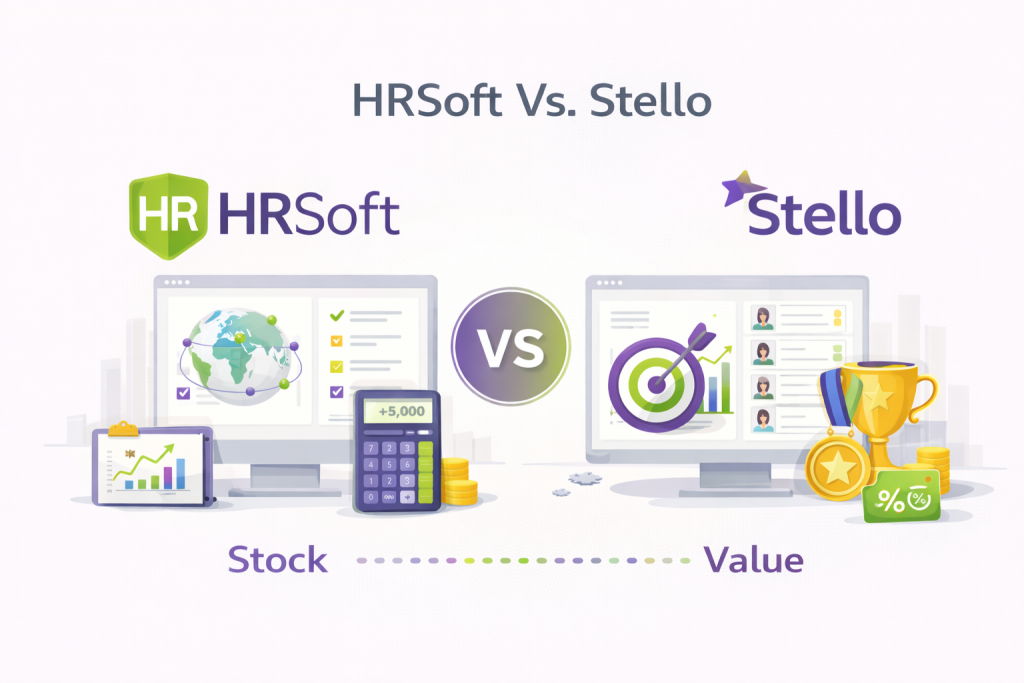
Enterprise compensation has become significantly more complex. Finance and HR teams now manage base salary planning, incentive compensation, equity programs, and off-cycle adjustments across large, distributed organizations.
As this complexity increases, spreadsheets and disconnected systems no longer scale. Enterprises need compensation platforms that provide cost visibility, governance, and flexibility without slowing decision-making.
This is where tools like HRSoft and Stello come into focus. Both platforms aim to bring structure to compensation management, but they take different approaches in how they balance finance control, HR ownership, and manager flexibility.
This comparison examines HRSoft and Stello across compensation scope, governance, usability, and enterprise fit to help organizations determine which tool better aligns with their operating model and compensation strategy.
What Is Enterprise Compensation Management?
Enterprise compensation management is the process of planning, governing, and forecasting pay across salary, incentives, equity, and off-cycle adjustments at scale. It requires strict controls, clear approvals, and real-time cost visibility across large and distributed teams.
Finance teams need predictable spend and accurate forecasting. HR teams need policy consistency and fairness. Managers need flexibility without bypassing governance.
The challenge is enabling decentralized decisions while maintaining centralized financial control.
HRSoft: Product Overview
HRSoft is an enterprise compensation management platform focused on structured salary planning, incentive programs, and governance at scale. It is commonly used by large organizations that run formal annual and mid-cycle compensation processes.
HRSoft emphasizes policy-driven workflows, approval hierarchies, and compliance. Compensation decisions are typically centralized within HR, with strong controls to ensure consistency across roles, levels, and geographies.
The platform is well suited for enterprises that prioritize standardized compensation cycles, audit readiness, and HR-led ownership of compensation programs.
Stello: Product Overview
Stello is an enterprise compensation management platform designed for continuous, finance-led compensation decisions. It brings base pay, incentives, equity, and off-cycle adjustments into a single planning and governance layer.
Stello emphasizes real-time cost visibility, budget controls, and manager-led actions within defined guardrails. Rather than centering compensation around fixed annual cycles, it supports ongoing decision-making aligned with financial planning.
The platform is well suited for enterprises that want tighter finance ownership, faster decisions, and flexibility without sacrificing control.
Compensation Scope Comparison
Enterprise compensation platforms must support more than annual salary reviews. The breadth of compensation they manage directly affects cost visibility, governance, and decision speed.
HRSoft is structured around formal compensation programs. It supports base salary planning and incentive cycles that are typically managed during predefined review periods. The platform is well suited for organizations with standardized, calendar-driven compensation processes.
Stello takes a broader and more continuous approach. It supports base pay, incentives, equity, and off-cycle compensation within a single planning framework. This allows finance teams to see total compensation impact as decisions are made throughout the year.
The difference is less about feature availability and more about operating model. HRSoft aligns well with structured, HR-led compensation cycles. Stello is designed for enterprises that require ongoing compensation decisions with real-time financial oversight.
Winner: Stello Stello’s broader compensation scope and continuous planning model provide better total compensation visibility and financial control for enterprises managing ongoing, off-cycle decisions.
Finance Control and Governance
For enterprise organizations, compensation management is a financial control function as much as an HR process. Budget discipline, approvals, and auditability are critical.
HRSoft emphasizes governance through structured workflows and approval hierarchies. Compensation decisions are typically reviewed and approved within predefined cycles, ensuring consistency and compliance across the organization.
Stello focuses on real-time financial control. Every compensation action shows budget impact before approval, allowing finance teams to manage spend continuously rather than retrospectively. Approval workflows and guardrails are enforced while enabling faster decisions.
In practice, HRSoft supports centralized, policy-driven control. Stello supports finance-led oversight with flexibility built into day-to-day operations.
Winner: Stello Stello provides stronger real-time financial control by surfacing budget impact before approvals, enabling finance teams to manage compensation spend continuously rather than after decisions are made.
Manager Experience and Flexibility
Manager experience plays a significant role in how quickly and effectively compensation decisions are made at scale.
HRSoft is designed for structured participation. Managers typically engage during formal compensation cycles, submitting recommendations that flow through centralized HR and finance approvals. This supports consistency but can limit flexibility outside planned review periods.
Stello enables managers to act throughout the year. Managers can propose bonuses, lump-sum payments, or off-cycle salary increases within defined limits. Finance and HR retain approval control, but decision-making is faster and closer to the business.
The distinction is clear. HRSoft prioritizes structure and standardization. Stello prioritizes speed and flexibility without removing governance.
Winner: Stello Stello delivers greater manager flexibility and faster decision-making while maintaining finance and HR controls, making it better suited for dynamic enterprise environments.
Implementation, Scalability, and Integrations
Implementation speed and scalability are critical considerations for enterprise compensation platforms.
HRSoft is typically implemented as part of a broader HR-led transformation. Configuration can be detailed, reflecting the platform’s emphasis on structured compensation cycles, policy enforcement, and complex approval hierarchies. This makes it well suited for large organizations with established HR processes and longer implementation timelines.
Stello is designed for faster deployment and iteration. Its configuration focuses on financial models, budgets, and approval logic, allowing enterprises to roll out incrementally and adapt as compensation needs evolve.
Both platforms integrate with core HRIS and payroll systems. The difference lies in approach. HRSoft supports deep, process-heavy implementations. Stello prioritizes flexibility, faster time to value, and scalability across teams and geographies.
Winner: Stello Stello offers faster time to value and greater scalability through incremental implementation, making it better suited for enterprises that need flexibility without long deployment cycles.
AI Capabilities and Decision Intelligence
AI capabilities are becoming an important consideration for enterprise compensation platforms as compensation decisions move beyond fixed annual cycles.
HRSoft primarily relies on rules-based workflows and predefined approval logic. Compensation planning and analysis are driven by static reports and manual review, which supports consistency but limits proactive decision support. AI-driven insights, recommendations, or predictive signals are limited.
Stello is built with AI to support ongoing compensation decisions. The platform surfaces insights as actions are proposed, helping finance teams identify budget risk, outliers, and inconsistencies in real time. AI is used to support scenario evaluation and improve decision accuracy before approvals occur.
Both platforms automate compensation processes. The difference lies in intelligence. HRSoft emphasizes structured execution. Stello emphasizes AI-assisted decision-making that enables faster, more informed compensation choices at scale.
Winner: Stello Stello’s built-in AI capabilities provide proactive decision support, enabling finance teams to identify risk and guide compensation decisions in real time rather than relying on manual, post-hoc analysis.
HRSoft vs. Stello: Complete Comparison Table
Category
HRSoft
Stello
Core positioning
HR-led enterprise compensation management
Finance-led, continuous compensation planning
Primary ownership
HR-centric
Finance-centric with HR partnership
Compensation types supported
Base pay, incentives, simple equity
Base pay, incentives, complex equity, off-cycle pay
For modern enterprises, compensation is no longer a static, annual process. Pay decisions now span base salary, variable incentives, equity and retention awards — and must respond to changing business conditions throughout the year. This requires a platform that supports continuous planning, real-time financial control, and intelligent decision support.
Continuous Financial Control
Stello is designed for finance-led compensation planning. It gives finance teams real-time visibility into budget impacts before decisions are finalized. Rather than reconciling spending after the fact, finance leaders can evaluate trade-offs, run scenarios, and align compensation decisions with financial targets across the entire organization.
Support for All Compensation Types
Stello unifies base pay, variable incentives, equity, and off-cycle adjustments in a single model. This total compensation view helps enterprises understand true cost commitments and prevent surprises in payroll, forecasting, and long-term cost planning.
Manager Flexibility With Governance
Stello empowers managers to initiate compensation actions throughout the year — such as lump-sum bonuses, ad-hoc pay increases, and retention awards — while enforcing guardrails, budget limits, and approval workflows. This balance improves decision speed without sacrificing governance.
Built-In AI and Decision Intelligence
Stello embeds AI to support smarter compensation decisions. Instead of static, rules-only automation, the platform delivers insights that help identify budget risk, flag outliers, and support scenario modeling. This reduces manual analysis and helps finance teams guide decisions proactively.
Faster Time to Value
Stello supports incremental implementation, allowing enterprises to start with key compensation flows and expand over time. This leads to faster deployments and early cost savings compared to heavier, process-centric implementations.
Scalability and Integration
Stello integrates with core HRIS, payroll, and financial systems, ensuring data consistency without costly manual reconciliation. Its architecture supports large, distributed enterprises with varied compensation models across teams and geographies.
Conclusion
Choosing the right enterprise compensation management platform depends on how your organization operates.
HRSoft is well suited for enterprises that run structured, HR-led compensation cycles and prioritize standardization, policy enforcement, and formal governance. It works best in environments where compensation decisions are largely calendar-driven and change infrequently.
Stello is built for organizations where compensation is a continuous financial decision. With real-time budget visibility, support for complex equity and off-cycle compensation, manager flexibility with guardrails, and AI-assisted decision support, Stello enables faster, more controlled compensation planning at scale.
For enterprises seeking tighter finance ownership, greater flexibility, and smarter decision-making, Stello represents the more future-ready choice.
FAQs–
Which platform is better for enterprise finance teams, HRSoft or Stello?
Stello is better suited for finance-led organizations that require real-time budget visibility, continuous forecasting, and tighter control over compensation spend. HRSoft is better for HR-led environments with structured, cycle-based compensation processes.
Can both HRSoft and Stello support off-cycle compensation?
Both platforms support off-cycle compensation, but with different approaches. HRSoft typically handles off-cycle actions through formal workflows, while Stello natively supports ad hoc and off-cycle compensation with built-in guardrails and approvals.
How do HRSoft and Stello differ in AI capabilities?
HRSoft relies primarily on rules-based automation with limited AI-driven insights. Stello uses AI to support decision-making, including budget risk detection, outlier identification, and scenario modeling before approvals.
Which tool is easier to implement at enterprise scale?
HRSoft implementations are often more process-heavy and aligned with HR transformations. Stello supports faster, incremental rollouts focused on financial models and approvals, resulting in quicker time to value.
Stello AI’s Startup Program is live! Small, growing teams interested in working with us can apply for complimentary access to Stello’s AI compensation agent.
With Stello AI, your team can model different budget scenarios to stay within budget while maintaining pay equity and rewarding top performers.
AI Market Pricing
Accelerate your salary benchmarking process. Use Stello AI to accelerate your job matching and market pricing processes.
Compensation Planning
Manage an entire compensation cycle with integrated data to support compensation change decisions.
Total Rewards Portal
Send informative employee statements that incorporate total rewards. Allow employees to access their total rewards history at any time through a single portal.
Ad Hoc Increases
Initiate pay changes throughout the year, whether via base salary increases or spot bonuses.
AI Compensation Agent
Iconic is your company’s newest compensation partner, able to answer questions about your compensation data and handle complex calculations in seconds.