You would think something as fundamental as how a company pays its people would be straightforward. But ask five HR leaders to define a compensation plan, and you will probably get five different answers. Some think of it as a salary structure. Others include benefits, equity, and bonuses. A few will tell you it is really about philosophy and strategy, not just numbers on a spreadsheet.
A compensation plan runs through all of it. And in today’s environment, the stakes for getting it wrong are real. Employees have access to salary data that used to be locked behind closed doors. Pay transparency laws are expanding across the US and Europe. And the companies that cannot clearly explain how they pay people are losing talent to the ones that can.
This guide covers what a compensation plan actually is, the different types you should know about, and real examples of how companies structure them.
TL;DR
- → A compensation plan is a structured framework covering base salary, bonuses, equity, benefits, and non-monetary perks — not just the number on an offer letter
- → Every compensation plan is built on four pillars: compensation philosophy, job architecture, performance management, and incentive structure
- → Six common types: salary-based, hourly, commission-based, salary plus bonus, equity-heavy, and total rewards — each suited to different roles and company stages
- → Most employees dramatically undervalue their indirect compensation because they never see the full picture, making total rewards statements a critical retention tool
- → Building a compensation plan starts with defining your market positioning philosophy, then creating job architecture, connecting pay to performance, and investing in the right tools
- → Three mistakes that undermine even good plans: failing to communicate the framework, ignoring market benchmarking data, and treating compensation as an HR-only function
- → Stello AI automates the entire compensation cycle with AI Budget Modeling, AI Market Pricing, and a Total Rewards Portal that gives employees year-round visibility into their full compensation
What Is a Compensation Plan?
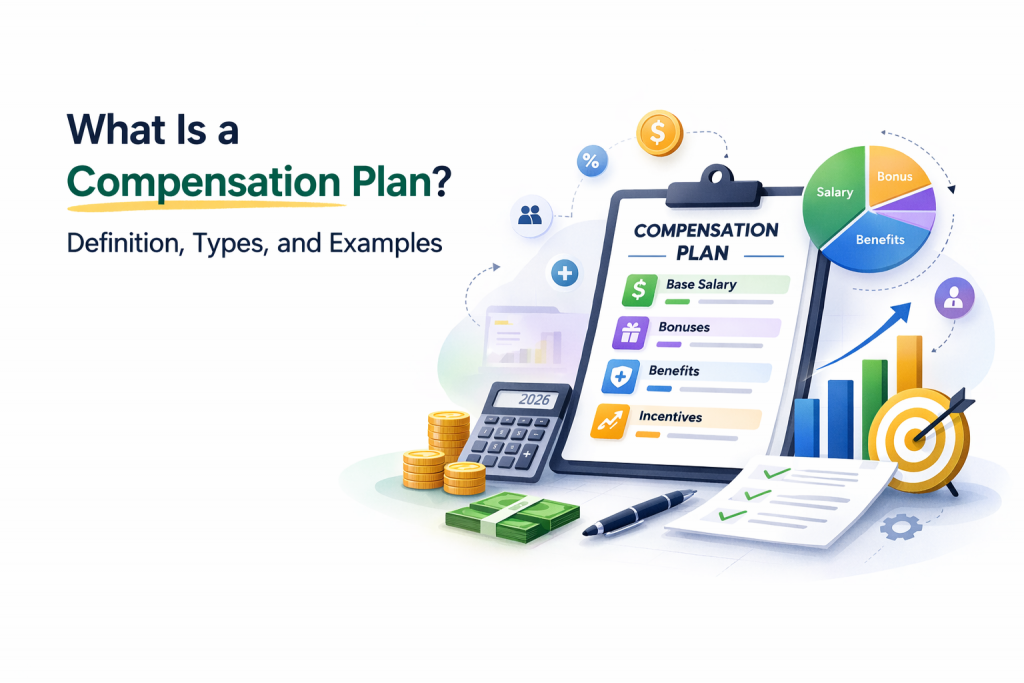
A compensation plan is a structured framework that outlines how an organization pays and rewards its employees. It covers everything from base salary and bonuses to equity, benefits, and non-monetary perks. Think of it as the complete picture of what an employee receives in exchange for their work, not just the number on their offer letter.
A well-built compensation plan does more than set pay rates. It defines the logic behind those rates. It explains how the company determines what each role is worth, how pay increases are earned, what performance looks like, and how the organization positions itself relative to the market. When someone asks why they are paid what they are paid, the compensation plan should have a clear answer.
At its core, every compensation plan is built on four pillars: a compensation philosophy that guides decision-making, a job architecture that maps roles and levels, performance management guidelines that connect effort to reward, and an incentive structure that motivates specific outcomes.
Direct vs. Indirect Compensation: Understanding the Two Categories
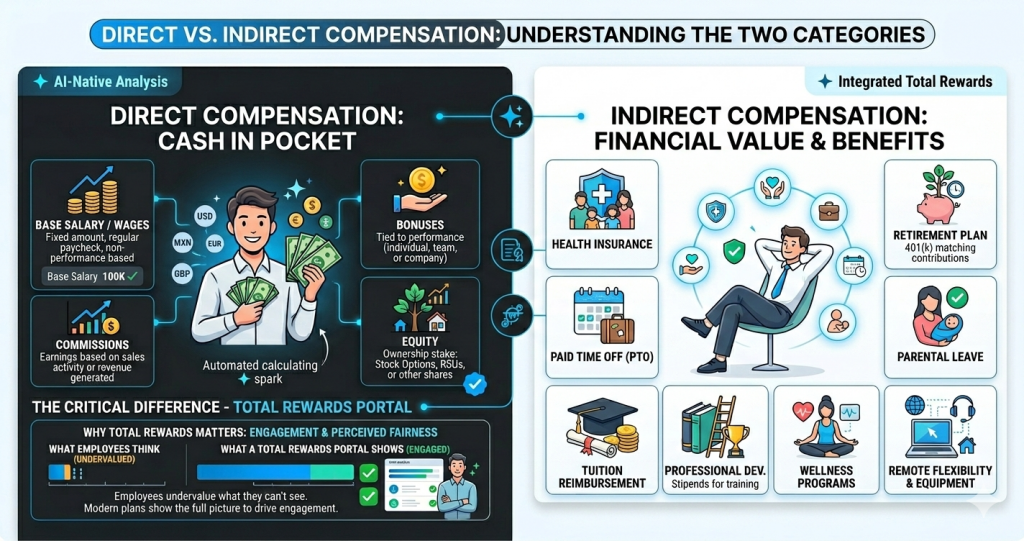
Every compensation plan is made up of two broad categories, and understanding the difference between them is essential before you start building one.
Direct Compensation
Direct compensation is the money that goes directly into an employee’s pocket. This is the part most people think of when they hear the word “compensation.” It includes base salary or hourly wages, which are the fixed amount an employee earns regardless of performance. It also includes bonuses, which are additional payments tied to individual, team, or company performance. Commissions fall here, too, which are earnings based on sales activity or revenue generated. And then there is equity, including stock options, restricted stock units, or other ownership stakes in the company.
Indirect Compensation
Indirect compensation covers the non-cash benefits that still carry real financial value. Health insurance is the most obvious example, but this category also includes retirement plan contributions like 401(k) matching, paid time off, parental leave, tuition reimbursement, professional development stipends, and wellness programs. In some companies, things like remote work flexibility, company equipment, and meal stipends also fall under indirect compensation.
Research consistently shows that employees who perceive their compensation plan as fair are significantly more likely to be engaged at work. But here is the catch: most employees dramatically undervalue their indirect compensation because they never see the full picture. That is why total rewards statements, which show both direct and indirect compensation in one view, have become such a critical part of modern compensation plans.
Types of Compensation Plans
Not every company uses the same compensation plan, and not every role within the same company is compensated the same way. Here are the most common types and when they work best.
| Type | How It Works | Best For |
| Salary-Based | Fixed annual pay with standard benefits. Predictable for both employer and employee. | Knowledge workers, management, and corporate roles where output is hard to measure hourly. |
| Hourly | Pay tied to hours worked, often with overtime eligibility. Variable earnings week to week. | Retail, hospitality, manufacturing, and part-time positions. |
| Commission-Based | Earnings are tied directly to sales performance. May include base salary plus commission or commission only. | Sales roles, real estate, financial services, and business development. |
| Salary + Bonus | Fixed base pay with performance bonuses tied to individual, team, or company goals. | Most corporate roles. Common in tech, finance, and professional services. |
| Equity-Heavy | Lower base salary offset by significant stock options, RSUs, or profit-sharing arrangements. | Startups, tech companies, and executive-level positions. |
| Total Rewards | A comprehensive plan that packages salary, bonuses, equity, benefits, and non-monetary perks into one framework. | Enterprises are competing for top talent, especially in tight labor markets. |
Compensation Plan Examples in Practice
Theory is one thing. Seeing how compensation plans actually work in the real world is another. Here are three examples that illustrate how different companies approach the same challenge.
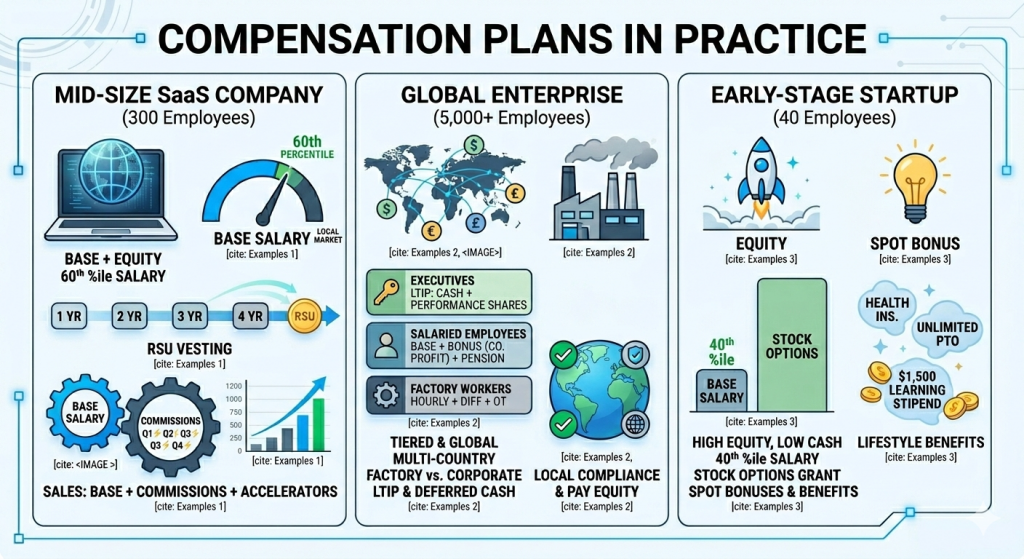
Example 1: Mid-Size SaaS Company (300 Employees)
This company uses a salary-plus-equity compensation plan. Every employee receives a base salary benchmarked to the 60th percentile of their local market. Engineers and product managers also receive RSUs that vest over four years. The company runs an annual merit cycle where managers propose salary adjustments based on performance ratings and market data. Bonuses are reserved for the sales team, which operates on a base-plus-commission structure with quarterly accelerators for exceeding quota.
Example 2: Global Manufacturing Enterprise (5,000+ Employees)
This organization runs a tiered compensation plan across multiple countries. Salaried corporate employees receive base pay, annual bonuses tied to company profitability, and a pension contribution. Factory workers are paid hourly with shift differentials and overtime. Executives participate in a long-term incentive plan with deferred cash and performance shares. The company uses compensation planning software to manage currency conversions, local compliance requirements, and pay equity across 14 countries.
Example 3: Early-Stage Startup (40 Employees)
Cash is tight, so this startup leans heavily on equity. Base salaries are set at the 40th percentile, below market, but every employee receives a meaningful stock option grant. There are no formal bonuses, but the founders offer spot bonuses for exceptional contributions. Benefits include health insurance, unlimited PTO, and a $1,500 annual learning stipend. The compensation plan is documented in a simple one-page philosophy that explains why equity is prioritized and how it could pay off if the company succeeds.
How to Build a Compensation Plan That Actually Works
Creating a compensation plan is not something you do once and forget about. It is an ongoing process that needs regular attention, especially as your company grows, your market shifts, and employee expectations evolve. Here is a practical path forward.
Start with your compensation philosophy. This is the foundation everything else sits on. Decide whether your company will lead the market, match it, or lag with the intention of making up the difference in equity or benefits. Be honest about your budget constraints and what you value most.
Next, build your job architecture. Map every role to a level, define what each level means in terms of scope and responsibility, and assign pay ranges based on market data. This gives you a defensible structure that removes guesswork from pay decisions.
Then connect compensation to performance. Decide how merit increases, bonuses, and promotions will be determined. Make the criteria transparent so employees understand what they need to do to earn more.
Finally, invest in the right tools. Once you grow beyond a hundred employees, managing a compensation plan in spreadsheets creates more risk than it saves in cost. Compensation planning software like Stello AI helps automate the entire compensation cycle. Its AI Budget Modeling lets HR and finance teams create and compare multiple budget scenarios while maintaining pay equity. The AI Market Pricing module accelerates job matching and salary benchmarking. And the platform handles all major equity types, including RSUs, stock options, profit sharing, and complex vesting schedules, so your compensation plan covers the full picture in one place.
Stello also generates total rewards statements through its Total Rewards Portal, giving employees year-round access to personalized compensation statements that show base salary, bonuses, equity, and benefits together. When employees can actually see what their compensation plan is worth, they value it more and are far less likely to leave over a misperception about pay.
Mistakes That Undermine Even Good Compensation Plans
The most common mistake is building a compensation plan and never communicating it. If employees do not know how pay decisions are made, they will assume the worst. Transparency does not mean publishing every salary. It means explaining the framework clearly enough that people trust the process.
Another frequent mistake is ignoring market data. A compensation plan based on internal budgets alone, without benchmarking against what competitors are paying, will gradually push your best people toward the door. Markets move. Your compensation plan needs to move with them.
The third mistake is treating the compensation plan as an HR-only document. The best compensation plans have buy-in from finance, leadership, and managers. Finance ensures the plan is sustainable. Leadership ensures it aligns with strategy. Managers ensure it works in practice.
Getting Your Compensation Plan Right
A compensation plan is more than a pay structure. It is a statement about what your company values, how it treats people, and whether it can compete for talent in a market that is more transparent than ever. The organizations that invest in building a clear, fair, and well-communicated compensation plan are the ones that consistently attract and keep the people who drive results.
Whether you are building your first compensation plan or overhauling one that has not been updated in years, the principles are the same: define your philosophy, benchmark against the market, tie rewards to performance, and communicate openly. The tools to do this well are better than they have ever been, and the cost of getting it wrong keeps going up.
Frequently Asked Questions
What is a compensation plan?
A compensation plan is a structured framework that defines how a company pays and rewards employees. It includes salary, bonuses, equity, benefits, and the philosophy and criteria behind pay decisions.
What’s the difference between a compensation plan and a salary structure?
A salary structure defines pay ranges (minimum, midpoint, maximum) for roles. A compensation plan is broader—it includes salary ranges plus bonuses, equity, benefits, incentives, and performance criteria.
What are the main types of compensation plans?
Common types include salary-based, hourly, commission-based, salary-plus-bonus, equity-heavy, and total rewards plans that combine all pay elements into one framework.
What’s the difference between direct and indirect compensation?
Direct compensation is cash pay, like salary, bonuses, and equity. Indirect compensation includes benefits such as health insurance, retirement contributions, paid time off, and other perks.
How do companies choose a compensation percentile target?
It depends on strategy and budget. The 50th percentile aligns with market median pay, while the 60th or 75th percentile is used to compete for top talent. Some companies balance lower base pay with stronger equity or benefits.
How often should a compensation plan be updated?
At least annually before the merit cycle. Salary ranges should be benchmarked yearly, and the overall plan should be reviewed during major business changes.
What is a total rewards statement?
It’s a personalized summary showing the full value of an employee’s compensation—salary, bonuses, equity, and benefits—to improve transparency and retention.
When should a company invest in compensation planning software?
Typically, between 100 and 250 employees, spreadsheets become unreliable and compensation cycles, compliance, and pay equity management grow more complex.
Need help turning your compensation plan into an automated, data-driven process? Book a demo with Stello AI to see how AI-powered compensation planning software can simplify merit cycles, budget modeling, and pay equity for your organization.