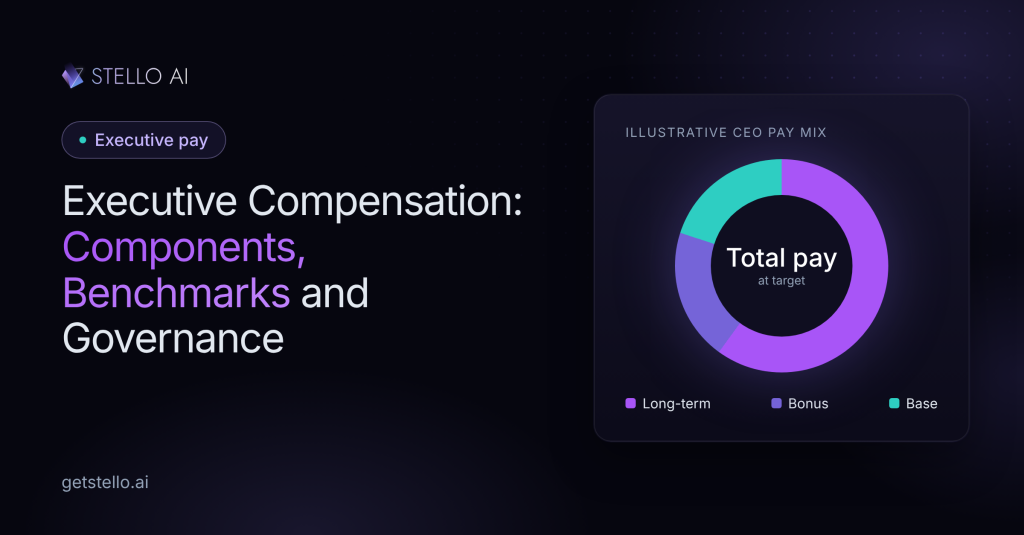
Executive compensation is the total pay package a company gives its senior leaders, such as the CEO, CFO and other top executives. It usually includes base salary, an annual bonus, long-term incentives like stock awards, benefits and perks. At most large companies, the majority of an executive’s pay is tied to performance, and a compensation committee of the board approves it.
Executive pay gets more scrutiny than any other part of a company’s pay structure. Shareholders vote on it, regulators require it to be disclosed, and employees notice it. That’s why getting the structure, benchmarks and governance right matters as much as the numbers.
What Is Executive Compensation?
Executive compensation is the combination of fixed and variable pay used to attract, keep and motivate a company’s top leaders. Unlike pay for most employees, a large share of executive pay is “at risk,” meaning it depends on how the company performs.
The 5 Components of Executive Compensation
| Component | What it is | Purpose |
|---|---|---|
| Base salary | Fixed annual cash pay | Pays for the role and stays the same regardless of results |
| Annual incentive (bonus) | Cash tied to one-year goals | Rewards short-term results such as revenue or profit |
| Long-term incentives | Stock or cash earned over several years | Ties pay to long-term shareholder value and retention |
| Benefits | Retirement plans, insurance, deferred compensation | Supports financial security |
| Perquisites | Extras such as car allowances or security | Covers needs specific to the role |
Long-term incentives carry the most weight
Long-term incentives are usually the largest part of a CEO’s pay at big companies. Among the 250 largest US companies, FW Cook found that 93% use performance-based awards, and these make up 61% of CEO long-term incentive value. Total shareholder return (TSR) is the most common performance measure, used by 73% of companies. Read our guide to how an LTIP works for more detail.
How Companies Benchmark Executive Pay
Executive pay is benchmarked against a peer group: a set of 15 to 25 companies of similar size, industry and complexity that compete for the same talent. A typical process looks like this:
- Build the peer group. Choose companies with similar revenue, market value, industry and geography.
- Gather market data. Use public proxy filings for public peers and executive compensation surveys for broader data.
- Match roles carefully. A CFO at a $500 million company has a different job from a CFO at a $20 billion company.
- Set a target position. Many companies aim for the median of the peer group, adjusting for experience and performance.
- Review every year. Peer groups and market pay change, so refresh both annually.
Stello AI’s AI Market Pricing helps compensation teams match executive roles to market data and see where each leader’s pay sits, while Stello’s Compensation Planning tool models base, bonus and equity together.
Who Approves Executive Compensation?
At public companies, the compensation committee of the board of directors approves executive pay. The committee is made up of independent directors and often works with an outside compensation consultant.
The compensation committee’s main responsibilities include:
- Setting the company’s executive pay philosophy
- Approving the CEO’s pay and reviewing pay for other top executives
- Choosing the peer group and performance measures
- Approving incentive plan payouts
- Overseeing the executive pay disclosure in the annual proxy statement
The CEO usually recommends pay for the executives who report to them but doesn’t decide their own pay.
Say on Pay and Disclosure
US public companies must disclose executive pay in detail in their annual proxy statement. Under the Dodd-Frank Act, shareholders also get an advisory “say on pay” vote on executive compensation at least once every three years. A weak vote is a signal to the board that investors are unhappy with how executives are paid.
Board of Directors Compensation
Board members are paid differently from executives. Directors usually receive an annual cash retainer plus a stock award, with extra pay for chairing the board or a committee. Director pay is typically not tied to performance goals, so directors stay independent from the executives they oversee.
Common Executive Compensation Mistakes
- Paying above market without a reason: setting every role at the 75th percentile without a clear strategy
- Weak links to performance: incentive goals that are too easy to hit
- Poor peer groups: choosing peers that are much larger to justify higher pay
- Inconsistent pay below the executive team: a gap that creates pay compression for the leaders reporting to executives
Frequently Asked Questions
What is included in executive compensation?
Executive compensation usually includes base salary, an annual bonus, long-term incentives such as stock awards, benefits like retirement plans, and perquisites.
What does a compensation committee do?
A compensation committee is a group of independent board directors that sets executive pay philosophy, approves the CEO’s pay, reviews pay for other top executives, approves incentive payouts and oversees pay disclosure.
How is executive compensation benchmarked?
Companies compare executive pay with a peer group of similar companies, using proxy filings and executive compensation surveys. Many target the median of the peer group.
What is say on pay?
Say on pay is an advisory shareholder vote on executive compensation. US public companies must hold it at least once every three years under the Dodd-Frank Act.
How are board directors paid?
Board directors usually receive an annual cash retainer and a stock award, plus extra pay for chairing the board or a committee.