Equity compensation has moved well beyond startup culture. Today, companies of all sizes use it to attract, retain, and motivate talent. But for many HR and comp teams, equity is still managed reactively: grants go out without a clear rationale, employees don’t understand what they’ve received, and the retention value quietly erodes.
In this article, we cover what a deliberate equity compensation strategy looks like, from building your equity philosophy to structuring grants, designing vesting schedules, and communicating total comp clearly to employees.
TL;DR
- Equity compensation includes stock options (ISOs and NSOs), RSUs, ESPPs, and performance shares. The right type depends on your company’s stage, structure, and talent goals.
- Most equity programs fail not because of wrong grant types, but because they are managed reactively with no documented rationale or governance.
- Before granting anything, build a written equity philosophy that defines the role of equity in your comp mix, eligibility tiers, dilution thresholds, and refresh cadence.
- Structure grants using a tiered matrix tied to job levels, benchmarking data, and role criticality. Avoid over-granting to retain underperformers and under-granting top performers out of outdated bands.
- Internal equity matters here too. Employees doing comparable work at comparable levels should not be receiving meaningfully different grants.
- Vesting design is a retention lever, not a default setting. Front-loaded schedules, milestone-based vesting, and shorter windows for senior hires are all worth evaluating.
- The most overlooked part of any equity program is communication. Employees who do not understand their grants cannot be retained by them.
- Equity programs need ongoing governance. Regular audits, internal equity gap checks, and a deliberate refresh strategy keep the program competitive and fair over time.
Building an Equity Compensation Philosophy
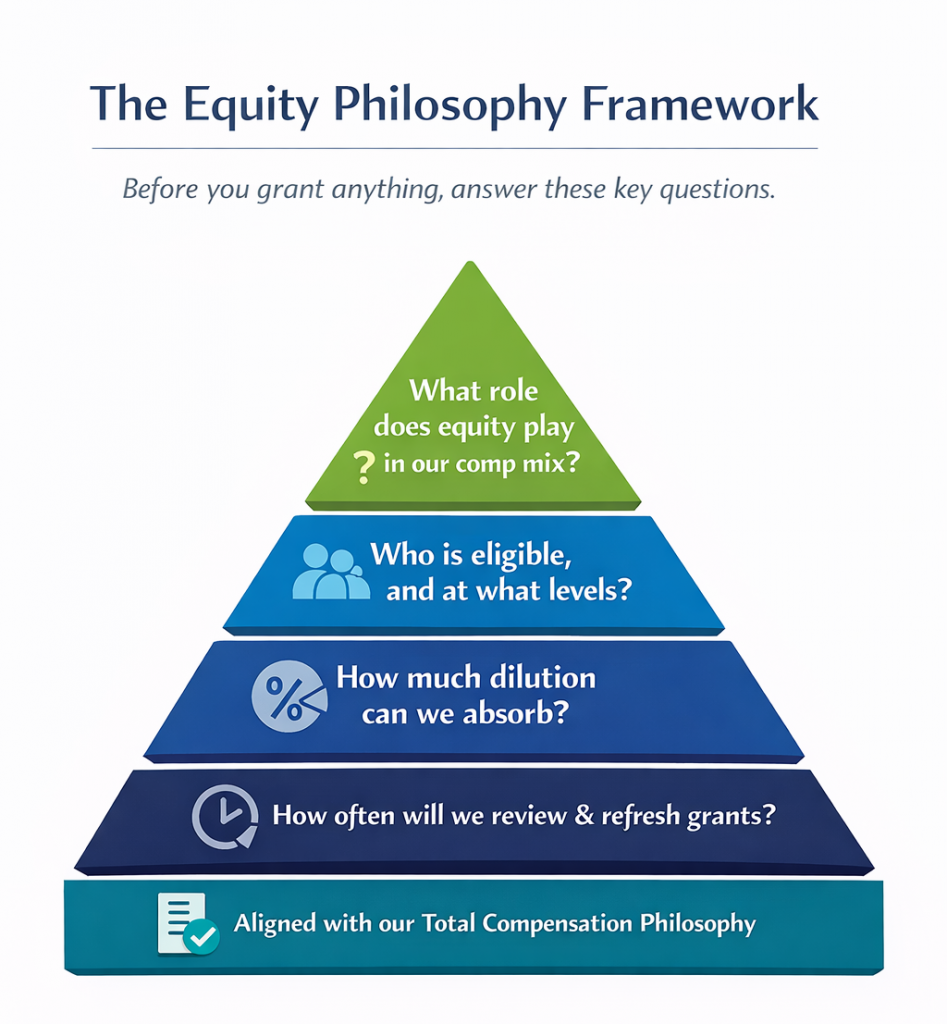
Before you grant a single share, you need a written equity philosophy. This is a documented set of principles that explains why your company offers equity, who is eligible, how much is appropriate at each level, and how grants will be reviewed over time. Without it, equity decisions become inconsistent and hard to defend.
Your equity philosophy should answer a few core questions:
What role does equity play in your total compensation mix?
Some companies use equity to offset below-market cash salaries. Others layer it on top of competitive cash to drive ownership behavior. Knowing which camp you’re in shapes every grant decision that follows.
Who is eligible, and at what levels?
Eligibility tiers should be intentional. Offering equity to all employees signals a culture of shared ownership. Restricting it to senior roles signals that equity is a leadership incentive. Neither is wrong, but the decision should be deliberate and documented.
How much dilution are you willing to absorb?
Equity isn’t free. Every grant dilutes existing shareholders. HR teams need to work closely with finance and legal to understand the option pool, track burn rate, and set guardrails before grants are made.
How often will you review and refresh grants?
A one-time grant at hire is rarely enough to retain high performers over a multi-year period. Building a refresh cadence into your philosophy gives managers a legitimate tool to reward and retain talent without relying solely on promotions or raises.
Your equity philosophy also needs to connect to your broader compensation philosophy. If your comp strategy is built around pay equity and transparency, your equity program needs to reflect the same values. Inconsistent or opaque equity grants are one of the fastest ways to undermine employee trust.
Structuring Equity Across Roles and Levels
Once your equity philosophy is in place, the next step is translating it into a structure that works across your workforce. This means deciding how much equity to grant, to whom, and on what basis.
The most practical starting point is a grant matrix: a framework that maps equity ranges to job levels and functions. Similar to how salary bands work, a grant matrix gives managers and HR a defensible range to work within rather than making grant decisions from scratch each time. It also makes it significantly easier to maintain internal equity across the organization.
When building your matrix, a few factors should drive the numbers:
Market benchmarking
Use compensation survey data to understand what equity looks like at comparable companies, by stage, industry, and role. Equity benchmarks shift frequently, especially in competitive talent markets, so this isn’t a one-time exercise.
Business impact and role criticality
Not all roles carry the same strategic weight. Engineers at a product-led company, or enterprise sellers at a revenue-critical stage, may warrant higher equity positioning than the midpoint of their band.
Level and scope
Equity should scale meaningfully with seniority. If the jump in equity value between a senior individual contributor and a manager is negligible, you’ve reduced one of the most powerful incentives for taking on greater responsibility.
Two failure modes are worth watching for. The first is over-granting to retain underperformers, which dilutes the option pool and sends the wrong signal about what equity is for. The second is under-granting top performers because the band wasn’t reviewed recently enough, which is often how companies lose the people they most need to keep.
Internal equity is also worth examining closely here. If employees doing comparable work at comparable levels are receiving meaningfully different grants, that gap will surface eventually. Building your matrix with pay equity principles in mind from the start is far easier than auditing and correcting it later.
Vesting Schedules and Cliff Design
A vesting schedule determines when employees actually receive the equity they’ve been granted. It’s one of the most consequential design decisions in any equity program, and one that HR teams often inherit rather than actively choose.
The most common structure is a four-year vesting schedule with a one-year cliff. Employees receive nothing if they leave before their first anniversary. After that, the remaining equity vests monthly or quarterly over the following three years. This structure became the default at startups for good reason: it filters for employees who are genuinely committed, while still rewarding tenure over time.
But it isn’t the only option, and it isn’t always the right one.
Front-loaded vesting distributes more equity in the earlier years of the schedule. A common variation grants 40% in year one, then spreads the remaining 60% over years two through four. This works well when you’re competing for candidates who have unvested equity at a current employer and need a stronger near-term incentive to make the move.
Milestone-based vesting ties equity delivery to hitting specific performance or business targets rather than time alone. It’s most commonly used for executive grants or performance shares, where the goal is to align payout directly with outcomes. The tradeoff is complexity: milestones need to be clearly defined, measurable, and perceived as fair.
Shorter vesting windows are also worth considering for senior hires who are closer to retirement age or who bring immediate, high-impact value. A three-year schedule with a six-month cliff may be more competitive than a standard four-year structure in certain hiring situations.
What employees actually care about, more than the specific structure, is clarity. Many employees accept equity grants without fully understanding when they vest, what triggers acceleration, or what happens to unvested shares if they’re let go. HR teams that take the time to explain vesting mechanics during onboarding and in offer letters significantly improve the perceived value of the equity being offered.
Communicating Equity to Employees
Even the best-designed equity program fails if employees don’t understand it.
Most employees don’t know what they’ve been granted, what it’s worth, or when they’ll actually receive it. As a result, equity — which is meant to drive retention — often gets undervalued or ignored entirely.
The gap isn’t in the grant. It’s in communication.
Start with the offer letter. Equity should be presented in a way that’s easy to interpret, not buried in legal language or abstract numbers. Clearly outline the number of shares, vesting schedule, and what that could mean in real terms under different company scenarios.
Beyond hiring, communication needs to be ongoing. Annual equity statements, total compensation summaries, and simple vesting breakdowns help employees stay connected to what they own. Without this, equity becomes invisible after the initial grant.
Clarity also builds trust. When employees can see how their equity aligns with their role, level, and performance, they’re less likely to question fairness — and more likely to value what they’ve been given.
This is where most HR teams struggle to scale. Equity data often lives across systems, spreadsheets, and cap table tools, making it hard to present a unified view.
Platforms like Stello AI address this by bringing equity into total compensation visibility — giving employees a clear, real-time understanding of their ownership, not just a one-time explanation.
Equity Audits and Ongoing Governance
Equity compensation isn’t a set-it-and-forget-it system.
Over time, even well-designed programs drift. Hiring cycles, market shifts, and ad hoc decisions can create inconsistencies that aren’t immediately visible but become obvious to employees.
Regular equity audits help catch these gaps early.
This means reviewing grants across gender, tenure, role, and level to identify patterns that may signal inequity. Small differences, when compounded over multiple grant cycles, can lead to significant disparities.
Governance also includes tracking how your equity pool is being used. Monitoring burn rate, dilution, and allocation across functions ensures that equity remains a sustainable tool, not a short-term fix.
Refresh grants are another critical lever. Used well, they reinforce retention and reward performance. Used poorly, they become reactive and inconsistent. The difference comes down to having clear criteria and a defined cadence.
The challenge is that most of this work is manual and fragmented.
Stello AI enables continuous equity governance by centralizing grant data, flagging inconsistencies, and helping teams make informed, defensible decisions over time instead of relying on periodic audits alone.
Conclusion
Equity compensation works when it’s deliberate.
A clear philosophy, structured grant approach, thoughtful vesting design, and consistent communication all contribute to whether equity actually drives retention — or quietly loses impact over time.
The challenge for most organizations isn’t intent. It’s execution at scale.
That’s where having the right systems in place matters.
Stello AI helps compensation teams design, manage, and communicate equity programs as part of a unified total compensation strategy — making equity easier to understand, easier to govern, and more effective as a long-term retention tool.
FAQs
1. What is equity compensation?
Equity compensation is ownership in a company offered to employees as part of their total pay. It typically includes stock options, RSUs, or other share-based incentives that vest over time.
2. What is the difference between stock options and RSUs?
Stock options give employees the right to buy shares at a fixed price. RSUs are shares granted directly to employees once they meet vesting conditions. RSUs are simpler, while stock options can offer higher upside if the company grows.
3. How often should companies refresh equity grants?
Most companies review equity at least annually or during major events like promotions. High-performing employees may receive refresh grants more frequently to maintain retention and competitiveness.
4. Why do employees undervalue equity compensation?
Employees often do not understand how equity works, when it vests, or what it could be worth. Poor communication and lack of visibility reduce its perceived value, even when the actual grant is meaningful.