Most bonus plans fail quietly. Not with a lawsuit or a mass resignation — just with a slow erosion of trust. Employees stop believing the plan is fair. Managers start bending the rules. Finance questions why the payout didn’t move the needle. And HR is left defending a structure nobody fully understands.
The root cause is almost always the same: the plan was designed quickly, documented loosely, and never properly revisited. Someone drafted it during a budget cycle years ago, it got copied into the next year’s handbook, and now it has a life of its own.
This guide is a working reference for HR professionals and people managers who want to do it differently. It covers how to structure a bonus plan that employees actually understand, how to set metrics that drive real behavior, what the law requires, and where most organizations quietly get it wrong. Whether you are building something new or fixing something broken, start here.
- Bonus plans fail when poorly designed and unclear.
- Tie bonuses to measurable performance and outcomes.
- Use a mix of individual, team, and company metrics.
- Set threshold, target, and stretch goals.
- Choose funding: formula-based vs budget-based.
- Document everything to reduce legal risk.
- Train managers for fairness and consistency.
- Communicate clearly to build trust.
- Review annually to improve effectiveness.
What is an Employee Bonus Plan?
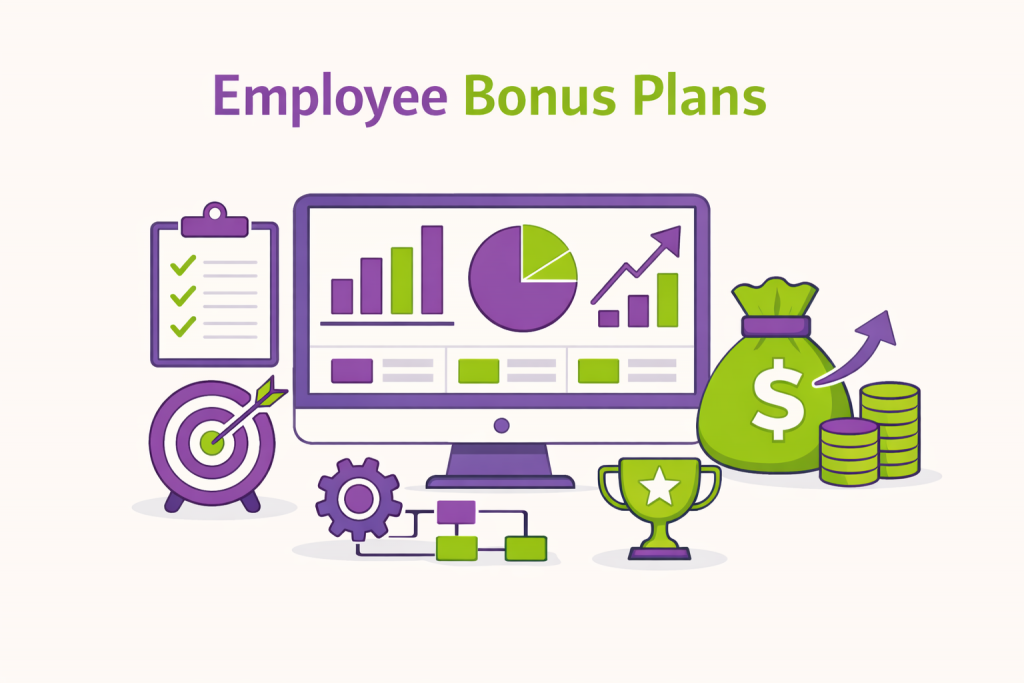
An employee bonus plan is a formal compensation structure that provides employees with additional financial rewards beyond their fixed base salary. Unlike standard pay increases, bonuses are typically variable — they fluctuate based on performance, company results, specific milestones, or other defined criteria.
Bonus plans serve multiple organizational functions simultaneously:
- Motivation: Incentivize employees to achieve specific goals and behaviors.
- Retention: Make it financially costly for high performers to leave, particularly when bonuses are tied to tenure.
- Recruitment: Attract competitive talent, especially in sectors where base salary flexibility is limited.
- Alignment: Connect individual effort to team, departmental, and enterprise-level outcomes.
- Cost management: Tie compensation expense to organizational performance, reducing fixed payroll risk.
Important distinction: HR professionals should differentiate between discretionary bonuses (fully at employer discretion, not guaranteed) and nondiscretionary bonuses (promised in advance based on defined criteria). This distinction carries significant legal and FLSA implications, which we address in the compliance section below.
Also read: The Complete Guide to Equity Compensation: RSUs, Stock Options, and Strategic Target Setting
Types of Employee Bonus Plans: A Complete Taxonomy
There is no one-size-fits-all bonus structure. The most effective HR leaders select and combine bonus types based on their organization’s culture, financial model, workforce profile, and strategic objectives. Below is a detailed breakdown of every major bonus type in use today.
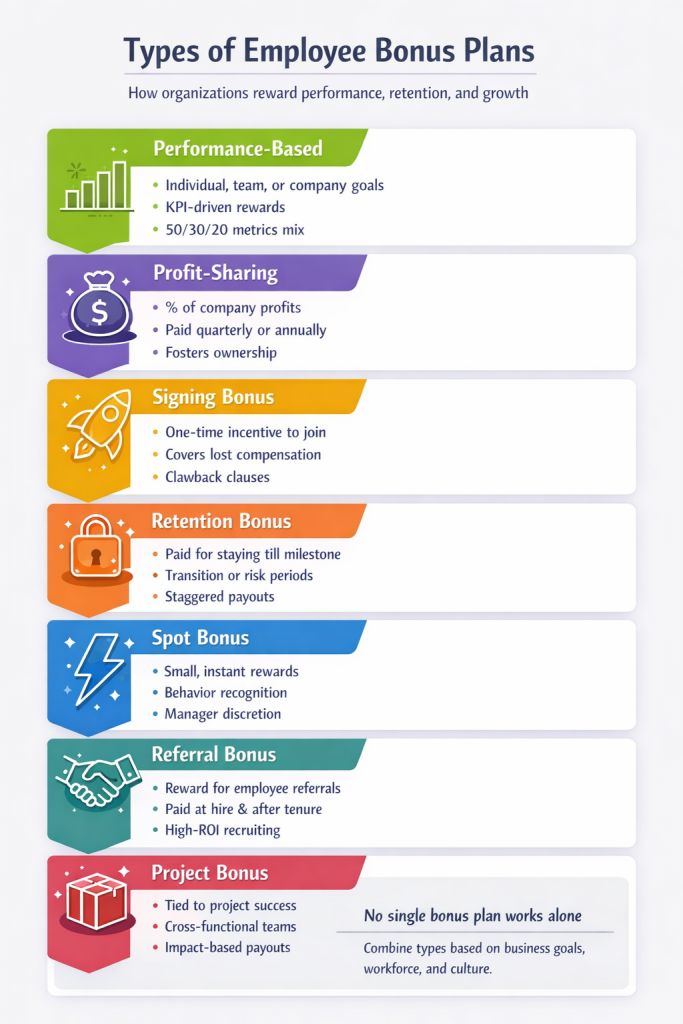
1. Performance-Based Bonuses
Performance-based bonuses are the most prevalent bonus type in corporate environments. They tie payout directly to the achievement of predetermined goals at the individual, team, or company level. These goals can include revenue targets, customer satisfaction scores, production quotas, project delivery milestones, or any other measurable KPI.
- Individual performance bonuses: Reward personal output. Effective for roles with clear, measurable deliverables — sales, recruiting, customer service.
- Team performance bonuses: Reward collective output. Better for collaborative environments where individual contribution is difficult to isolate.
- Company-wide performance bonuses: Tie payout to organizational results (e.g., EBITDA margin, total revenue, NPS). Builds enterprise alignment but can feel remote to individual contributors.
Best practice: Use a weighted combination — for example, 50% individual metrics, 30% team metrics, 20% company metrics — to balance personal accountability with collaborative behavior.
2. Profit-Sharing Plans
In a profit-sharing arrangement, a defined portion of the company’s net profits is distributed to employees on a periodic basis, typically annually or quarterly. The pool size is usually determined by a formula (e.g., 5–15% of pre-tax profits) and then allocated to participants based on salary, tenure, or a combination of both.
Profit-sharing is especially effective in closely-held businesses, employee-owned companies, and organizations that want to foster an ownership mindset across the workforce. When employees see a direct line between company profitability and their own paycheck, discretionary effort tends to increase.
- HR tip: Profit-sharing plans can be structured as qualified deferred compensation plans under IRS rules (contributions placed into a 401(k)-style trust), or as immediate cash payouts. Each structure has distinct tax advantages — consult with a compensation attorney or benefits advisor.
3. Signing Bonuses
Signing bonuses — also called sign-on bonuses — are one-time payments offered to candidates as a financial incentive to accept a job offer. They are particularly common in high-demand fields such as technology, healthcare, finance, and senior executive roles.
From an HR strategy perspective, signing bonuses allow organizations to bridge the gap when they cannot match a candidate’s current base salary or when a candidate must forfeit unvested equity or bonuses at their current employer.
- Clawback provisions: Always include a repayment clause requiring the employee to return the bonus (or a prorated amount) if they leave within 12–24 months of hire. Failing to do so creates significant financial exposure.
- Budget consideration: Signing bonuses are a one-time cost that does not inflate base salary — and therefore does not compound into future raises, benefits calculations, or severance obligations.
4. Retention Bonuses
Retention bonuses are payments offered to incumbent employees to encourage them to remain with the organization through a defined period or critical event — such as an acquisition, product launch, restructuring, or leadership transition. They typically pay out in full upon completing the designated retention window.
Unlike performance bonuses, retention bonuses are not contingent on output — they reward presence and commitment. They are most often deployed for high-risk, hard-to-replace talent during times of organizational uncertainty.
- Design tip: Consider staggered retention schedules (e.g., 50% at 6 months, 50% at 12 months) rather than a single lump sum. This creates sustained incentive throughout the retention period, rather than a cliff employees wait out and then immediately leave.
5. Spot Bonuses
Spot bonuses are small, immediate cash awards given to recognize exceptional contributions that fall outside the normal performance review cycle. They are highly effective for reinforcing specific behaviors in real time — the closer the reward is to the behavior, the stronger the reinforcement.
Common triggers include: going above and beyond on a project, providing exceptional customer service, developing a process improvement, or demonstrating company values in a notable way.
- Manager training: The effectiveness of spot bonuses depends entirely on manager discretion and consistency. HR should establish clear criteria, dollar-band guidelines (e.g., $100–$500), and a lightweight approval workflow to prevent favoritism or perceived inequity.
6. Referral Bonuses
Employee referral bonuses incentivize current employees to refer qualified candidates from their personal networks. Referred candidates tend to be higher quality, onboard faster, and stay longer — making referral programs one of the highest-ROI recruiting tools available.
Referral bonuses typically pay out in two tranches: a portion at hire, and the remainder after the referred employee completes 90–180 days. This ensures the referring employee has an ongoing interest in the success of their referral.
7. Project-Based Bonuses
Project bonuses are awarded upon the successful delivery of a defined project or milestone — a product launch, system implementation, facility opening, or deal close. They are particularly effective for project-based work environments and for motivating cross-functional teams assembled around a specific deliverable.
Bonus Plan Comparison: Quick Reference for HR Professionals
The following table summarizes key attributes of each bonus type to assist in plan selection and design decisions.
| Bonus Type | Basis for Award | Typical Timing | Amount Driver | Who Is Eligible |
|---|---|---|---|---|
| Performance-Based | Individual/Team/Company Goals | Quarterly or Annual | Revenue, KPIs, OKRs | All levels |
| Profit-Sharing | Company-wide profits | Annual / Quarterly | Company net income | Broad workforce |
| Signing Bonus | Offer acceptance | At hire or after tenure | Market competitiveness | New hires |
| Retention Bonus | Staying through trigger date | At milestone date | Retention risk level | Key employees |
| Spot Bonus | Exceptional contribution | Ad hoc / immediate | Manager discretion | Any employee |
| Referral Bonus | Successful hire referral | After new hire tenure | Hiring difficulty | Current employees |
| Project Bonus | Delivery of specific project | On project completion | Complexity & impact | Project team |
How Bonus Plans Work: The Design Framework
Designing an effective bonus plan requires deliberate choices at each stage of the design process. Below is the end-to-end framework used by leading compensation professionals.
Step 1: Define Objectives and Eligibility
Before setting a single metric, define what business problem the bonus plan is solving. Is the goal to improve sales performance? Reduce turnover among engineers? Drive adoption of a new product line? The answer shapes every subsequent design decision.
Then define eligibility clearly:
- Which employee populations are covered (full-time only, part-time pro-rated, exempt vs. non-exempt)?
- Is there a minimum tenure requirement (e.g., employed by March 31 to be eligible for the prior year)?
- Are employees on performance improvement plans (PIPs) eligible?
- How does mid-year hire, promotion, or leave of absence affect proration?
Step 2: Set Goals and Metrics
Effective bonus metrics are SMART: Specific, Measurable, Achievable, Relevant, and Time-bound. Vague goals (‘perform well’) create disputes and erode trust. Over-ambitious goals demotivate rather than inspire.
For each metric, establish three performance levels:
- Threshold: The minimum acceptable performance level required to earn any bonus (e.g., 80% of target).
- Target: The expected performance level that earns 100% of the target bonus.
- Stretch / Outperformance: An aspirational level that earns an above-target payout (e.g., 125–150% of target bonus).
This three-tier structure avoids the ‘all or nothing’ problem that causes employees to either coast once they hit target or give up entirely when they fall behind early in the performance period.
Step 3: Determine Payout Structure and Funding
Decide whether the bonus pool is:
- Formula-funded: A predetermined formula ties the total available pool to a business metric (e.g., bonus pool = 10% of operating income above plan). This structure is self-funding and aligns bonus cost with organizational health.
- Budget-funded: A fixed dollar amount is budgeted at the beginning of the year. Simpler to administer but can create perverse incentives if the pool must be fully distributed regardless of performance.
At the individual level, determine payout as either a flat dollar amount, a percentage of base salary, or a performance-multiplier on a target bonus amount. The latter — (Target Bonus) × (Performance Score) — is the most sophisticated and commonly used approach in corporate environments.
Step 4: Establish Governance and Approval Workflows
Define who has authority to approve bonus payouts at each level of the organization. Typical governance structures include:
- Manager recommends → HR reviews for equity → Finance approves against budget → Executive signs off above threshold.
Document this workflow and build it into your HRIS or performance management platform to ensure auditability.
Step 5: Communicate the Plan Clearly
A well-designed bonus plan that employees do not understand provides zero motivational value. HR should:
- Distribute written plan documents at the start of each performance period.
- Hold manager training sessions to ensure consistent interpretation.
- Provide each employee with a personalized target bonus amount in writing.
- Offer mid-year check-ins so employees can gauge their progress.
- Send payout statements with transparent calculations showing how the bonus was derived.
Step 6: Review, Audit, and Iterate
Bonus plans should be reviewed annually. Key questions for each review cycle:
- Did the metrics drive the intended behaviors? Were there unintended consequences?
- What was the distribution of payouts across performance levels, demographics, and departments?
- Did the plan stay within budget? If over or under, why?
- What do employee surveys say about the perceived fairness and clarity of the plan?
Legal and Compliance Considerations for HR
Bonus plans carry significant legal exposure if not carefully structured. HR professionals must navigate a complex web of federal law, state-specific wage regulations, and anti-discrimination requirements.
| Area | Key Consideration | HR Action Required |
|---|---|---|
| Tax Treatment | Bonuses are taxable wages | Withhold at supplemental rate (22% federal) |
| FLSA / Overtime | Nondiscretionary bonuses affect overtime pay | Include in regular rate for OT calculation |
| Earned Wage Laws | Some states treat accrued bonuses as earned wages | Review state law; include clear forfeiture language |
| Discrimination Risk | Inconsistent distribution may trigger disparate impact claims | Audit payout data across protected classes |
| Plan Documentation | Oral plans can create enforceable obligations | Always use signed, written agreements |
Documentation is Non-Negotiable
Every bonus plan, regardless of size, should be documented in a signed written agreement that specifies:
- Eligibility criteria and any exclusions.
- The formula or criteria by which the bonus is calculated.
- Payment timing and method.
- The employer’s right to modify or terminate the plan.
- Any clawback, forfeiture, or repayment provisions.
Verbal or informal bonus promises have been upheld as enforceable contracts in multiple jurisdictions. Do not rely on email threads or manager conversations to communicate plan terms.
Best Practices for HR Professionals and Managers
| Quick Reference: Bonus Plan Best Practices – Always document bonus plans in signed written agreements before the performance period begins. – Use a three-tier threshold/target/stretch structure to maintain motivation across all performance levels. – Audit payout distributions annually for disparate impact across gender, race, age, and other protected classes. – Train managers consistently on eligibility rules and payout calculations before communicating to employees. – Review FLSA overtime implications for any non-discretionary bonuses paid to non-exempt employees. – Consult employment counsel before launching any new or significantly modified bonus structure. – Use personalized payout statements that show employees exactly how their bonus was calculated. |
Promoting Equity and Transparency
One of the most common sources of employee relations issues is perceived inequity in bonus administration. HR can proactively reduce this risk by:
- Standardizing performance rating scales and calibrating managers before final ratings are submitted.
- Using compensation analytics to identify and investigate outliers in bonus payouts by demographic group.
- Publishing the bonus plan structure (not individual amounts) company-wide so employees understand the rules.
- Creating a formal appeals or review process for employees who believe their bonus was calculated incorrectly.
Aligning Bonus Plans With Company Culture
Bonus plan design sends a powerful cultural signal. A plan that rewards only individual metrics in a team-oriented culture can actively damage collaboration. Conversely, a pure team-based plan in a high-accountability sales environment can mask individual underperformance.
HR should involve business leaders and employee focus groups in the design process to ensure the plan structure reflects and reinforces the organization’s stated values — not just its financial objectives.
Technology and Administration
Modern HRIS and compensation management platforms (e.g., Workday, SAP SuccessFactors, Beqom, Betterworks) can automate significant portions of bonus administration, including:
- Goal setting and cascading at the start of the performance period.
- Real-time tracking of goal progress throughout the year.
- Automated payout calculations based on final performance scores.
- Manager workflow for recommendations and approvals.
- Employee self-service access to plan documents and payout statements.
Investing in the right tooling reduces administrative burden, improves accuracy, and creates the audit trail required for compliance purposes.
Emerging Trends in Bonus Plan Design (2024–2025)
Continuous recognition and micro-bonuses: Point-based recognition platforms (e.g., Bonusly, Workhuman) that allow peer-to-peer micro-rewards are supplementing — and in some cases replacing — annual spot bonus programs. The real-time feedback loop aligns with the expectations of younger workforce generations.
ESG-linked bonuses: A growing number of organizations are incorporating environmental, social, and governance (ESG) metrics into executive and manager bonus plans, signaling that financial performance alone is insufficient for full reward.
Personalized bonus elections: Some organizations are experimenting with giving employees a choice between different bonus vehicles — cash, deferred stock, PTO, or even experiences. This flexibility can increase perceived value without increasing cost.
Pay transparency legislation: As an increasing number of states enact pay transparency laws, HR must ensure that bonus ranges and criteria are included in job postings and total compensation disclosures. Failing to include variable pay in transparency reporting is a compliance gap that regulators are beginning to scrutinize.
Conclusion
A well-structured employee bonus plan is far more than a financial transaction — it is a communication to your workforce about what the organization values, what it expects, and how it recognizes contribution. When designed with intentionality, administered with consistency, and reviewed with rigor, bonus plans are among the most effective tools available to HR professionals for driving performance and building an engaged, committed workforce.
HR professionals who invest the time to build legally sound, equitably administered, and strategically aligned bonus programs will find themselves better positioned to attract top talent, retain high performers, and demonstrate the tangible business impact of their people strategy.
This document is intended for internal HR and management use. For legally binding compensation commitments, consult your employment counsel and ensure all plan terms are documented in signed agreements.