Nobody ever makes a deliberate decision to run a compensation program on spreadsheets. It just kind of happens. You start with a simple tab to track salaries. Someone adds a column for merit increases. Then bonuses. Then equity. Then someone builds a formula to calculate ratios. Before you know it, you have a 47-tab workbook with nested VLOOKUPs, conditional formatting that nobody remembers setting up, and a filename that ends in “v7_FINAL_FINAL_updated_March.”
And honestly, it works for a while. Spreadsheets are flexible, familiar, and free. There is no implementation timeline, no vendor evaluation, and no change management. For a company with 30 or 50 employees, Excel is a perfectly reasonable tool for compensation planning.
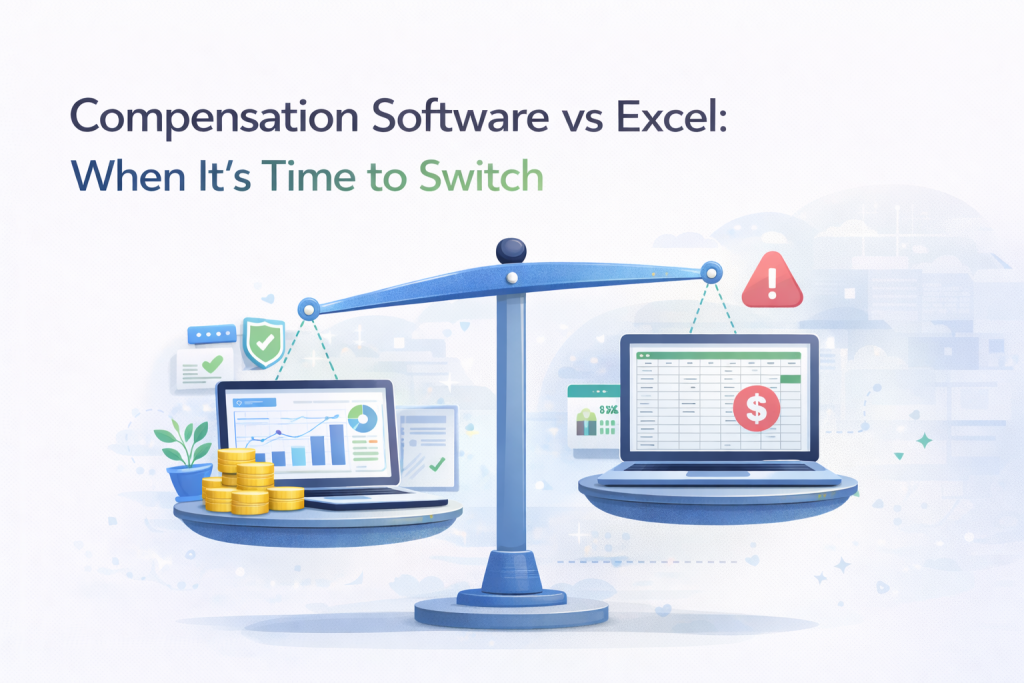
But spreadsheets do not scale. And the moment they stop working, they do not fail gracefully. They fail in ways that cost real money, damage employee trust, and create compliance exposure that nobody sees coming. The question is not whether you will eventually need compensation planning software. It is whether you will make the switch before or after the spreadsheet causes a problem you cannot undo.
TL;DR
- → Excel works for small teams under ~75 employees, single-country operations, and simple salary structures — but it breaks quickly as headcount and complexity grow
- → Warning signs you have outgrown spreadsheets include merit cycles longer than four weeks, formula errors impacting pay, inconsistent manager decisions, and finance questioning compensation numbers
- → Pay equity questions, equity managed in separate systems, and crossing the 100-employee threshold are strong indicators it is time for compensation planning software
- → Switching to dedicated software reduces cycle time by 40–60%, eliminates most formula errors, improves budget accuracy, and gives finance real-time visibility
- → Managers gain clear compa-ratios, salary ranges, and AI-powered recommendations instead of confusing multi-tab spreadsheets, leading to more consistent pay decisions
- → Stello AI centralizes base salary, bonuses, and equity in one AI-native platform with AI Budget Modeling, AI Market Pricing, structured approvals, and an AI Compensation Agent for instant insights
- → The visible cost of software is lower than the invisible cost of spreadsheet errors, compliance risk, lost talent, and unreliable labor forecasting — switching proactively is always cheaper than reacting to a failure
Where Excel Works Fine
Let us be honest about where spreadsheets still make sense. If you are a company with fewer than 75 employees, a single office or country, straightforward compensation structures with no equity component, and a small enough HR team that one person can manage the entire process, Excel can work. You do not need compensation planning software to give three dozen people a merit increase once a year.
Spreadsheets also work for one-off analysis. Modeling a what-if scenario, building a quick salary range comparison, or pulling together ad hoc data for a leadership conversation. These are tasks where the flexibility of a spreadsheet is genuinely useful, and there is no reason to stop using Excel for them even after you have dedicated software for the core process.
The problems start when the spreadsheet becomes the system, not just a tool.
Seven Signs You Have Outgrown Excel
The shift from Excel to compensation planning software is rarely triggered by a single event. It is usually a pattern that builds over several compensation cycles until the friction becomes impossible to ignore. Here are the signs.
1. Your Merit Cycle Takes More Than Four Weeks
A well-run compensation cycle on dedicated software takes one to three weeks. If yours is stretching to six or eight weeks on spreadsheets, the bottleneck is not your team. It is the tool. The manual work of distributing worksheets, collecting responses, chasing managers, reconciling versions, and rolling up budgets adds weeks of overhead that software eliminates.
2. You Have Had a Formula Error That Cost Money
Spreadsheet errors in compensation are not hypothetical. Research suggests that nearly 90 percent of complex spreadsheets contain errors. In a compensation context, a misplaced decimal or a broken formula can mean an employee gets paid the wrong amount, a budget is miscalculated, or a pay equity issue goes undetected. If you have had even one incident where a spreadsheet error affected a pay decision, you have already paid a higher price than compensation planning software would have cost.
3. Managers Are Making Inconsistent Decisions
In a spreadsheet-based process, every manager is essentially working in isolation. They do not see how their recommendations compare to those of other managers. They do not have clear guardrails for what a reasonable increase looks like. And they do not get feedback on whether their proposals are within budget until HR manually checks weeks later. The result is that two managers in the same department make wildly different pay decisions for employees in similar roles, and nobody catches it until someone complains.
4. Finance Does Not Trust the Numbers
When HR sends finance a compensation budget summary that was assembled from twelve different spreadsheets, finance has no way to verify the accuracy of the underlying data. They either accept it on faith or spend days rebuilding the analysis themselves. Neither option is productive. If your finance team has ever questioned the accuracy of compensation data, it is because the tools are not giving them the visibility they need.
5. You Cannot Answer Pay Equity Questions Quickly
A board member asks whether there are any gender-based pay gaps in your engineering organization. A candidate asks how their offer compares to what existing employees in the same role are earning. A state regulator requests documentation showing your pay ranges are equitable. If answering any of these questions requires more than a few minutes of work, your tools are not keeping pace with the regulatory environment.
6. You Are Managing Equity in a Separate System
When stock options, RSUs, or profit sharing are tracked outside of your compensation planning process, you lose the ability to see total compensation in one view. Managers make base salary decisions without visibility into equity values. Employees do not understand their full compensation package. And finance cannot accurately forecast total compensation costs. If equity is a meaningful part of your compensation strategy and it is living in a separate spreadsheet or platform, you need a unified system.
7. Your Company Has Crossed 100 Employees
This is not a hard rule, but it is a reliable threshold. At 100 employees, you typically have enough managers, enough roles, enough complexity, and enough compliance exposure that the risks of spreadsheet-based compensation planning outweigh the convenience. Most companies that switch to compensation planning software wish they had done it sooner.
What Changes When You Make the Switch
The transition from Excel to compensation planning software changes the process in ways that compound over every cycle.
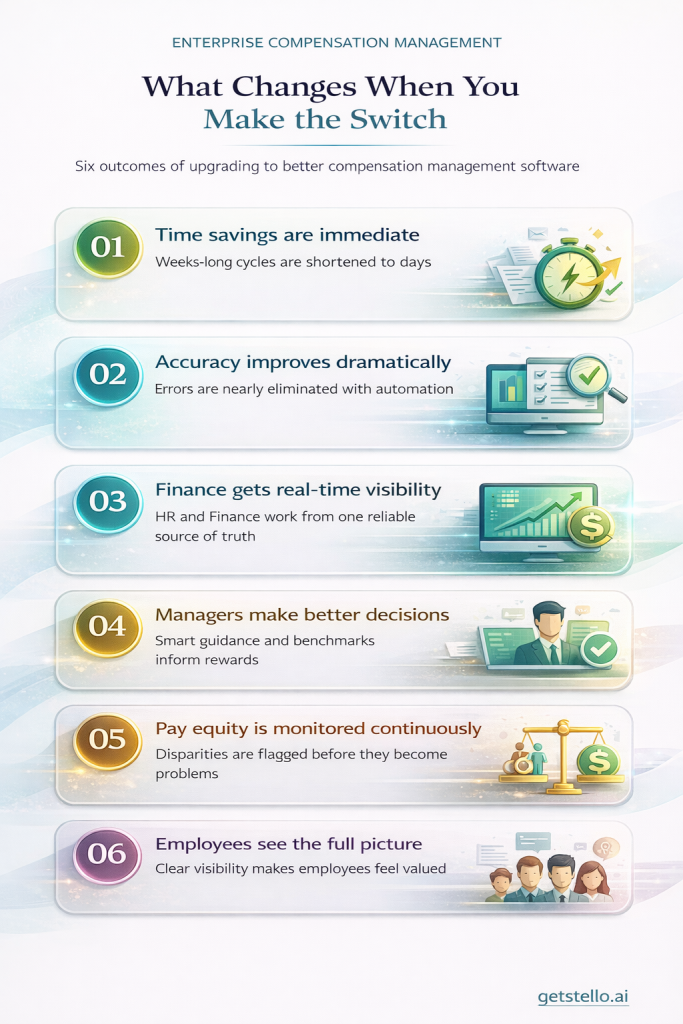
Time savings are immediate. Companies report saving 40 to 60 percent of the time previously spent on compensation cycles. The manual work of distributing, collecting, reconciling, and rolling up spreadsheets disappears. HR teams redirect those hours toward strategic work.
Accuracy improves dramatically. Automated calculations, integrated data sources, and built-in validation eliminate the formula errors and data integrity issues that plague spreadsheets. The error reduction is consistently measured at 90 percent or higher.
Finance gets real-time visibility. Instead of waiting for HR to produce a summary after the cycle, finance sees budget utilization in real time. Scenario modeling that used to take days happens in minutes.
Managers make better decisions. Clear interfaces with compa-ratios, salary ranges, budget guardrails, and AI-powered recommendations replace confusing spreadsheets. Managers spend less time figuring out the tool and more time making thoughtful pay decisions.
Pay equity is monitored continuously. Instead of running a post-cycle audit, the software flags potential disparities as recommendations are entered. Issues get addressed before they are approved, not after.
Employees see the full picture. Total rewards statements show employees the complete value of their compensation, not just the base salary number. This changes retention conversations fundamentally.
How Stello AI Makes the Transition Easy
One of the biggest reasons companies stay on spreadsheets longer than they should is fear of the implementation process. Stello AI was built to address this directly.
Stello integrates with existing HRIS, performance management tools, equity platforms, benefits systems, and Excel files. That last one matters. You do not have to abandon your existing data to get started. If your compensation data currently lives in spreadsheets, Stello can ingest it and put structure around it without requiring a months-long data migration project.
The platform manages the entire compensation cycle in one place, covering base salary, bonuses, and equity, including RSUs, stock options, profit sharing, and complex vesting schedules. This means you are not replacing one spreadsheet with software and keeping three other spreadsheets running alongside it. Everything moves into a single system.
Stello’s AI Budget Modeling lets HR and finance teams create and compare multiple budget scenarios while maintaining pay equity. Real-time budget panels track base salary, equity, and bonus allocations so both teams always see the same numbers. This alone eliminates the most common source of friction between HR and finance in spreadsheet-based environments.
Managers see clear compa-ratios and AI-powered salary increase recommendations based on merit matrix calculations. They can accept the recommendation or override it. This is the experience that drives adoption. When managers find the tool easier than a spreadsheet, the shadow process disappears.
The AI Compensation Agent answers complex compensation data questions and performs calculations instantly, replacing the ad hoc report requests that eat up HR bandwidth. And Stello’s Total Rewards Portal gives employees year-round access to personalized compensation statements showing their full rewards history, turning compensation communication from a once-a-year event into an always-on benefit.
For companies that need flexibility between cycles, Stello supports ad hoc increases throughout the year, including base salary adjustments and spot bonuses, so every compensation decision is tracked in one system regardless of timing.
The Real Cost of Staying on Spreadsheets
The cost of compensation planning software is visible. It shows up on a purchase order and hits a budget line. The cost of staying on spreadsheets is invisible but far larger. It is the hours your HR team wastes on administrative work. The errors that result in overpayments or underpayments. The pay equity gaps go undetected until they become compliance issues. The top performers who leave because they did not understand the full value of their compensation. And the finance team cannot produce accurate labor cost forecasts because the data is unreliable.
Every company makes the switch eventually. The only question is whether you make it proactively or reactively. The proactive path is cheaper, faster, and a lot less stressful.
Frequently Asked Questions
When is Excel still fine for compensation planning?
Under 75 employees, single country, no equity component, and one person can manage the whole process. Spreadsheets also work for one-off analysis and ad hoc modeling alongside dedicated software.
What are the biggest risks of staying on spreadsheets?
Formula errors that affect pay decisions, pay equity gaps that go undetected, inconsistent manager recommendations with no guardrails, finance teams working from unreliable data, and merit cycles that take two to three times longer than necessary.
How much time does switching to software actually save?
Companies report saving 40 to 60 percent of cycle time. Merit cycles that took four to eight weeks on spreadsheets consistently finish in one to three weeks on dedicated software.
Does switching mean abandoning all our existing spreadsheet data?
No. Stello AI integrates with Excel files directly. Your existing compensation data can be ingested into the platform without a months-long data migration project.
What changes for managers when you switch from Excel?
They get a clean interface showing compa-ratios, salary ranges, budget guardrails, and AI-powered salary recommendations instead of a confusing multi-tab spreadsheet. Real-time budget tracking lets them self-correct immediately rather than waiting for HR to flag issues later.
What changes for finance?
Real-time budget visibility replaces after-the-fact summary reports. Scenario modeling that took days happens in minutes. Both HR and finance work from the same live numbers instead of competing spreadsheets.
How does compensation planning software help with pay equity?
It monitors for disparities continuously as recommendations are entered and flags potential gaps before they are approved, instead of discovering them in a post-cycle audit when nobody wants to reopen decisions.
What does Stello AI handle that Excel cannot?
The entire compensation cycle in one platform: base salary, bonuses, equity including RSUs, stock options, and profit sharing. AI Budget Modeling, AI Market Pricing, an AI Compensation Agent for instant data answers, structured approval workflows, real-time budget panels, and a year-round Total Rewards Portal for employees.
Ready to move beyond spreadsheets? Book a demo with Stello AI and see how AI-native compensation planning software replaces the complexity of Excel with the clarity your team deserves.