Every year around merit cycle season, HR teams across the country go through the same ritual. Someone dusts off last year’s compensation spreadsheet, spends a week updating formulas, sends it to fifteen managers, and then waits. What follows is a month of version conflicts, broken cell references, frantic Slack messages asking which file is the latest, and at least one moment where someone accidentally overwrites another manager’s recommendations.
If that sounds familiar, you are not alone. Studies show that the majority of organizations still use spreadsheets for compensation planning, even though the process consistently creates errors, wastes time, and frustrates everyone involved. The good news is that compensation planning software has matured to the point where the switch is no longer painful, expensive, or reserved for Fortune 500 companies.
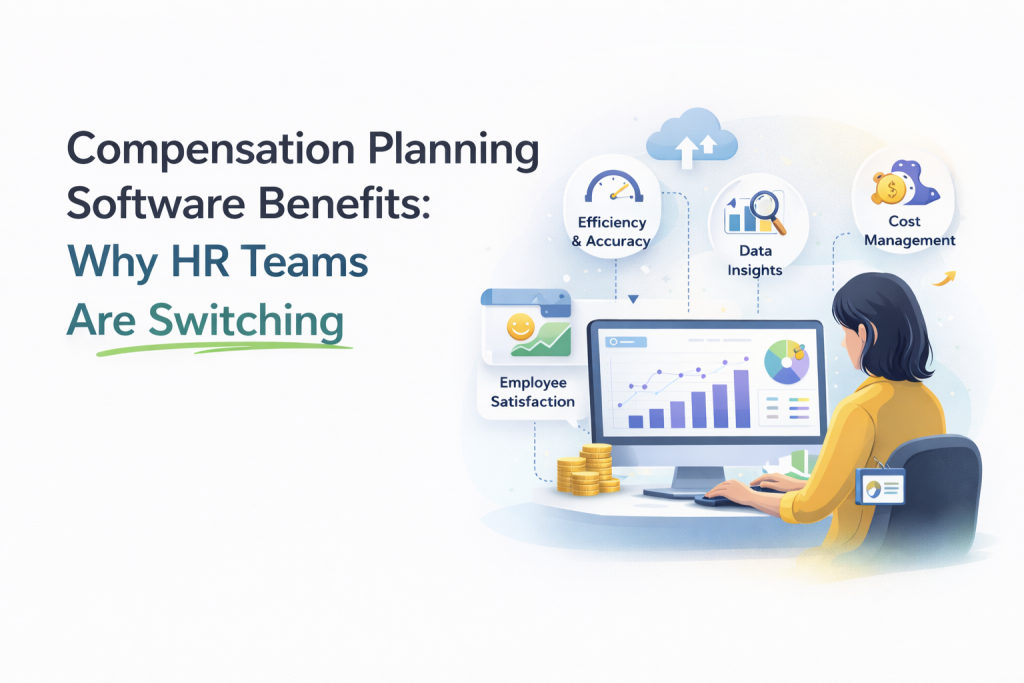
Here is a look at the specific benefits of compensation planning software and why so many HR teams are finally making the move.
TL;DR
- → Spreadsheets cost more than you think: up to 90 percent of complex spreadsheets contain errors, and HR teams waste 40 to 60 percent of cycle time on manual processes
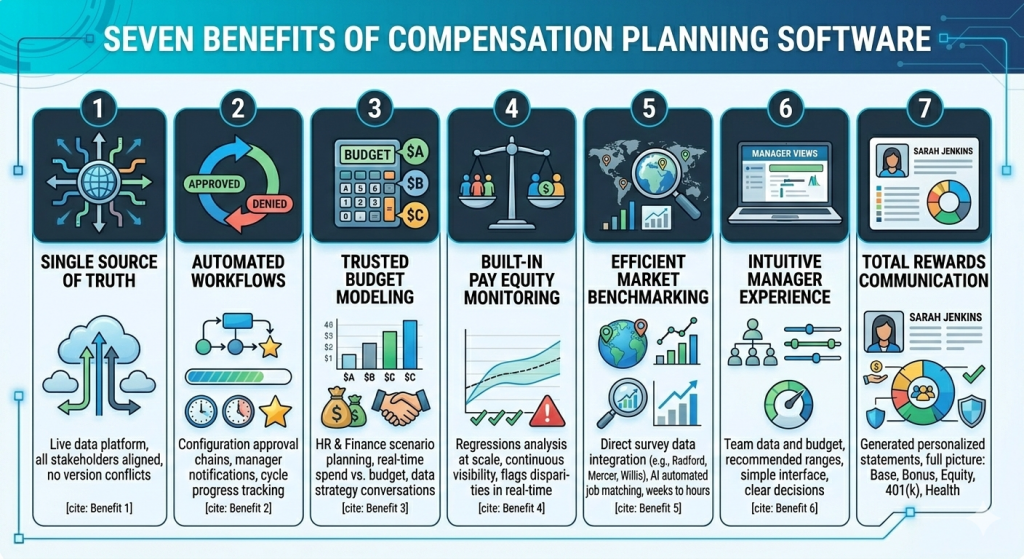
- → Seven core benefits of switching: single source of truth, automated approval workflows, trusted budget modeling, built-in pay equity monitoring, automated benchmarking, better manager experience, and total rewards communication
- → Merit cycles drop from four to eight weeks on spreadsheets to one to three weeks on dedicated software
- → Pay equity monitoring shifts from post-cycle audits to real-time flagging during the cycle, a necessity under expanding transparency laws like SB 1162 and the EU Directive
- → The real trigger to switch is usually an event — a costly formula error, a failed pay equity audit, or a top performer leaving over a compensation misperception
- → Stello AI delivers all seven benefits through an AI-native platform with AI Budget Modeling, AI Market Pricing, an AI Compensation Agent, and a year-round Total Rewards Portal
- → Once HR teams switch to compensation planning software, they never go back to spreadsheets — the cost of staying is not the time you waste but the talent you lose
The Real Cost of Sticking with Spreadsheets
Before getting into the benefits of compensation planning software, it is worth understanding what spreadsheets actually cost you. Most HR leaders know spreadsheets are not ideal, but they underestimate just how much time and money they are burning.
The numbers tell a painful story. According to industry benchmarks, companies that switch to dedicated compensation planning software reduce planning errors by up to 90 percent. HR teams report saving 40 to 60 percent of the time they previously spent on compensation cycles. And only 10 percent of software users report data access issues, compared to 25 percent of teams still relying on spreadsheets.
Those are not abstract numbers. If your compensation team spends 200 hours running a merit cycle on spreadsheets, that is 80 to 120 hours you could reclaim. If a single formula error results in an overpayment or underpayment that goes unnoticed, the financial and trust consequences compound quickly.
Seven Benefits of Compensation Planning Software That Change How HR Works
1. One Source of Truth for All Compensation Data
The most immediate benefit of compensation planning software is that it eliminates the version control nightmare. Instead of fifteen different spreadsheets floating around in email threads, every stakeholder works from the same live platform. When a manager updates a merit recommendation, it shows up in real time for HR and finance. No more reconciling conflicting versions at the end of the cycle.
This matters more than people realize. In a spreadsheet-based process, the compensation team often spends more time chasing data than analyzing it. With compensation planning software, the data is already where it needs to be.
2. Automated Workflows That Cut Weeks Off Merit Cycles
Spreadsheets have no built-in concept of approvals, deadlines, or routing. Someone has to manually track who has submitted their recommendations, who is still working on them, and who needs a reminder. Compensation planning software automates all of this. Approval chains are configured once and enforced automatically. Managers get notified when it is their turn. HR can see cycle progress in a dashboard instead of maintaining a tracking spreadsheet on top of the compensation spreadsheet.
The result is that companies running compensation cycles on dedicated software consistently finish weeks faster than those doing it manually. That time savings flows directly to managers, HR business partners, and finance teams.
3. Budget Modeling That Finance Actually Trusts
One of the biggest pain points in spreadsheet-based compensation planning is the disconnect between HR and finance. HR proposes increases. Finance questions the numbers. Neither side trusts the other’s spreadsheet. Compensation planning software solves this by giving both teams access to the same budget models. HR can run scenarios showing the cost impact of different merit budgets, promotion pools, or equity refreshes. Finance can see real-time spend against budget without waiting for a manually updated report.
When you can model three different budget scenarios in ten minutes instead of three days, conversations between HR and finance shift from arguing over data accuracy to debating strategy. That is a much better use of everyone’s time.
4. Built-In Pay Equity Monitoring
Pay equity is no longer something you audit once a year and file away. With California SB 1162, the EU Pay Transparency Directive, and similar legislation expanding across states and countries, organizations need continuous visibility into pay gaps. Compensation planning software provides this by flagging potential disparities in real time, before merit recommendations are finalized, not after.
This is nearly impossible to do effectively in spreadsheets. Running regression analysis across thousands of employees while accounting for role, level, location, tenure, and performance requires statistical tools that Excel was never designed to handle at scale.
5. Market Benchmarking Without the Manual Work
Staying competitive with pay requires regular benchmarking against market data. In a spreadsheet world, this means manually importing survey data, matching jobs by hand, and building lookup tables that break every time you add a new role. Compensation planning software integrates directly with survey providers like Radford, Mercer, and Willis Towers Watson. Some platforms use AI to automate job matching, cutting what used to be a weeks-long process down to hours.
6. Manager Experience That Drives Adoption
Here is a truth that does not get talked about enough: the success of your compensation cycle depends on managers, not HR. Managers are the ones making pay recommendations, explaining decisions to employees, and dealing with the consequences of getting it wrong. Compensation planning software gives managers a clean, intuitive interface instead of a bewildering spreadsheet with 47 columns and color-coded conditional formatting.
Good platforms show managers exactly what they need: their team’s current compensation, the recommended ranges, the budget they have to work with, and how their proposed changes affect the overall numbers. That clarity leads to better decisions and fewer exceptions that HR has to clean up later.
7. Total Rewards Communication That Builds Trust
Most employees have no idea what their total compensation actually looks like. They see their base salary and maybe their bonus. They do not think about the employer’s 401(k) match, the health insurance premium the company pays, or the value of their equity grants. Compensation planning software can generate personalized total rewards statements that show employees the complete picture. This is one of the most underutilized benefits of compensation planning software, and one of the most impactful for retention.
Spreadsheets vs. Compensation Planning Software: A Side-by-Side Look
| Capability | Spreadsheets | Compensation Planning Software |
| Version control | Manual, error-prone, multiple conflicting files | Single live platform, real-time updates |
| Approval workflows | Email-based, no tracking or enforcement | Automated routing, deadline alerts, progress dashboards |
| Budget modeling | Static, time-consuming to update | Dynamic scenario modeling in minutes |
| Pay equity analysis | Requires external tools and manual analysis | Built-in, continuous monitoring and flagging |
| Market benchmarking | Manual survey imports and job matching | Direct survey integrations, AI-powered matching |
| Security | Shared files with sensitive salary data | Role-based access, encryption, SOC 2 compliance |
| Time to complete cycle | 4-8 weeks typically | 1-3 weeks on average |
When Is the Right Time to Switch?
There is no magic headcount number, but most HR teams start feeling the pain somewhere between 100 and 250 employees. That is when spreadsheets start breaking in ways that are hard to fix: too many managers, too many exceptions, too many currencies, too many compliance requirements.
But the real trigger is usually not headcount. It is an event. Maybe it is a merit cycle that went sideways because someone overwrote a formula. Maybe it is a pay equity audit that took two months instead of two days. Maybe it is a departing employee who said they left because they did not understand their compensation. Whatever the catalyst, the pattern is consistent: once an HR team switches to compensation planning software, they never go back to spreadsheets.
How Stello AI Delivers These Benefits
Stello AI was built from the ground up as an AI-native compensation planning software platform, not a legacy tool with AI added as an afterthought. It addresses the core pain points outlined in this article through a set of purpose-built capabilities.
Its AI Budget Modeling feature lets HR and finance teams create and compare multiple budget scenarios while maintaining pay equity and rewarding top performers. Budget panels track base salary, equity, and bonus allocations in real time, so both teams always see the same numbers. The AI Market Pricing module accelerates job matching and salary benchmarking, cutting weeks off the process that most companies still handle manually.
Stello manages the entire compensation cycle in one platform, with integrated data supporting compensation change decisions across base salary, bonuses, and equity, including RSUs, stock options, profit sharing, and complex vesting schedules. Managers see clear budget utilization, compa-ratios, and AI-powered salary increase recommendations that they can accept or override.
The built-in AI Compensation Agent answers complex compensation data questions and performs calculations instantly, freeing HR and finance teams from building custom reports. And Stello’s Total Rewards Portal lets employees access personalized statements showing their full compensation history at any time, not just once a year during the review cycle.
The platform integrates with existing HRIS, performance management tools, equity platforms, benefits systems, and Excel files, so teams can get started without ripping out their current tech stack. It also supports ad hoc increases throughout the year, whether base salary adjustments or spot bonuses, so compensation decisions are not locked to a single annual cycle.
The Bottom Line
The benefits of compensation planning software are not theoretical. They show up in faster cycles, fewer errors, better decisions, and happier employees who actually understand how they are paid. The cost of staying on spreadsheets is not just the time you waste. It is the talent you lose, the compliance risks you carry, and the strategic conversations you never get to have because your team is too busy fixing broken formulas.
If your next merit cycle is on the horizon, now is the time to make the switch.
Frequently Asked Questions
What are the main benefits of compensation planning software?
It eliminates spreadsheet errors, automates merit cycles, provides real-time budget tracking, monitors pay equity, simplifies market benchmarking, and improves manager and employee experience with clear total rewards visibility.
How much time can it save?
Companies typically save 40–60% of the time spent on compensation cycles. Processes that took 4–8 weeks in spreadsheets often finish in 1–3 weeks with dedicated software.
Does it reduce errors?
Yes. Dedicated platforms can reduce compensation planning errors by up to 90% by removing manual data entry, complex formulas, and version control issues.
How does it support pay equity?
It flags potential pay gaps in real time during planning, helping companies stay compliant with pay transparency regulations and avoid post-cycle surprises.
Is it only for large enterprises?
No. While enterprises benefit greatly, companies with 100–500 employees often see the biggest impact as they outgrow spreadsheet-based processes.
What should I look for in a platform?
Look for structured approval workflows, real-time budget modeling, HRIS/payroll integrations, pay equity monitoring, market benchmarking, and an easy-to-use manager interface.
How does Stello AI compare to spreadsheets?
Stello AI replaces manual spreadsheets with automated workflows, real-time budget dashboards, AI-powered market pricing, instant reporting, and year-round total rewards access.
Can it integrate with existing HR systems?
Yes. Most modern platforms integrate with HRIS, payroll, performance, and equity systems, reducing manual data imports and exports.
Ready to leave spreadsheets behind? Book a demo with Stello AI and see how AI-native compensation planning software can transform your next merit cycle.