Here is a number that should keep every CFO up at night: compensation typically accounts for 60 to 80 percent of a company’s total operating expenses. It is the single largest line item on most income statements. And yet in a surprising number of organizations, the finance team has almost no real-time visibility into how that money is being allocated.
HR runs the merit cycle. Finance gets a summary after the fact. The budget that was approved in October looks nothing like the actual spending by March. Promotions, off-cycle adjustments, new hires, and departures create a moving target that no static spreadsheet can track. And when the board asks for a compensation cost forecast by business unit for the next twelve months, the answer involves two weeks of manual data gathering and a confidence level that nobody is comfortable with.
Compensation planning for finance teams is not about taking over the process from HR. It is about getting the visibility, controls, and modeling capabilities that allow finance to fulfill its actual role: ensuring the company’s largest investment is being deployed strategically, sustainably, and in line with the business plan.
TL;DR
- → Compensation represents 60–80% of operating expenses, yet many finance teams lack real-time visibility into how salary, bonus, and equity budgets are actually deployed
- → Spreadsheet-based compensation planning creates budget variance, slow scenario modeling, disconnected labor forecasting, and hidden compliance risk
- → Modern compensation planning for finance requires real-time budget dashboards by business unit, fast scenario modeling, and governance guardrails with built-in audit trails
- → CFO-level metrics should extend beyond total spend to include compensation-to-revenue ratio, real-time merit variance, compa-ratio distribution, attrition cost vs. retention investment, and pay equity remediation exposure
- → Stello AI centralizes base salary, bonus, and equity planning in one AI-native platform, enabling instant scenario modeling and on-demand cost analysis through its AI Compensation Agent
- → Real-time integration between HR and finance eliminates conflicting spreadsheets and turns compensation from a reactive expense into a strategically managed investment
- → The companies that treat compensation with CFO-level rigor gain forecasting accuracy, cost control, and a measurable competitive advantage over those that do not
Why Finance Teams Are Frustrated with the Status Quo
The tension between HR and finance around compensation is one of the most common and least discussed pain points in growing organizations. It is not a people problem. It is a tool and process problem.
Budget numbers do not match reality. Finance approves a merit budget in Q4 based on projected headcount and a target increase percentage. By the time the cycle runs in Q1, headcount has changed, promotions have been added, and the actual spend lands somewhere different from the original plan. Finance finds out after the fact rather than tracking the variance in real time.
Scenario modeling takes too long. When the CEO asks what it would cost to bring all employees below the salary range midpoint up to market, or what the impact of a three percent versus four percent merit budget would be across the APAC region, finance should not need two weeks and a team of analysts to produce the answer. But in spreadsheet-based environments, that is exactly what happens.
Labor cost forecasting is disconnected from compensation decisions. Finance builds workforce cost models in its FP&A tools. HR makes compensation decisions in spreadsheets. The two rarely connect in real time, which means finance is always working with slightly stale data. For a line item that represents the majority of operating expenses, this disconnect is unacceptable.
Audit and compliance exposure is invisible. Finance is ultimately accountable for the accuracy of compensation accruals, the defensibility of pay practices, and the cost of compliance failures. But without the right tools, finance has no way to independently verify that merit decisions align with approved budgets and guidelines.
What Compensation Planning for Finance Should Actually Look Like
The shift from reactive to proactive compensation planning for finance teams requires three fundamental changes: real-time visibility, modeling capability, and governance controls.
Real-Time Budget Visibility by Business Unit
Finance needs to see compensation spend the same way it sees every other budget category: in real time, broken down by business unit, function, geography, and cost center. This means a live dashboard that shows approved budget versus committed spend versus actual spend at every level of the organization. When a manager submits a merit recommendation, the budget impact should be visible to finance immediately, not after HR aggregates everything into a summary spreadsheet.
Scenario Modeling That Moves at the Speed of Decisions
The most valuable thing compensation planning software can do for finance is compress the time between question and answer. What is the total cost of a company-wide equity refresh? What happens to our compensation-to-revenue ratio if we hire 200 people in Q3? What does the merit budget look like if we exclude employees who received off-cycle increases in the past six months?
These are the questions finance teams ask every quarter. In a spreadsheet world, each one is a project. In a purpose-built compensation planning software environment, each one is a five-minute exercise.
Governance Without Bottlenecks
Finance does not want to approve every individual salary increase. That is HR’s job. What finance needs is confidence that the guardrails are working. Budget caps are enforced automatically. Exceptions require documented justification. Approval chains route decisions to the right people at the right level. And every decision has an audit trail that can be reviewed during internal audits or board-level reporting.
The goal of compensation planning for finance is not more control. It is the right amount of control in the right places, so finance can trust the process without micromanaging it.
The Metrics Finance Teams Should Be Tracking
Most finance teams track total compensation cost and headcount. That is a start, but it barely scratches the surface. Here are the compensation metrics that give finance teams genuine strategic visibility.
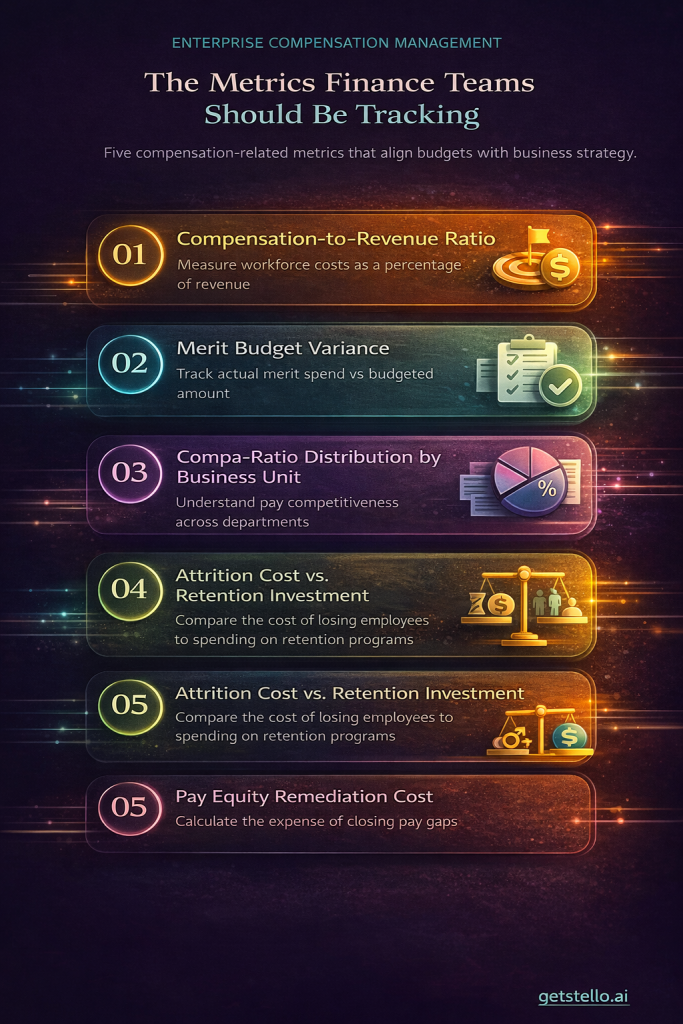
Compensation-to-revenue ratio. This tells you whether your people investment is scaling efficiently with business growth. If revenue is growing at fifteen percent but compensation costs are growing at twenty percent, you have a sustainability problem that needs to be addressed before it compounds.
Merit budget variance. The difference between the approved merit budget and actual merit spend is tracked in real time rather than calculated after the cycle closes. Catching variance during the cycle allows for course correction. Catching it after the cycle is just an autopsy.
Compa-ratio distribution by business unit. This shows how employee pay compares to salary range midpoints across the organization. If one business unit has an average compa-ratio of 0.85 while another sits at 1.10, finance needs to understand why and what the cost of rebalancing would be.
Attrition cost versus retention investment. Replacing an employee costs between 50 and 200 percent of their annual salary, depending on the role. Finance should be comparing the cost of competitive merit increases and equity refreshes against the cost of the turnover that happens when compensation falls behind the market.
Pay equity remediation cost. As pay transparency laws expand, the cost of correcting pay disparities is becoming a predictable budget item. Finance teams that model this proactively can plan for it. Those who are not surprised by unplanned six-figure remediation costs.
How Stello AI Serves the Finance Perspective
Most compensation planning software was designed for HR. Stello AI was built for both HR and finance from the start, which is why its capabilities align directly with what CFOs and FP&A leaders need.
Stello’s AI Budget Modeling feature is where finance teams spend most of their time on the platform. HR and finance can create and compare multiple budget scenarios while maintaining pay equity and rewarding top performers. Real-time budget panels track base salary, equity, and bonus allocations simultaneously. When finance needs to model the impact of a half-point change in the merit budget across a specific region or business unit, the answer is available in minutes.
The platform manages the entire compensation cycle in one place, covering base salary, bonuses, and equity, including RSUs, stock options, profit sharing, and complex vesting schedules. For finance teams that need to forecast the full cost of compensation programs, having all components in a single system eliminates the reconciliation work that comes from pulling equity data from one platform, bonus data from another, and base salary data from a spreadsheet.
Stello’s AI Compensation Agent is particularly useful for finance. Instead of submitting data requests to HR and waiting days for a custom report, finance analysts can ask the AI Compensation Agent complex compensation questions and get calculations instantly. What is the total loaded cost of the engineering team in Germany? How much of the Q2 merit budget has been committed versus spent? The AI handles it in seconds.
Managers see compa-ratios and AI-powered salary increase recommendations based on merit matrix calculations, with the ability to override with justification. This gives finance confidence that the guardrails are working without requiring finance to review individual decisions. The platform integrates with existing HRIS, performance management tools, equity platforms, benefits systems, and Excel files, fitting into the enterprise tech stack without requiring a wholesale replacement.
Stello’s Total Rewards Portal lets employees view their full compensation at any time, which reduces compensation-related attrition driven by misperception about pay. For finance teams, lower attrition directly translates to lower replacement costs. And Stello supports ad hoc increases throughout the year so that mid-cycle adjustments are tracked in the same system as the annual cycle, giving finance a complete picture of compensation spend rather than a partial one.
Bringing HR and Finance Together
The most effective compensation planning processes are the ones where HR and finance are working from the same data on the same platform in real time. HR brings the people expertise. Finance brings budget discipline. When both teams have visibility into the same numbers, the conversations shift from debating whose spreadsheet is right to making strategic decisions about how to invest in people.
Compensation planning for finance is ultimately about treating the company’s largest expense with the same rigor, visibility, and strategic intent that finance applies to every other major investment. The tools to do that are available now. The companies that use them have a measurable advantage over those that do not.
Read: Compensation Planning for HR: How to Run Better Merit Cycles
Frequently Asked Questions
Why is compensation a finance issue, not just HR?
Compensation typically represents 60–80% of operating expenses. Without real-time visibility, finance cannot accurately forecast labor costs, control budget variance, or plan for pay equity adjustments.
What visibility does finance need?
Real-time budget tracking by business unit, geography, and cost center—showing approved budget vs. committed and actual spend. Budget impact should be visible immediately when recommendations are entered.
What metrics should finance track?
Key metrics include compensation-to-revenue ratio, real-time merit budget variance, compa-ratio distribution, attrition cost vs. retention investment, and projected pay equity remediation costs.
How does software improve scenario modeling?
It reduces analysis time from days to minutes. Finance can instantly model changes to merit budgets, hiring plans, or regional investments and see the financial impact immediately.
What governance controls should exist?
Budget cap enforcement, structured approval workflows, documented exception justifications, and full audit trails for every compensation decision.
How does Stello AI support finance teams?
Stello AI provides AI-driven budget modeling, real-time tracking of salary, bonus, and equity allocations, instant cost analysis via its AI Compensation Agent, and a unified system that eliminates spreadsheet reconciliation.
Does it help reduce attrition costs?
Indirectly, yes. Transparent total rewards visibility reduces turnover driven by pay misperception, lowering replacement costs.
How does it align HR and finance?
Both teams work from the same real-time data platform—HR proposes changes, finance sees immediate budget impact—eliminating conflicting spreadsheets and shifting discussions toward strategic workforce investment decisions.