Most companies that benchmark compensation do it wrong. Not because they lack data or tools, but because they skip steps, take shortcuts, or treat the process as a one-time project rather than an ongoing discipline. The result is salary ranges that look defensible on paper but do not actually reflect what the market is paying, which means every compensation decision built on those ranges inherits the same inaccuracy.
The compensation benchmarking process is not complicated in concept. Compare what you pay to what the market pays, identify the gaps, and adjust accordingly. But executing it well requires a methodical approach that most organizations have never formally defined. Instead, the process lives in the head of one or two analysts who do it slightly differently each year based on what they remember from last time.
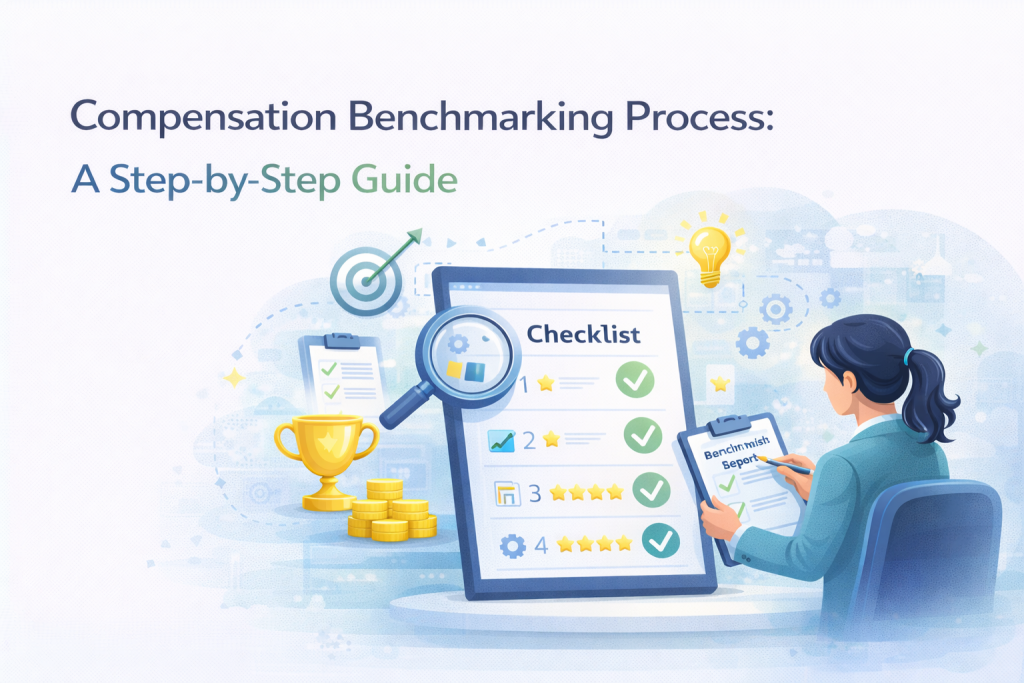
This guide lays out the compensation benchmarking process step by step so your team can follow a consistent, repeatable methodology that produces benchmarks you actually trust.
TL;DR
- → The compensation benchmarking process follows eight steps: define philosophy, select comparator market, choose data sources, match jobs by content, age the data, build salary ranges, analyze internal pay, and take action.
- → Most companies get benchmarking wrong by skipping aging factors, matching roles by title instead of responsibilities, relying on a single data source, and treating benchmarking as a once-a-year project.
- → Blending multiple data sources and applying consistent aging factors produces more reliable, current salary range midpoints aligned to your target percentile.
- → Salary ranges are built from benchmarked midpoints using defined range spreads (typically 40–60%), then validated for internal consistency before analyzing compa-ratios.
- → Platforms like Stello AI accelerate job matching with AI, connect benchmarks directly to merit cycles and budget modeling, and make benchmarking a continuous discipline rather than an annual spreadsheet exercise.
Step 1: Define Your Compensation Philosophy
The benchmarking process starts before you open a single survey. It starts with a clear answer to one question: where does your company intend to position pay relative to the market?
This is your compensation philosophy, and it drives every decision that follows. A company targeting the 50th percentile is saying it wants to pay at the market median. A company targeting the 60th or 75th percentile is making a deliberate choice to pay above market, usually to attract top talent in competitive fields or to compensate for other factors like location or company stage.
Your philosophy does not need to be a single number across the board. Many companies target the 50th percentile for most roles but the 75th percentile for critical technical roles where talent scarcity is acute. Some companies target a lower percentile for base salary but make up the difference with equity, effectively targeting a higher percentile for total compensation.
What matters is that the philosophy is documented, approved by leadership, and understood by everyone involved in the benchmarking process. Without it, benchmarking produces data that nobody knows how to act on.
Step 2: Identify Your Comparator Market
The next step is deciding who you are benchmarking against. This sounds obvious, but it is one of the most common sources of error.
Your comparator market should reflect the companies you actually compete with for talent, not necessarily your business competitors. A mid-size fintech company competes for software engineers against Google, Stripe, and dozens of well-funded startups. It does not compete for that same talent against other mid-size fintechs. Benchmarking against the wrong peer set produces benchmarks that are technically accurate but strategically useless.
Define your comparator market along several dimensions. Industry is the most obvious, but also consider company size, geography, funding stage, and growth rate. A 500-person Series C company and a 500-person publicly traded company attract different talent pools, even if they are in the same industry.
Most survey providers let you filter data by these dimensions. Real-time benchmarking platforms offer similar filtering. The important thing is to be intentional and consistent about your comparator set rather than using default survey cuts that may not represent your actual talent market.
Step 3: Select Your Data Sources
With your philosophy and comparator market defined, the next step is choosing where your benchmarking data will come from.
Most organizations use a combination of sources. Traditional surveys from providers like Radford, Mercer, and Willis Towers Watson provide methodologically rigorous data with broad coverage. Real-time platforms like Pave and Ravio provide fresher data sourced from HRIS integrations but may have narrower coverage depending on your industry and geography.
The best practice is to use at least two sources and blend the results. No single survey or platform covers every role in every market with equal accuracy. Blending reduces the risk of bias from any one source and produces more reliable composite benchmarks.
When selecting sources, consider coverage for your specific roles. Radford is strong in technology. Mercer has broad global and multi-industry coverage. WTW is widely used in financial services and executive compensation. Platform-based tools tend to be strongest in US tech. Choose sources that cover the roles and markets that matter most to your organization.
Step 4: Match Jobs to Market Data
Job matching is where the benchmarking process either gains credibility or loses it. This step involves mapping each internal role to the closest equivalent in your survey or platform data.
The critical rule is to match on job content, not job title. Titles are wildly inconsistent across companies. Your “Senior Software Engineer” might have the responsibilities of another company’s “Staff Engineer” or “Software Engineer III.” Matching by title alone produces misleading benchmarks.
Effective job matching considers the role’s scope of responsibilities, the level of autonomy and decision-making authority, management responsibilities, including the number and type of direct reports, the technical skills and expertise required, and the role’s organizational impact and budget influence.
For companies with hundreds of roles, manual matching is a significant investment of analyst time. This is one area where AI has made a measurable difference. Compensation planning software like Stello AI uses AI Market Pricing to automate the initial matching pass by analyzing job descriptions and matching based on content rather than titles. The AI handles the heavy lifting while human reviewers validate and refine the matches, cutting the timeline from weeks to days.
Step 5: Age the Data
This step is frequently skipped, and skipping it introduces a systematic error that makes every benchmark too low.
Compensation survey data reflects what companies were paying at the time the survey was conducted, which is typically six to twelve months before publication. In a market where salaries are increasing three to five percent annually, six-month-old data is already 1.5 to 2.5 percent below current market rates. For high-demand roles where increases are running ten percent or more, the gap is even wider.
Aging factors adjust historical survey data to estimate current market rates. The calculation is straightforward. If the survey’s effective date was January and you are using the data in July, applying a four percent annual increase rate means multiplying the survey values by approximately 1.02 to project forward six months.
Most survey providers publish recommended aging factors or guide how to calculate them. Use these rather than guessing. And apply aging consistently across all data sources so your blended benchmarks are aligned to the same point in time.
Step 6: Build Salary Ranges
With aged, blended benchmark data in hand, the next step is building salary ranges for each role and level in your organization.
A standard salary range has three points: minimum, midpoint, and maximum. The midpoint is typically set at your target percentile from the benchmark data. If your compensation philosophy targets the 50th percentile, the midpoint equals the 50th percentile market rate for that role. The minimum and maximum are then calculated based on your desired range spread.
Range spread varies by level. A typical structure uses a 40 percent spread for individual contributor roles, meaning the maximum is 40 percent higher than the minimum. Management roles might use a 50 percent spread. Executive roles often use 60 percent or wider to accommodate the greater variability in executive pay.
The formula for building a range from a midpoint and spread is straightforward. Minimum equals midpoint divided by one plus half the spread. Maximum equals midpoint multiplied by one plus half the spread. For a midpoint of $100,000 with a 40 percent spread, the minimum is approximately $83,333, and the maximum is approximately $116,667.
Review the resulting ranges for internal consistency. Adjacent levels should have logical progression. Ranges for similar roles in different functions should not have inexplicable gaps. And no range should create a situation where an employee would receive a pay decrease upon promotion from the maximum of their current range to the minimum of the next.
Step 7: Analyze Internal Pay Against New Ranges
With new ranges set, compare where your current employees sit. This analysis produces the metrics that drive compensation decisions.
Calculate compa-ratios for every employee. Identify employees below the minimum range, which represents both a retention risk and a potential compliance issue in pay transparency jurisdictions. Identify employees above the maximum range, which may indicate an outdated range or a role that has been outgrown. Look at compa-ratio distributions by department, function, and demographic group to identify patterns that suggest systemic pay equity issues.
This analysis also produces the business case for your compensation budget. If twenty percent of your engineering team is below the minimum range, you can quantify exactly what it costs to bring them to market. That number is far more compelling to leadership than a vague statement about being “behind on pay.”
Step 8: Take Action and Monitor Continuously
Benchmarking without action is an academic exercise. The final step is translating your analysis into concrete compensation decisions and building a cadence for ongoing monitoring.
Immediate actions might include adjusting pay for employees below range minimum, updating offer ranges for open requisitions, and adjusting merit budget allocations to prioritize roles or teams that are furthest from market. Longer-term actions include building benchmarking-driven adjustments into your annual merit cycle, reviewing ranges quarterly rather than annually, and establishing triggers that prompt off-cycle reviews when market data shifts significantly.
Compensation management software makes this transition from analysis to action seamless. Stello AI’s platform connects benchmarking data directly to the compensation cycle. When market data is updated, it flows into compa-ratio calculations, AI-powered salary increase recommendations, and budget modeling without manual data transfers.
Stello’s AI Budget Modeling lets HR and finance teams model the cost of bringing employees up to new benchmarks across multiple scenarios while maintaining pay equity. Managers see the updated compa-ratios and recommendations based on merit matrix calculations during the cycle. The AI Compensation Agent answers questions about benchmarking data instantly, so when an HRBP asks what percentage of a department falls below the new range minimum, they get an answer in seconds.
The platform manages base salary, bonuses, and equity, including RSUs, stock options, profit sharing, and complex vesting schedules in one system. This matters because the benchmarking process should cover total compensation, not just base salary. Stello’s Total Rewards Portal gives employees year-round access to personalized compensation statements that show the full value of their pay, and ad hoc increases throughout the year ensure benchmarking-driven adjustments happen when they are needed rather than waiting for the annual cycle.
Making the Process Repeatable
The compensation benchmarking process is only as good as its consistency. A rigorous benchmarking exercise done once and then neglected for eighteen months is worse than a simpler process that runs quarterly. The goal is to build a repeatable methodology that your team can execute efficiently on a regular cadence.
Document every step. Record which surveys you used, what aging factors you applied, how you resolved matching conflicts, and what assumptions drove your range calculations. Next year’s analyst, who may not be the same person, will thank you.
Frequently Asked Questions
What are the steps in the compensation benchmarking process?
Eight steps: define your compensation philosophy, identify your comparator market, select data sources, match jobs to market data based on role content, age the data to adjust for survey lag, build salary ranges, analyze internal pay against new ranges, and take action while monitoring continuously.
Why do most companies get benchmarking wrong?
They skip steps, take shortcuts, or treat it as a one-time project. The most common errors are skipping aging factors, matching by title instead of content, relying on a single data source, and never revisiting ranges after the annual cycle.
What is a comparator market, and how do I define one?
The set of companies you actually compete with for talent may differ from your business competitors. Define it by industry, company size, geography, funding stage, and growth rate. A fintech company competes for engineers against Google and Stripe, not other fintechs.
How do I build salary ranges from benchmark data?
Set the midpoint at your target percentile from blended, aged benchmark data. Calculate the minimum and maximum using your desired range spread. For a $100,000 midpoint with 40 percent spread: minimum is approximately $83,333, maximum is approximately $116,667. Use a 40 percent spread for individual contributors, 50 percent for management, and 60 percent or wider for executives.
How does Stello AI speed up the benchmarking process?
AI Market Pricing automates job matching based on role content, cutting weeks to days. Benchmarking data feeds directly into compa-ratios, merit recommendations, and budget modeling without manual transfers. The AI Compensation Agent answers benchmarking questions instantly, and AI Budget Modeling lets you model the cost of closing market gaps across multiple scenarios.
Ready to build a benchmarking process that runs in days instead of weeks?
Book a demo with Stello AI and see how AI-powered compensation plan software makes every step faster and more accurate.