If you have ever tried running a compensation cycle on spreadsheets, you already know the pain. Version control nightmares, formula errors nobody catches until it is too late, and weeks of back-and-forth between HR and finance that leave everyone frustrated. It is a problem that gets worse every year as headcount grows, pay transparency laws tighten, and employees expect fairer, faster decisions about their pay.
That is exactly why compensation planning software exists. These platforms take the chaos out of merit cycles, budget modeling, salary benchmarking, and pay equity analysis by putting everything in one place. But not all tools are created equal, especially when you are running compensation for an enterprise with thousands of employees across multiple countries.
In this guide, we break down what compensation planning software actually does, what to look for when evaluating platforms, and which tools are worth considering in 2026.
TL;DRTL;DR
- → Compensation planning software replaces spreadsheets with a centralized platform for merit cycles, budget modeling, benchmarking, pay equity, and total rewards
- → Enterprises face unique complexity: multiple compensation types, multi-country compliance, and real-time budget visibility requirements that spreadsheets cannot handle
- → Key evaluation criteria: budget modeling, market benchmarking, pay equity monitoring, merit cycle workflows, system integrations, and total rewards communication
- → Stello AI stands out as an AI-native platform with an AI Compensation Agent, AI Budget Modeling, and AI Market Pricing built into every workflow
- → The platform handles all equity types including RSUs, stock options, and profit sharing alongside base salary and bonuses in one system
- → AI is the biggest shift in 2026: automating job matching, budget scenario modeling, pay equity detection, and natural language compensation data queries
- → Avoid three common mistakes: choosing based on features alone without considering implementation, excluding finance from the evaluation, and ignoring the manager experience
What is Compensation Planning Software?
Compensation planning software is a purpose-built platform that helps HR and finance teams plan, manage, and execute employee pay decisions. Think of it as the operating system for everything related to how your company pays people.
At a basic level, it replaces the spreadsheets and disconnected tools that most companies still use. According to industry research, most organizations still rely on spreadsheets or static surveys to guide salary offers. That might work when you have 50 employees. It falls apart quickly when you are managing thousands of people, multiple currencies, equity programs, and annual merit cycles that need to go through layers of approvals.
A good compensation planning software platform handles salary planning, bonus allocation, equity grants, market benchmarking, budget modeling, pay equity analysis, and total rewards communication. The best ones tie all of these together so decisions made in one area automatically update everywhere else.
Why Enterprises Need Dedicated Compensation Planning Software
The stakes are higher for enterprises. A miscalculated merit increase for one employee is an inconvenience. Miscalculated merit increases across 5,000 employees is a six-figure budget problem that shows up in your next board meeting.
Here is what makes enterprise compensation uniquely complex. You are dealing with multiple compensation types simultaneously, including base salary, short-term incentives, long-term incentives, equity, and deferred compensation. You have employees in different countries with different currencies, tax rules, and labor laws. Pay transparency legislation like California SB 1162 and the EU Pay Transparency Directive now requires you to disclose salary ranges and prove pay equity. And your finance team needs real-time visibility into compensation spend, not a spreadsheet that was accurate three weeks ago.
Compensation planning software solves these problems by centralizing data, automating workflows, and giving both HR and finance a single source of truth.
What to Look for in Compensation Planning Software
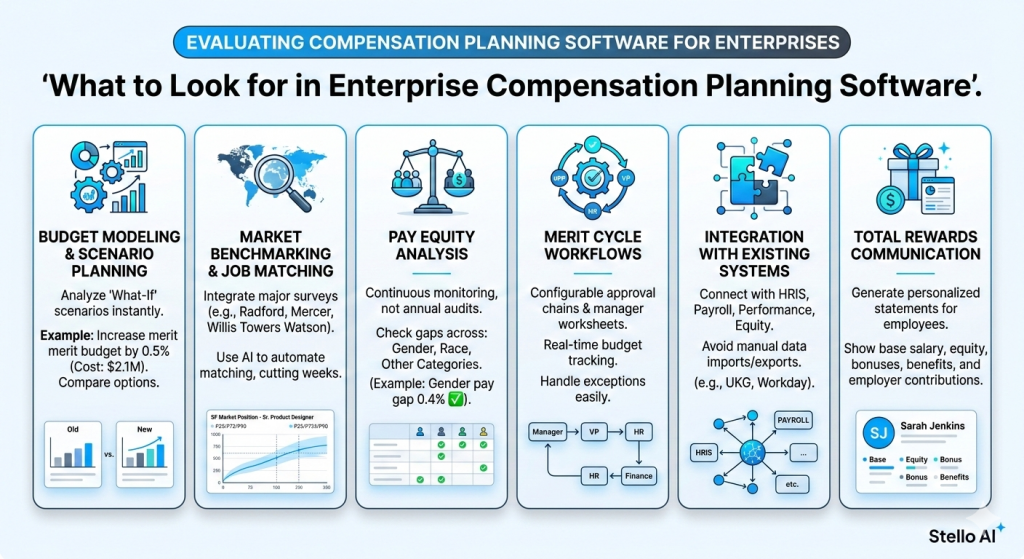
Not every platform is right for every company. Here is what matters most when you are evaluating compensation planning software for an enterprise:
Budget Modeling and Scenario Planning
You need the ability to model multiple budget scenarios before committing to anything. What happens if you increase the merit budget by half a percent? What is the cost of bringing everyone below the salary range midpoint up to market? A strong compensation planning software platform lets you answer these questions in minutes, not days.
Market Benchmarking and Job Matching
Accurate market data is the foundation of competitive pay. Look for platforms that integrate with major survey providers like Radford, Mercer, and Willis Towers Watson. Some newer tools use AI to automate job matching, which can cut weeks off the benchmarking process.
Pay Equity Analysis
This is no longer optional. With pay transparency laws expanding across the US and Europe, enterprises need software that continuously monitors for pay gaps across gender, race, and other protected categories. Annual audits are not enough anymore.
Merit Cycle Workflows
The annual merit cycle is where compensation planning software earns its keep. You need configurable approval chains, manager worksheets, real-time budget tracking, and the ability to handle exceptions without breaking the entire process.
Integration with Existing Systems
Your compensation planning software needs to connect with your HRIS, payroll system, performance management tools, and equity platforms. If it requires manual data imports and exports, you are just replacing one set of problems with another.
Total Rewards Communication
Employees consistently undervalue their compensation because they only see base salary on their paycheck. The best platforms generate personalized total rewards statements that show the full picture, including benefits, equity, bonuses, and employer contributions.
Top Compensation Planning Software Platforms for Enterprises in 2026
Here is a look at the platforms that enterprise HR and finance teams are evaluating right now:
Platform | Best For | AI Capabilities | Company Size |
| Stello AI | AI-native compensation planning with full cycle management | AI Compensation Agent, AI Budget Modeling, AI Market Pricing | Startups, Midsize, and Enterprise |
| Pave | Market data and tech-centric benchmarking | Paige, AI analyst, AI job matching | Startup to Enterprise |
| Comprehensive | Flexible rules and quick implementation | Basic automation | 100 to 2,000 employees |
| Beqom | Global enterprises with complex structures | Predictive modeling, pay equity AI | 1,000+ employees |
| Compport | Multi-country pay equity and analytics | AI-driven analytics, bias detection | 500+ employees (global) |
| HRSoft | Configurable workflows with white-glove support | HRSoft Intelligence, explainable AI | 500+ employees |
| Workday | Single-vendor HCM stack | Native HCM analytics | 1,000+ employees |
Why Stello AI Stands Out
What makes Stello different from the rest of this list is that it was built as an AI-native platform from day one, not a legacy tool with AI added after the fact. Its AI Compensation Agent acts as an on-demand analyst that answers complex compensation data questions and performs calculations instantly, eliminating the need for custom reports or manual number crunching.
Stello manages the entire compensation cycle in one platform. Its AI Budget Modeling feature lets HR and finance teams create and compare multiple budget scenarios while maintaining pay equity and rewarding top performers. Real-time budget panels track base salary, equity, and bonus allocations so both teams always see the same numbers. The AI Market Pricing module accelerates job matching and salary benchmarking, cutting what used to take weeks down to hours.
The platform handles all major equity types, including RSUs, stock options, profit sharing, and complex vesting schedules. Managers see clear compa-ratios and AI-powered salary increase recommendations based on merit matrix calculations that they can accept or override. Stello integrates with existing HRIS, performance management tools, equity platforms, benefits systems, and Excel files, so teams can get started without ripping out their current tech stack.
Employees get access to a Total Rewards Portal where they can view personalized compensation statements and their full rewards history at any time, not just during the annual review. And Stello supports ad hoc increases throughout the year, whether base salary adjustments or spot bonuses, so compensation decisions are not locked to a single cycle.
How AI is Changing Compensation Planning Software in 2026
The biggest shift in compensation planning software right now is the move toward AI. But it is worth being specific about what that actually means in practice.
First-generation compensation tools digitized spreadsheets. Second-generation tools added workflows and approvals. What we are seeing now is a third generation where AI handles the analysis and recommendations that used to take compensation teams days or weeks.
Practically, this shows up in a few key areas. AI-powered job matching can align your internal roles with survey data automatically, cutting benchmarking time from weeks to hours. Budget modeling with AI lets you simulate dozens of compensation scenarios and see the cost and equity impact of each one in real time. Pay equity detection using machine learning can flag disparities that traditional regression analysis misses. And AI compensation agents can answer natural language questions about your compensation data without requiring you to build custom reports.
That said, AI is not replacing compensation professionals. The platforms that succeed are the ones that make AI accessible to people who are not data scientists, while still giving compensation teams the controls they need.
Mistakes to Avoid When Choosing Compensation Planning Software
After talking to dozens of HR and finance leaders who have been through this process, a few patterns emerge.
The first mistake is choosing a platform based on features alone without considering implementation. Some enterprise-grade tools take six months or longer to deploy and require expensive consultants to configure. Ask vendors for a realistic timeline and what resources you will need on your side.
The second mistake is treating compensation planning software as just an HR tool. If your finance team is not involved in the evaluation, you will end up with a platform that works for merit cycles but does not give leadership the budget visibility and scenario modeling they need.
The third mistake is ignoring the manager’s experience. Managers are the ones entering merit recommendations and making pay decisions. If the interface is clunky or confusing, adoption will suffer and you will find people going right back to spreadsheets.
Making the Right Choice for Your Organization
There is no single best compensation planning software for every enterprise. The right choice depends on your company size, the complexity of your compensation programs, your global footprint, and how much you value speed versus configurability.
What is clear is that the cost of not investing in dedicated compensation planning software keeps going up. Pay transparency laws are expanding. Employees have more access to salary data than ever before. And the organizations that can make faster, fairer compensation decisions are the ones that will win the talent competition.
If you are evaluating platforms right now, start by defining what success looks like for your next compensation cycle. Then find the tool that gets you there with the least friction and the most confidence in your data.
Frequently Asked Questions
1. What is compensation planning software?
Compensation planning software is a purpose-built platform that helps HR and finance teams plan, manage, and execute employee pay decisions. It centralizes salary planning, bonus allocation, equity grants, market benchmarking, budget modeling, pay equity analysis, and total rewards communication in one system, replacing the spreadsheets and disconnected tools that most organizations still use.
2. How is compensation planning software different from payroll software?
Payroll software processes payments after decisions have been made. Compensation planning software is where those decisions happen. It handles the strategy, analysis, and approval workflows that determine how much employees are paid, while payroll handles the actual disbursement. Most compensation planning platforms integrate with payroll systems, so approved changes flow downstream automatically.
3. When should a company switch from spreadsheets to compensation planning software?
Most companies start feeling the pain between 100 and 250 employees, when the number of managers, roles, currencies, and compliance requirements exceeds what spreadsheets can handle reliably. Common triggers include merit cycles that take more than four weeks, formula errors that affect pay decisions, pay equity gaps discovered too late, and finance teams that do not trust the compensation data.
4. What does compensation planning software cost?
Pricing varies widely based on headcount, feature scope, and vendor. Mid-market platforms typically charge on a per-employee-per-month basis, while enterprise platforms use custom pricing based on company size and complexity. The total cost of ownership should include implementation fees, integration costs, and any ongoing professional services, not just the license fee.
5. How does AI improve compensation planning software?
AI enhances compensation planning in four main areas: salary increase recommendations that consider multiple variables like compa-ratio, performance, market data, and budget constraints simultaneously; automated job matching that cuts benchmarking from weeks to hours; budget scenario modeling that can optimize across multiple constraints in real time; and AI compensation agents that answer complex data questions instantly without requiring custom reports.
6. Can compensation planning software handle equity and long-term incentives?
The best platforms can. Stello AI, for example, supports RSUs, stock options, profit sharing, and complex vesting schedules alongside base salary and bonuses in the same system. This gives companies a complete view of total compensation rather than managing equity in a separate platform that is disconnected from the planning process.
7. How long does it take to implement compensation planning software?
Implementation timelines range from a few weeks for platforms designed for fast deployment to six months or longer for complex enterprise tools that require extensive configuration and consulting support. Ask vendors for realistic timelines based on companies similar to your size and complexity, and factor in the internal time your team will need for data migration, configuration, and training.
8. Does compensation planning software help with pay equity compliance?
Yes. Modern platforms monitor for pay disparities across gender, race, and other protected categories in real time as merit recommendations are entered, rather than relying on post-cycle audits. This is increasingly important given expanding pay transparency legislation like California SB 1162 and the EU Pay Transparency Directive.
Ready to see how AI-native compensation planning works? Book a demo with Stello AI and experience the platform that is built for the way enterprises actually run compensation.