Two years ago, AI in compensation planning was mostly a marketing buzzword. Vendors slapped “AI-powered” on their websites, but the actual product was the same rules-based software it had always been, with maybe an auto-fill feature or a basic recommendation engine bolted on. HR teams were rightly skeptical.
That has changed. In 2026, AI compensation planning software is delivering capabilities that genuinely transform how pay decisions get made. Not by replacing compensation professionals, but by eliminating the manual analysis that consumes most of their time. The shift is real, it is measurable, and it is creating a widening gap between companies that have adopted AI-native tools and those still running compensation the old way.
Here is what AI actually does in compensation planning today, where it makes the biggest difference, and how to separate genuine AI capabilities from marketing noise.
TL;DR
- → AI in compensation planning software has moved beyond marketing buzzwords — in 2026 it actively improves pay accuracy, speed, and equity across the full compensation cycle
- → True AI goes beyond rule-based automation by analyzing role, level, location, tenure, compa-ratio, performance history, market data, and budget constraints to generate optimized salary recommendations
- → AI-powered salary recommendations eliminate the blank-page problem for managers and reduce variance across teams, naturally improving pay equity and decision consistency
- → AI Market Pricing uses natural language processing to match job descriptions to survey data based on content, cutting benchmarking cycles from weeks to days
- → Real-time pay equity detection flags disparities as recommendations are entered — preventing inequities instead of discovering them in post-cycle audits
- → AI Compensation Agents answer complex compensation questions instantly, replacing manual report requests and democratizing access to real-time pay insights
- → AI-native platforms like Stello AI embed intelligence into budget modeling, job pricing, salary recommendations, and analytics — creating faster cycles, stronger equity controls, and more strategic compensation teams
What AI Actually Means in Compensation Planning Software
Before getting into specific use cases, it is worth defining what AI means in this context because the term gets stretched beyond recognition by sales teams.
In compensation planning software, AI refers to machine learning models and natural language processing that can analyze large datasets, identify patterns, generate recommendations, and respond to questions in ways that would take a human analyst hours or days. This is different from basic automation, which follows predefined rules. Automation says, “If the performance rating is 4, suggest a 3.5 percent increase.” AI says, “Based on this employee’s role, level, location, tenure, compa-ratio, performance history, and the current market data, here is the optimal increase that balances retention risk, budget constraints, and internal equity.”
The distinction matters because many platforms that claim AI capabilities are actually delivering rule-based automation with a more modern interface. There is nothing wrong with automation. It is valuable. But it is not AI, and the outcomes are measurably different.
Five Ways AI Is Changing Compensation Decisions
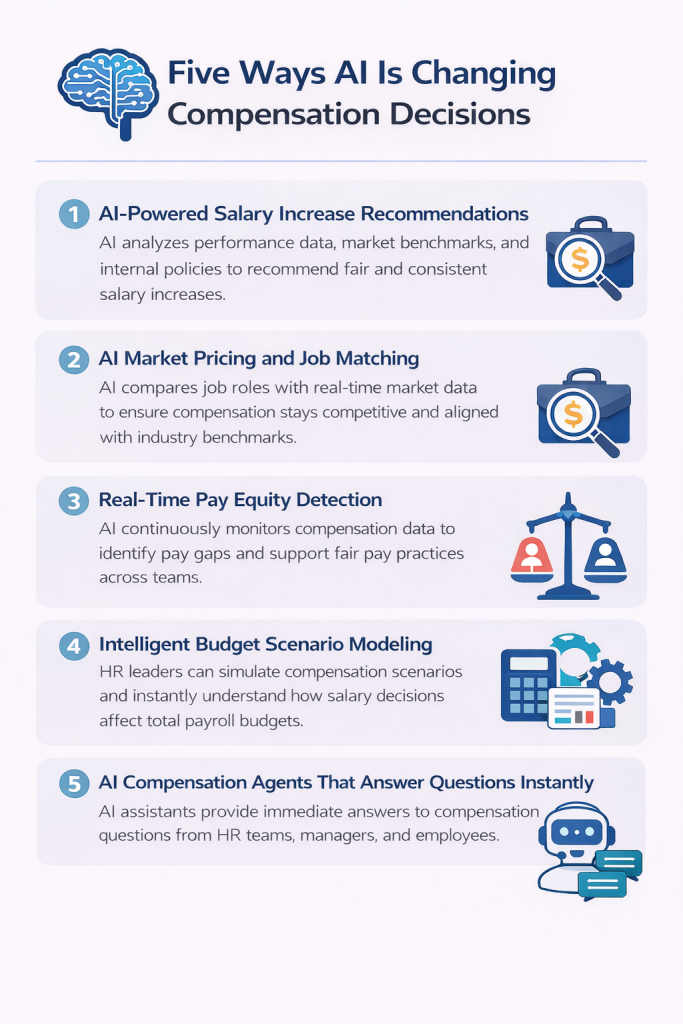
1. AI-Powered Salary Increase Recommendations
This is the most immediately visible application of AI in compensation planning software. Instead of giving managers a blank field and asking them to decide on a merit increase, AI analyzes the full context of each employee’s compensation situation and generates a recommended increase.
The inputs typically include current base salary, salary range, and compa-ratio, performance rating and history, time since last increase, market benchmarking data, internal equity relative to peers, and budget constraints. The output is a specific dollar or percentage recommendation that the manager can accept or override with justification.
This changes the merit cycle in two fundamental ways. First, it eliminates the blank-page problem. Managers who previously agonized over what number to enter or defaulted to giving everyone the same increase now have a data-backed starting point. Second, it creates consistency. When every recommendation starts from the same analytical foundation, the variance between managers shrinks dramatically, and pay equity improves as a natural byproduct.
2. AI Market Pricing and Job Matching
Salary benchmarking has traditionally been one of the most time-consuming tasks in compensation. An analyst downloads survey data, manually matches internal jobs to survey job codes, applies aging factors, blends data from multiple sources, and builds lookup tables. For a large company with hundreds of unique roles, this process can take weeks.
AI compensation planning software automates this by using natural language processing to read job descriptions and match them to survey data based on role content, not just job titles. A “Senior Software Engineer” at one company might match a “Staff Developer” in a survey dataset. AI catches these matches. Manual processes miss them or take hours to resolve.
The result is that benchmarking cycles that previously took three to six weeks can be completed in days. For companies that are adding new roles through growth or acquisitions, this speed is the difference between making competitive offers and losing candidates to companies that can price jobs faster.
3. Real-Time Pay Equity Detection
Traditional pay equity analysis happens after the compensation cycle is complete. An analyst runs a regression model, identifies outliers, and produces a report that lands on someone’s desk weeks after merit decisions have been approved. By that point, reopening recommendations are politically and operationally painful.
AI changes the timing. AI compensation planning software can monitor for pay disparities continuously as merit recommendations are being entered. When a manager proposes an increase that would widen a gap based on gender, race, or another protected category, the system flags it in real time before the recommendation is submitted.
This is not just a compliance improvement. It is a fundamentally different approach to pay equity. Instead of detecting and remediating after the fact, organizations prevent inequities from entering the system in the first place. With pay transparency legislation expanding across the US and Europe, this proactive approach is becoming a competitive necessity.
4. Intelligent Budget Scenario Modeling
Budget modeling in a spreadsheet is a linear, time-consuming process. You build a scenario, calculate the results, adjust the inputs, recalculate, and repeat. Each scenario takes hours. Comparing five different budget approaches takes days.
AI-powered budget modeling changes this from a manual exercise to an interactive conversation. What happens to total compensation cost if we increase the merit budget by half a percent but reduce the promotion pool by a quarter percent? What is the cheapest way to bring all employees below the 25th percentile up to market without exceeding the approved budget? What is the pay equity impact of each scenario?
AI can evaluate dozens of scenarios simultaneously, optimize for multiple constraints, and surface trade-offs that a human analyst might not consider. This gives both HR and finance teams the ability to make faster, more informed decisions about how to allocate the compensation budget.
5. AI Compensation Agents That Answer Questions Instantly
This is the newest and potentially most transformative application of AI in compensation planning software. An AI compensation agent is a natural language interface that sits on top of your compensation data and answers questions in real time.
Instead of submitting a report request to the analytics team and waiting three days, an HR business partner can ask the AI agent a question like “how does our engineering team’s pay compare to the 50th percentile in the Bay Area?” and get an answer in seconds. A finance analyst can ask “what percentage of our Q2 merit budget has been committed across the EMEA region?” and see the number immediately.
This capability fundamentally changes who can access compensation insights and how quickly decisions get made. It democratizes data that was previously locked behind report queues and analyst bandwidth.
Read more: AI Compensation Agent: How Enterprises Are Automating Compensation Decisions
How to Tell Real AI from Marketing AI
Not every platform that claims AI capabilities delivers genuine artificial intelligence. Here is how to tell the difference during your evaluation.
Ask what data the AI trains on. Real AI models learn from data. If the vendor cannot explain what data feeds the model and how it improves over time, the “AI” is likely a rules engine with a modern label.
Ask for a live demonstration of your scenario. Marketing AI looks impressive in a controlled demo with clean sample data. Real AI performs well with messy, incomplete, real-world data. Give the vendor a realistic scenario from your last compensation cycle and see how the AI handles it.
Ask what happens when the AI is wrong. Good AI compensation planning software gives users the ability to override recommendations with justification and captures that feedback to improve future suggestions. If the AI is a black box with no override capability, it is not ready for production use.
Ask about explainability. When the AI recommends a 4.2 percent increase for an employee, can it explain why? Compensation decisions affect people’s lives. The recommendation needs to be transparent enough that a manager can understand and defend it.
How Stello AI Delivers on the AI Promise
Stello AI was built as an AI-native platform from day one, which means AI is embedded in the core architecture rather than layered on top of legacy software.
Stello’s AI Compensation Agent answers complex compensation data questions and performs calculations instantly. This is not a chatbot that redirects you to a help article. It is an analytical engine that queries your actual compensation data and returns real answers in seconds.
The AI Budget Modeling feature lets HR and finance teams create and compare multiple budget scenarios while maintaining pay equity and rewarding top performers. Real-time budget panels track base salary, equity, and bonus allocations so both teams always see the same numbers.
The AI Market Pricing module accelerates job matching and salary benchmarking, cutting the process from weeks to hours. Managers see clear compa-ratios and AI-powered salary increase recommendations based on merit matrix calculations, with the ability to accept or override.
The platform manages the entire compensation cycle, covering base salary, bonuses, and equity, including RSUs, stock options, profit sharing, and complex vesting schedules. It integrates with existing HRIS, performance management tools, equity platforms, benefits systems, and Excel files. Stello’s Total Rewards Portal gives employees year-round access to personalized compensation statements. And ad hoc increases throughout the year ensure every compensation decision is captured in one system.
What makes Stello genuinely AI-native rather than AI-adjacent is that every major workflow in the platform is enhanced by intelligence. The AI is not a separate module that you access through a different tab. It is woven into how budgets are modeled, how jobs are priced, how recommendations are generated, and how questions are answered.
The Gap Is Widening
The companies that adopted AI compensation planning software early are now running faster cycles, making more accurate pay decisions, catching equity issues before they become liabilities, and freeing their compensation teams to do strategic work instead of data processing. The companies that have not adopted AI are falling further behind with every cycle.
AI is not replacing compensation professionals. It is giving them capabilities that were previously impossible. The question for every organization in 2026 is not whether AI belongs in compensation planning. It is how quickly you can get it working for your team.
Frequently Asked Questions
What is the difference between AI and automation in compensation software?
Automation follows predefined rules like “if performance rating is 4, suggest 3.5 percent.” AI analyzes multiple variables simultaneously, including role, location, tenure, compa-ratio, performance history, market data, and budget constraints, to generate an optimal recommendation. Both are valuable, but the outcomes are measurably different.
How does AI improve salary increase recommendations?
It eliminates the blank-page problem by giving managers a data-backed starting point that considers the full context of each employee’s compensation situation. It also creates consistency across managers, which reduces variance and improves pay equity as a natural byproduct.
How does AI speed up salary benchmarking?
AI reads job descriptions and matches roles to survey data based on content and responsibilities, not just titles. This catches matches that manual processes miss and cuts benchmarking cycles from three to six weeks down to days.
How does AI help with pay equity?
Traditional analysis happens after the cycle, when reopening decisions are painful. AI monitors for disparities in real time as recommendations are entered, flagging issues before they are approved. This prevents inequities instead of detecting them after the fact.
How can I tell real AI from marketing AI during a vendor evaluation?
Four tests: ask what data trains the model, request a live demo with your real-world data instead of clean sample data, ask what happens when the AI is wrong and whether users can override, and ask whether the AI can explain why it made a specific recommendation.
Is AI replacing compensation professionals?
No. AI eliminates the manual analysis that consumes most of their time, such as data gathering, report building, job matching, and scenario modeling. This frees compensation teams to focus on strategy, communication, and the judgment calls that require human expertise.
What makes Stello AI genuinely AI-native?
AI is embedded in every major workflow, not accessed through a separate tab. It is woven into how budgets are modeled, how jobs are priced, how salary recommendations are generated, and how compensation questions are answered. The AI Compensation Agent, AI Budget Modeling, and AI Market Pricing are core architecture, not add-ons.
What is an AI Compensation Agent?
A natural language interface that sits on top of your actual compensation data and answers questions in real time. Instead of submitting report requests and waiting days, anyone can ask complex questions and get calculations in seconds, democratizing data that was previously locked behind analyst queues.
Ready to see what AI-native compensation planning actually looks like? Book a demo with Stello AI and experience the difference between real AI and marketing AI.