An LTIP, or long-term incentive plan, is a type of pay that rewards employees for company results over several years, usually three or more. LTIP awards are most often paid in company stock, such as performance shares, restricted stock units (RSUs) or stock options. Companies use them to keep senior leaders and key employees focused on long-term value and to encourage them to stay.
Among the 250 largest US companies, FW Cook found that 93% use performance-based awards in their long-term incentive plans, and 90% of those awards measure performance over three years.
What Is an LTIP?
An LTIP is any incentive plan where the reward is earned over a period longer than one year. That sets it apart from a short-term incentive plan, such as an annual bonus, which pays out based on results for a single year.
LTIPs are most common for executives and senior leaders, but many companies, especially in tech, extend them to managers and key individual contributors. The 2026 WorldatWork and Compensation Advisory Partners Incentive Pay Practices Survey found long-term incentives at 95% of public companies and 61% of private companies. Private companies most often use long-term cash plans, which typically measure profit over a rolling three-year period.
How Does a Long-Term Incentive Plan Work?
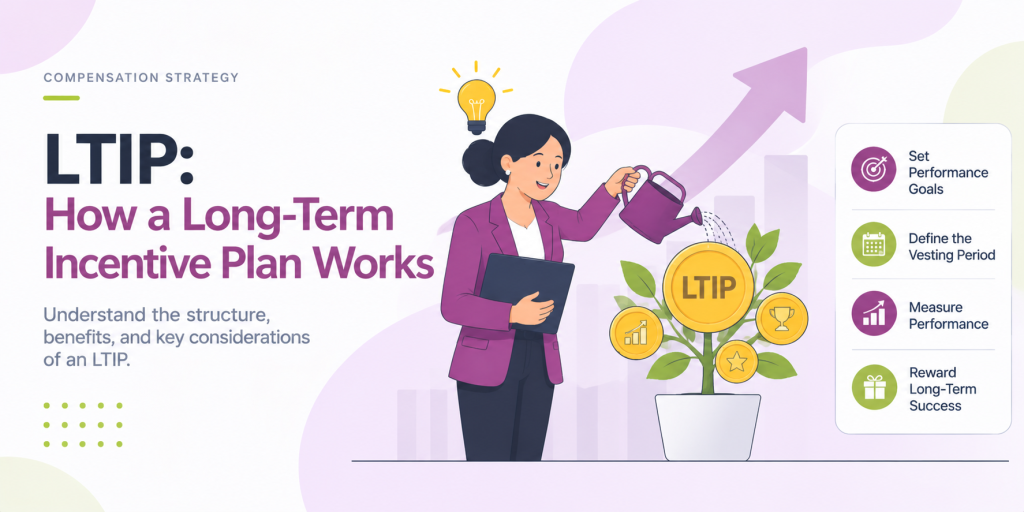
Most long-term incentive plans follow the same basic steps:
- Grant: the company awards the employee a target number of shares, units or a cash amount.
- Vesting or performance period: the employee must stay with the company, and sometimes the company must hit goals, over a set period.
- Payout: at the end of the period, the award vests and the employee receives shares or cash. For performance awards, the payout can be higher or lower than the target depending on results.
If the employee leaves before the award vests, they usually lose the unvested part. This is why LTIPs are also a strong retention tool.
Types of Long-Term Incentives
| Award type | How it works | What it rewards |
| Performance shares or units | Shares earned only if the company hits set goals, such as total shareholder return (TSR) or profit targets | Company performance |
| Restricted stock or RSUs | Shares that vest over time if the employee stays | Retention |
| Stock options | The right to buy shares at a set price in the future | Share price growth |
| Stock appreciation rights (SARs) | A payment equal to the rise in share price | Share price growth |
| Long-term cash plans | Cash paid at the end of a multi-year period if goals are met | Company performance, often for private companies |
Performance awards are now the largest part of executive long-term pay. FW Cook found they make up 61% of CEO long-term incentive value at Top 250 companies. Use of restricted stock has risen in recent years, while use of stock options has fallen.
For a deeper look at equity types, see our guide to equity compensation.
Common LTIP Performance Measures
Performance-based LTIP awards pay out based on goals set at the start of the period. According to FW Cook, the most common measures at large US companies are:
- Total shareholder return (TSR): used by 73% of companies, often compared against a peer group
- Profit measures: such as earnings per share or operating income, used by about half
- Return measures: such as return on capital
![*]() Revenue growth
Many plans use two or more measures so no single number drives the whole payout.
Vesting Schedules for Long-Term Incentives
Time-based awards like RSUs and stock options most commonly vest in equal parts over three years, such as one-third each year. Performance awards usually vest at the end of a three-year performance period, a structure known as cliff vesting.
How to Design a Long-Term Incentive Plan
- Decide who is eligible. Start with roles that most affect long-term results.
- Set target award values. Base them on market data for each role and level, often as a percentage of base salary.
- Choose the award mix. Many companies combine performance shares with RSUs to balance performance and retention.
- Pick performance measures that match your strategy and that employees can influence.
- Set vesting and leaver rules, including what happens on retirement, layoff or a change in control.
- Model the total cost and share use over several years.
Stello AI’s Compensation Planning tool helps compensation teams model long-term incentive grants alongside base pay and bonuses, using market data for each role, so total pay stays competitive and within budget.
Frequently Asked Questions
What does LTIP stand for?
LTIP stands for long-term incentive plan. It is a pay plan that rewards employees for company performance over several years, usually through stock or cash awards.
What is the difference between an LTIP and an annual bonus?
An annual bonus rewards results over one year and is usually paid in cash. An LTIP rewards results over several years, usually three, and is often paid in company stock.
How long is a typical LTIP performance period?
Most LTIP performance periods are three years. FW Cook found that 90% of performance-based awards at large US companies use a three-year period.
What happens to an LTIP if you leave the company?
In most plans, unvested LTIP awards are forfeited if the employee resigns. Plans often have special rules for retirement, death, disability, layoffs and a change in control.
Do private companies offer LTIPs?
Yes. Private companies often use stock options, phantom stock or long-term cash plans instead of publicly traded shares.