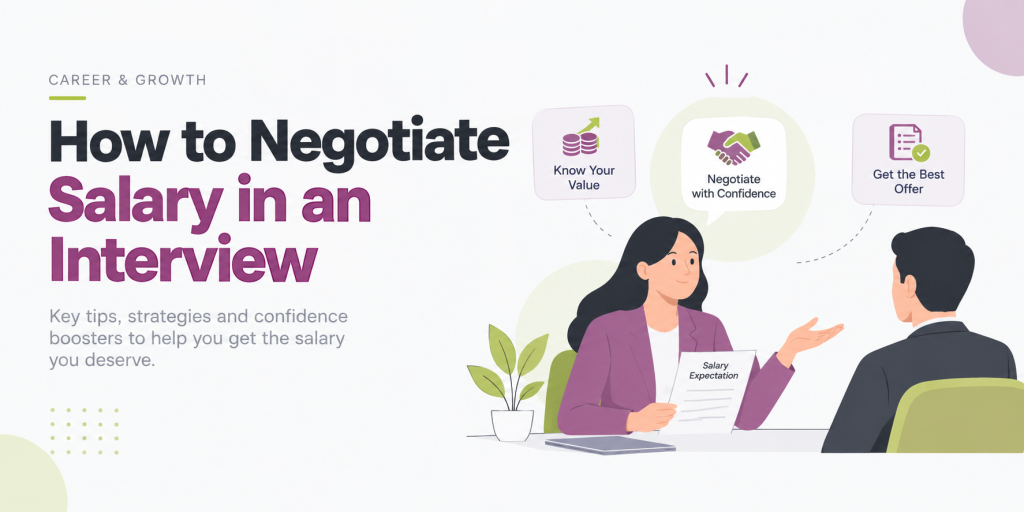
To negotiate salary in an interview, avoid committing to a single number too early. When asked about pay, share a range based on market research, ask what the budgeted range is, and save the real negotiation for when you have an offer. Your goal in the interview is to show your value and make sure your expectations line up with the role.
When Salary Comes Up in the Interview Process
Salary usually comes up at three points, and each needs a different approach.
| Stage | What they usually ask | Your goal |
| Recruiter screen | “What are your salary expectations?” | Confirm the role’s range fits yours |
| Hiring manager or final interview | “Is the range we discussed still okay?” | Show value, stay flexible |
| Offer stage | “Here’s our offer” | Negotiate |
The real negotiation happens at the offer stage. Before that, you’re making sure you’re not wasting each other’s time, without boxing yourself in.
How to Answer “What Are Your Salary Expectations?”
This is the question most people dread. You have three good options.
Ask for their range first
“I’d love to understand the budgeted range for this role first. Can you share it?” Many states now require employers to share the range, either in the job posting or on request, so this is a normal question.
Give a researched range
If they push, give a range based on market data for the role, level and location: “Based on my research for similar roles in Chicago, I’m looking at $95,000 to $110,000, depending on the full package.” Make the bottom of your range a number you’d be happy with.
Anchor to the posted range
If the job posting listed pay, refer to it: “The posted range of $90,000 to $120,000 works for me. Given my experience, I’d expect to land in the upper half.”
How to Negotiate About Salary in an Interview Without Hurting Your Chances
- Do your research first. Know the market rate before the first call, so you’re not guessing under pressure.
- Talk about value before money. Every example you give of results you’ve delivered strengthens your position later.
- Be flexible on structure. Saying you’re open to the full package (bonus, equity, benefits) signals you’re reasonable.
- Don’t share your current salary. Many US states and cities ban employers from asking about salary history. Even where it’s allowed, you can say: “I’d rather focus on the value I’d bring to this role.”
- Keep the tone warm. Interviewers are judging whether they want to work with you as much as your skills.
What to Say: Scripts for Each Stage
At the recruiter screen
“I’m flexible and most interested in the right role. Could you share the budgeted range? I want to make sure we’re aligned.”
If they insist on a number
“For roles like this in Austin, I’ve seen ranges of about $95,000 to $110,000. That’s where I’d expect to be, depending on bonus and benefits.”
In the final interview
“I’m really excited about this role. Assuming the range we discussed still applies, I’m confident we can find a number that works for both of us.”
When the offer arrives
“Thank you, I’m thrilled. Could I have a day to review the full offer? I’d like to come back to you on the base salary.”
The offer stage itself is covered in our guide on how to negotiate salary after a job offer.
Salary Negotiation in Interviews Is Easier With Pay Transparency
More than a dozen US states and Washington, D.C. now require employers to include pay ranges in job postings, including California, Colorado, Illinois, Maryland, Massachusetts, New Jersey, New York and Washington. If the role is covered, you already know the range before the first interview. Your conversation is about where you fit in it, not whether the numbers are in the same ballpark.
For Employers: Prepare Interviewers for Salary Questions
Candidates now arrive with posted ranges and market data. Recruiters and hiring managers need consistent answers: what the range is, where new hires usually land, and what’s negotiable. Without that, two candidates for the same job can end up with very different offers.
Stello AI’s Match a Job builds a salary range for any new role from market data, using your target percentile and location rules, and compares it with what similar roles already earn inside your company. Interviewers start with a range they can explain. See how Stello AI prices new roles.
Frequently Asked Questions
Should you negotiate salary in the first interview?
Usually not. In the first interview, confirm the role’s range fits your expectations. Save the negotiation for when you have an offer.
How do you answer salary expectations in an interview?
Ask for the role’s budgeted range first. If pressed, give a researched range, with the bottom set at a number you’d be happy to accept.
Is it okay to ask about salary in an interview?
Yes. Asking about the pay range is normal, and in many states employers must share it in job postings or on request.
Do I have to tell an interviewer my current salary?
Many US states and cities ban employers from asking about salary history. Where it’s allowed, you can politely decline and focus on the value you’d bring to the role.
What’s the best way to say my salary expectations?
Keep it simple: “Based on my research for similar roles, I’m looking at $X to $Y, depending on the full package.”