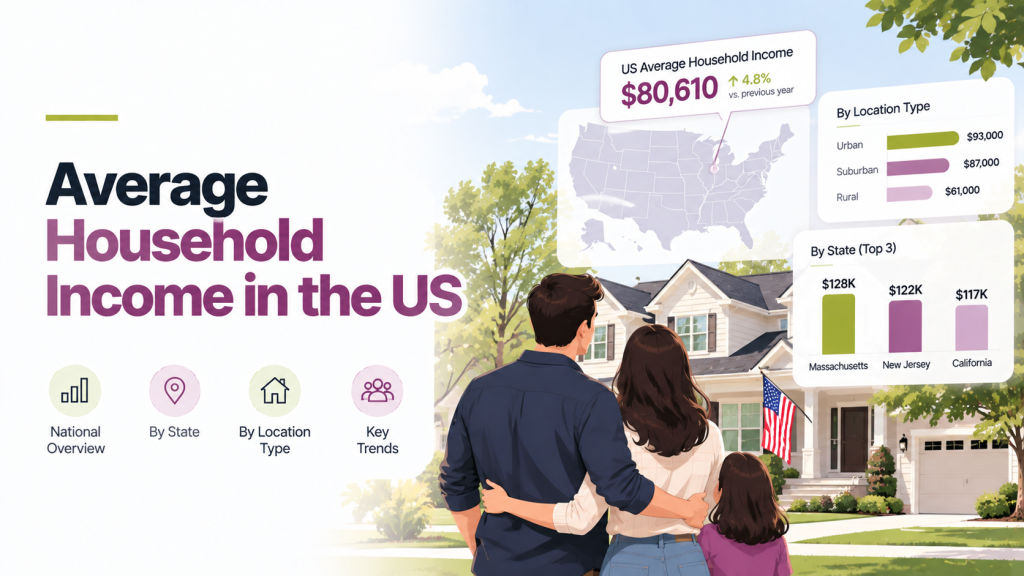
The median US household income was $87,460 in 2025, the highest since the Census Bureau began tracking it in 1967. The average (mean) household income is much higher, at about $126,700, because a small number of very high-income households pull it up. After taxes and credits, the typical household kept $76,060.
What Is the Average American Income?
The answer depends on whether you mean the median or the mean, and whether you count income before or after taxes.
| Measure (2025) | Amount | What it tells you |
|---|---|---|
| Median household income | $87,460 | Half of households earn more, half earn less |
| Mean (average) household income | About $126,700 | Total income divided by number of households |
| Median household income after taxes and credits | $76,060 | What the typical household actually keeps |
| Median household income in 2024, for comparison | $85,210 | Up 2.6% in a year, after inflation |
For most people asking about the average American income, the median of $87,460 is the more useful number. The mean is about $39,000 higher because household income is uneven. A household earning $2 million raises the average a lot, but it doesn’t change the median at all.
US Median Household Income Hit a Record in 2025
Household income has recovered from the inflation of 2021 and 2022 and moved past its pre-pandemic peak.
| Year | Real median household income (2025 dollars) |
|---|---|
| 2019 | $85,310 |
| 2022 | $81,460 |
| 2024 | $85,210 |
| 2025 | $87,460 |
All figures are adjusted for inflation, so the rise is real growth in buying power. The 2.6% increase in 2025 came largely from higher earnings. Women working full-time, year-round saw median earnings rise 3.2%, and their earnings reached 83.9% of men’s, up from 80.6% in 2024.
How Household Income Is Spread Across the US
The median hides how far apart US households are.
- The 10th percentile household earned about $20,010 in 2025.
- The 90th percentile household earned about $261,300, more than 13 times as much.
- The top fifth of households received 52.4% of all household income. The bottom fifth received 3%.
The gap is widening. Income at the 90th percentile rose 1.7% in 2025, while income at the 10th percentile showed no significant change. Since 1967, income at the 90th percentile has grown about 121% after inflation, compared with about 56% at the median.
Average Combined Income by Number of Earners
Searches for “average combined income” are usually about couples or households with two incomes. The number of earners makes a large difference.
| Earners in the household | Median income (2024) |
|---|---|
| No earners | $50,810 |
| One earner | $71,720 |
| Two earners | $142,200 |
| Three earners | $163,400 |
A two-earner household has roughly double the income of a one-earner household. Households with no earners are mostly retirees living on Social Security, pensions and savings.
Average Income per Family by Family Size
Family income usually rises with family size up to four people, then levels off.
| Family size | Median income (2024) |
|---|---|
| 2 people | $91,180 |
| 3 people | $107,500 |
| 4 people | $139,900 |
| 5 people | $121,600 |
| 6 people | $123,600 |
| 7 or more people | $125,600 |
Four-person families earn the most because many have two working parents in their peak earning years. Larger families more often have one earner or include children and older relatives who don’t work.
Average Household Income by Age
Household income follows a career curve. It’s lowest for the youngest households, peaks in middle age and falls after retirement.
| Age of householder | Median household income (2025) |
|---|---|
| 15 to 24 | $60,870 |
| 45 to 54 | $120,100 |
| 55 to 64 | $99,320 |
| 65 and over | $59,680 |
Households headed by someone aged 55 to 64 saw the fastest growth of any age group in 2025, up 5.9%.
US Median Household Income by State
Where you live changes what counts as an average income. These are the highest and lowest states by median household income.
| Highest | Median income | Lowest | Median income |
|---|---|---|---|
| District of Columbia | $109,870 | Mississippi | $56,447 |
| Massachusetts | $103,960 | West Virginia | $59,608 |
| Maryland | $103,678 | Louisiana | $60,756 |
| New Jersey | $103,556 | Arkansas | $60,773 |
| Kentucky | $63,726 |
A household in Massachusetts earns nearly twice as much as one in Mississippi, but housing and everyday costs are also far higher.
Average Household Income vs. Average Salary
Household income combines everyone in the household. It includes wages, self-employment income, Social Security, pensions, investments and other sources. An individual salary is one person’s pay from their job.
That’s why the two numbers are so far apart. The median full-time worker earns about $65,050 a year, based on Bureau of Labor Statistics data for Q2 2026. The median household, which often has more than one earner, has $87,460. For a full breakdown of individual pay, see our guide to the [average salary in the US](link to Blog 3).
What Household Income Data Means for Employers
Employees see the same headlines. When a news story says the typical household earns $87,460, many people compare it with their own paycheck, often without counting what their employer spends on health insurance, retirement contributions, bonuses and equity.
For many employees, those benefits add thousands of dollars a year that never show up in base pay. When the full value isn’t visible, people underestimate what they’re paid.
Total rewards statements fix this. Stello AI creates a personalized statement for every employee showing their base salary, bonus, equity and, if you choose, benefits and health insurance costs. Employees see their full package, not just the number on their paycheck. [See how Stello AI handles total rewards statements](link to AI Compensation Planning page).
Frequently Asked Questions
What is the average American income?
The median US household income was $87,460 in 2025. The mean household income is about $126,700. For individuals, the median full-time salary is about $65,050 a year.
What is the US median household income?
$87,460 in 2025, according to the Census Bureau. That’s up 2.6% from 2024 after inflation, and the highest on record since 1967.
What is the average combined income for a two-earner household?
Households with two earners had a median income of $142,200 in 2024, roughly double the $71,720 median for one-earner households.
What is the average income per family?
It depends on family size. In 2024, the median was $91,180 for two-person families and $139,900 for four-person families.
Is $100,000 a good household income?
It’s above the national median of $87,460, so a $100,000 household earns more than over half of US households. How far it goes depends on where you live and how many people it supports.
What is the difference between average and median household income?
The median is the middle household, and the mean, or average, is the total divided by the number of households. The mean is higher because a small number of very high incomes pull it up.