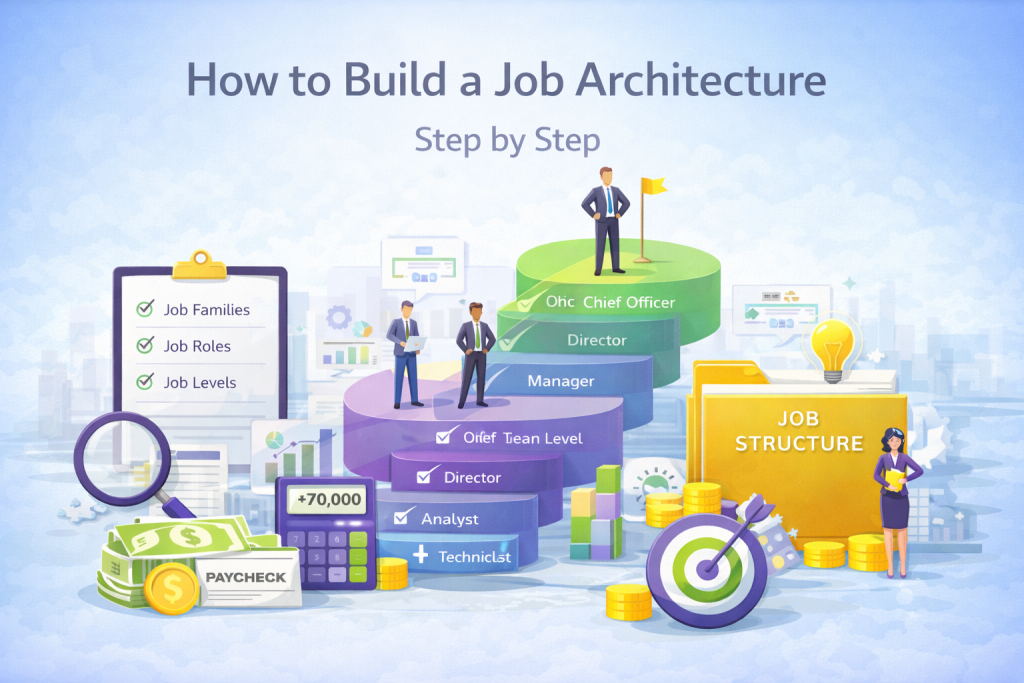
Most growing companies do not realize they need job architecture until compensation starts breaking.
Titles become inconsistent. Promotions feel subjective. Pay decisions rely on negotiation instead of structure. Managers create roles to solve immediate needs. Finance struggles to forecast long-term compensation costs.
What once felt like flexibility turns into confusion.
Job architecture fixes this.
It provides a structured framework that defines how work is organized, how roles progress, and how compensation aligns with scope and impact. It connects career growth to business strategy. It strengthens internal equity. And it gives leaders a defensible system for pay decisions.
More importantly, it shifts compensation from reactive to intentional.
Instead of debating individual cases during every cycle, you operate from a defined structure:
- Clear job families
- Transparent career levels
- Parallel career tracks
- Standardized role expectations
- Market-aligned salary bands
This guide walks through how to build job architecture step by step in a way that scales with your company, supports workforce planning, and strengthens pay transparency.
What Is Job Architecture?
Job architecture is a structured framework that organizes roles across an organization.
It defines how jobs relate to one another, how careers progress, and how compensation aligns with responsibility and impact.
At its core, job architecture answers three critical questions:
- What kind of work is this role responsible for?
- How advanced is this role compared to others?
- How should it be paid relative to scope and contribution?
A well-designed job architecture includes:
- Job families that group similar types of work
- Career levels that define progression and scope
- Career tracks that separate individual contributor and management paths
- Role profiles that clarify expectations
- Compensation bands aligned to market data
It is important to distinguish job architecture from an org chart.
An org chart shows reporting relationships. It answers who reports to whom.
Job architecture shows role structure. It answers how work is categorized, how roles compare across teams, and how employees grow over time.
For example, a Senior Marketing Manager and a Senior Engineering Manager may sit in different departments. But within a job architecture, both may sit at the same organizational level based on scope, impact, and complexity.
That consistency is what creates fairness.
Without job architecture, companies rely on titles and manager discretion. With it, they rely on defined criteria and structured progression.
Job architecture becomes the foundation for:
- Compensation planning
- Promotion decisions
- Workforce forecasting
- Pay transparency initiatives
- Internal equity audits
It is not just an HR exercise. It is an operational system that supports scale.
Why Job Architecture Matters
Job architecture creates structure where growth creates complexity.
As companies scale, role variety increases. New teams form. Scope expands. Expectations shift. Without a framework, compensation and promotions become inconsistent.
Job architecture brings discipline to that growth.
It Enables Pay Transparency
Clear levels and defined salary bands make compensation decisions easier to explain. Employees understand how pay connects to scope, impact, and progression.
Transparency reduces speculation and builds trust.
It Improves Internal Equity
When roles are leveled consistently across departments, similar work is paid similarly.
This reduces pay gaps caused by negotiation, tenure bias, or inconsistent manager judgment.
It Supports Workforce Planning
Finance can model compensation costs more accurately when roles are structured into levels and bands.
Instead of budgeting employee by employee, leaders can forecast by level, family, and growth plan.
It Reduces Bias in Promotions
Promotions shift from opinion-based decisions to criteria-based evaluations.
Clear level definitions make it easier to assess readiness and reduce favoritism.
It Simplifies Compensation Cycles
When architecture is defined, compensation reviews follow a framework.
Managers do not need to invent justifications. HR does not need to recalibrate titles every cycle. Finance can align increases to structured ranges.
Job architecture is not just about organization. It is about alignment.
It aligns pay to scope.
It aligns career growth to business impact.
It aligns HR and Finance around one consistent system.
Without it, compensation feels reactive.
With it, compensation becomes strategic.
Perfect. Let’s move into the build process.
Step 1: Define Your Job Families
Job families are the foundation of your job architecture.
A job family groups roles that perform similar types of work and require related skills. It creates logical categories across the organization.
Think of job families as the highest-level structure before levels are applied.
Common examples include:
- Engineering
- Product
- Marketing
- Sales
- Finance
- Human Resources
- Operations
- Customer Success
The goal is clarity, not precision at the margins.
How to Define Job Families
Start by reviewing all existing roles in your company. Look at actual work performed, not just titles.
Group roles based on:
- Core skill set
- Functional expertise
- Nature of work
- Business purpose
For example, Revenue Operations might sit within Operations in one company and within Sales in another. The right placement depends on how your business operates.
Avoid over-segmentation. If you create too many families, you make the structure harder to manage. If you create too few, you lose clarity.
Most mid-sized companies operate effectively with 8 to 15 job families.
Key Principles
- Align families to how your business delivers value.
- Keep the structure simple enough to scale.
- Ensure every role clearly fits into one family.
At this stage, do not worry about levels or compensation. Focus only on grouping similar work logically.
Once job families are defined, you are ready to layer in progression.
Step 2: Create Career Levels
Career levels define progression within each job family.
They describe how scope, impact, autonomy, and complexity increase over time. Levels create consistency across departments and make promotions measurable.
Without levels, growth becomes title-based. With levels, growth becomes criteria-based.
What Career Levels Represent
A level is not just tenure. It reflects:
- Scope of responsibility
- Decision-making authority
- Problem complexity
- Influence across the organization
- Business impact
Two employees can have the same title but operate at different levels of scope. Job architecture removes that ambiguity.
A Common Level Structure
While naming varies, many companies use a progression similar to:
- Level 1: Entry or Associate
- Level 2: Intermediate or Specialist
- Level 3: Senior
- Level 4: Lead or Principal
- Level 5: Director or Enterprise-level impact
Titles matter less than definitions. What matters is clearly describing how responsibility expands from one level to the next.
Define Level Criteria Clearly
For each level, document expectations across consistent dimensions such as:
- Technical or functional expertise
- Autonomy
- Scope of projects
- Stakeholder influence
- Financial or strategic impact
For example:
A Level 2 employee may execute defined projects independently.
A Level 3 employee may lead complex initiatives and mentor others.
A Level 4 employee may define strategy and influence cross-functional decisions.
The difference between levels should feel meaningful, not incremental.
Keep Levels Consistent Across Families
An important principle is cross-functional alignment.
A Level 3 in Engineering and a Level 3 in Marketing should represent comparable scope and organizational impact, even though the work differs.
This alignment is what enables internal equity and consistent pay positioning.
Perfect. Let’s continue.
Step 3: Define Career Tracks
Career tracks define how employees grow within each job family.
Most organizations need at least two parallel tracks:
- Individual Contributor
- Manager
Without parallel tracks, companies unintentionally signal that management is the only path to advancement. That creates unnecessary promotions, weak managers, and disengaged experts.
Why Parallel Tracks Matter
Not every high performer wants to manage people. Some employees create the most value through deep expertise, not team oversight.
A strong job architecture allows both paths to progress to comparable levels of impact and compensation.
For example:
- Senior Individual Contributor may align with Manager
- Principal Individual Contributor may align with Director
- Distinguished or Enterprise-level Contributor may align with Senior Director
The scope differs, but the organizational impact can be equivalent.
Define the Difference Clearly
The distinction between tracks should be based on accountability:
Individual Contributor track focuses on:
- Technical or functional expertise
- Complex problem-solving
- Strategic project ownership
- Influence without direct authority
Manager track focuses on:
- Team leadership
- Talent development
- Resource allocation
- Performance management
Both tracks require leadership skills. Only one requires direct people management.
Avoid Track Inflation
Do not create too many variations. Most companies operate effectively with:
- IC Track
- Manager Track
- Executive Track
Keep the structure simple. Complexity reduces clarity.
Perfect. Let’s move forward.Excellent. This is where structure connects directly to money.
Step 5: Build Compensation Bands
Compensation bands align pay to structure.
Once job families, levels, and tracks are defined, you can assign salary ranges that reflect market value and internal equity.
Without architecture, pay decisions happen role by role. With architecture, compensation is anchored to level and scope.
Start With Market Data
Benchmark each job family and level using reliable market data.
Focus on:
- Industry
- Company size
- Geography
- Talent competitiveness
Establish a salary range with:
- Minimum
- Midpoint
- Maximum
The midpoint typically reflects the market median. The range allows flexibility based on experience, performance, and tenure.
Align to Your Pay Philosophy
Before finalizing bands, clarify your positioning strategy.
Are you targeting:
- Market median
- Above market for critical roles
- Below market with stronger equity or variable pay
Your compensation philosophy should guide where your bands sit relative to market data.
Maintain Internal Equity
Market data is external. Equity is internal.
Review employees within the same level across departments. Compensation should align with defined scope, not negotiation history.
Look for:
- Pay compression
- Title inflation
- Legacy inconsistencies
Correcting inequities early prevents larger issues later.
Model Financial Impact
Finance should validate:
- Total payroll cost at each level
- Projected cost of promotions
- Growth scenario impact
- Budget alignment
This step ensures the architecture is financially sustainable.
Keep Bands Manageable
Avoid overly narrow ranges that force constant exceptions. Avoid overly wide ranges that undermine structure.
Most companies use ranges of 30 to 50 percent between minimum and maximum.
The goal is balance. Flexibility within structure.
Step 4: Write Clear Role Profiles
Once job families, levels, and tracks are defined, you need to document role expectations.
Role profiles translate structure into clarity.
They define what success looks like at each level within each family and track.
Without written profiles, architecture remains theoretical. Managers interpret levels differently. Promotions become inconsistent again.
What a Strong Role Profile Includes
Each role profile should clearly define:
- Purpose of the role
- Core responsibilities
- Scope of ownership
- Required skills and competencies
- Decision-making authority
- Expected impact
Focus on outcomes, not task lists.
For example:
Weak definition:
“Manages marketing campaigns and supports brand initiatives.”
Strong definition:
“Owns end-to-end campaign strategy and execution for a defined segment, drives measurable pipeline impact, and influences cross-functional alignment.”
The second version defines scope and impact.
Standardize Across Levels
For each job family, write profiles that show clear progression.
At lower levels:
- Execution-focused
- Defined scope
- Limited strategic input
At mid levels:
- Independent ownership
- Cross-functional collaboration
- Problem-solving in ambiguous situations
At senior levels:
- Strategic direction
- Broad organizational influence
- Financial or enterprise-level impact
The differences between levels should be explicit.
If you cannot explain why one level is higher than another, the structure is not strong enough.
Validate With Real Employees
Before finalizing profiles, test them against actual roles.
Ask:
- Does this accurately reflect current scope?
- Are employees over-leveled or under-leveled?
- Are expectations realistic and consistent?
This calibration step prevents misalignment later.
Perfect. Let’s bring leadership into the process.
Step 6: Validate With Leadership
Job architecture cannot live only within HR.
It must be aligned across leadership, especially Finance and department heads. Validation ensures the structure reflects real work, real budgets, and real growth plans.
Align on Level Definitions
Walk leaders through:
- Job families
- Level criteria
- Career tracks
- Compensation bands
Test the framework using actual employees.
Ask:
- Does this level accurately reflect scope?
- Are expectations clear and consistent?
- Would we make the same leveling decision across departments?
Calibration conversations are critical. This is where inconsistencies surface.
Pressure-Test Edge Cases
Every organization has complex roles that do not fit neatly into categories.
Use those roles to test the strength of your framework. If the system cannot accommodate edge cases without special exceptions, the definitions may need refinement.
The goal is flexibility within structure, not constant customization.
Model Promotion Scenarios
Work with Finance to simulate:
- Typical annual promotion rates
- Cost of level increases
- Hiring mix across levels
- High-growth scenarios
This ensures the architecture supports business strategy, not just current state alignment.
Secure Executive Sponsorship
Final approval should come from senior leadership.
Job architecture influences:
- Compensation decisions
- Organizational design
- Career mobility
- Workforce investment
Without executive sponsorship, adoption will be inconsistent.
With leadership alignment, the framework becomes the standard operating model.
Step 7: Communicate to Employees
Even the strongest job architecture fails if it is poorly communicated.
Employees want clarity. Managers want guidance. Transparency builds trust. Silence creates speculation.
Communication should be intentional and structured.
Decide Your Level of Transparency
Not every company shares everything. But most organizations benefit from communicating:
- Job families
- Career levels
- Career tracks
- Promotion criteria
- How compensation aligns to levels
Some companies also share salary bands. Others share ranges internally but not publicly.
What matters most is consistency.
Enable Managers First
Managers are the primary interpreters of job architecture.
Before company-wide rollout, ensure managers understand:
- How levels are defined
- How promotions are evaluated
- How compensation bands work
- How to explain leveling decisions
Provide talking points and FAQs. Anticipate common questions such as:
- Why am I at this level?
- What do I need to reach the next level?
- How does pay increase with promotion?
Manager confidence determines employee confidence.
Focus on Growth and Fairness
Frame communication around:
- Clear career paths
- Defined expectations
- Fair compensation practices
- Reduced bias
Avoid positioning architecture as administrative change. Position it as a long-term investment in clarity and equity.
Expect Adjustment
After rollout, questions will surface.
Some employees may discover leveling discrepancies. Some managers may request adjustments.
Build a process for:
- Review and appeals
- Ongoing calibration
- Annual updates
Architecture is not static. It evolves as the company evolves.
Maintaining and Updating Your Job Architecture
Job architecture is not a one-time project. It is an operating system.
As your company grows, roles evolve. New functions emerge. Market conditions shift. If the framework does not adapt, it slowly loses credibility.
Maintenance protects structure.
Establish Governance
Assign clear ownership.
Typically, HR owns design and calibration. Finance owns compensation alignment. Leadership owns strategic direction.
Define:
- Who approves new roles
- Who approves level changes
- How compensation band updates occur
- How often calibration happens
Without governance, exceptions multiply.
Review Annually
At minimum, conduct an annual review that evaluates:
- Market compensation shifts
- New job families or specializations
- Level definition clarity
- Promotion consistency
Align updates with compensation planning cycles to reduce disruption.
Monitor Trigger Events
Certain events should prompt review outside the annual cycle:
- Rapid headcount growth
- New business lines
- Mergers or acquisitions
- Geographic expansion
- Major strategic pivots
Architecture should support change, not block it.
Audit for Equity
Regularly assess:
- Pay equity across gender and demographic groups
- Compression between levels
- Title inflation
- Promotion velocity by department
This protects both fairness and compliance.
Keep It Simple
As companies scale, complexity increases naturally.
Resist the urge to over-engineer.
If managers cannot easily explain the system, it is too complex. If employees cannot see a clear path forward, it is not clear enough.
Structure should create clarity, not bureaucracy.
Conclusion
Job architecture creates consistency in how work is defined, how careers progress, and how compensation aligns with impact.
It aligns HR and Finance. It reduces bias. It strengthens transparency. And it makes workforce planning predictable.
Most importantly, it replaces reactive compensation decisions with a structured, defensible system.
Growth creates complexity.
Job architecture creates order.
When built thoughtfully and maintained intentionally, it becomes the foundation for fair pay and scalable growth.