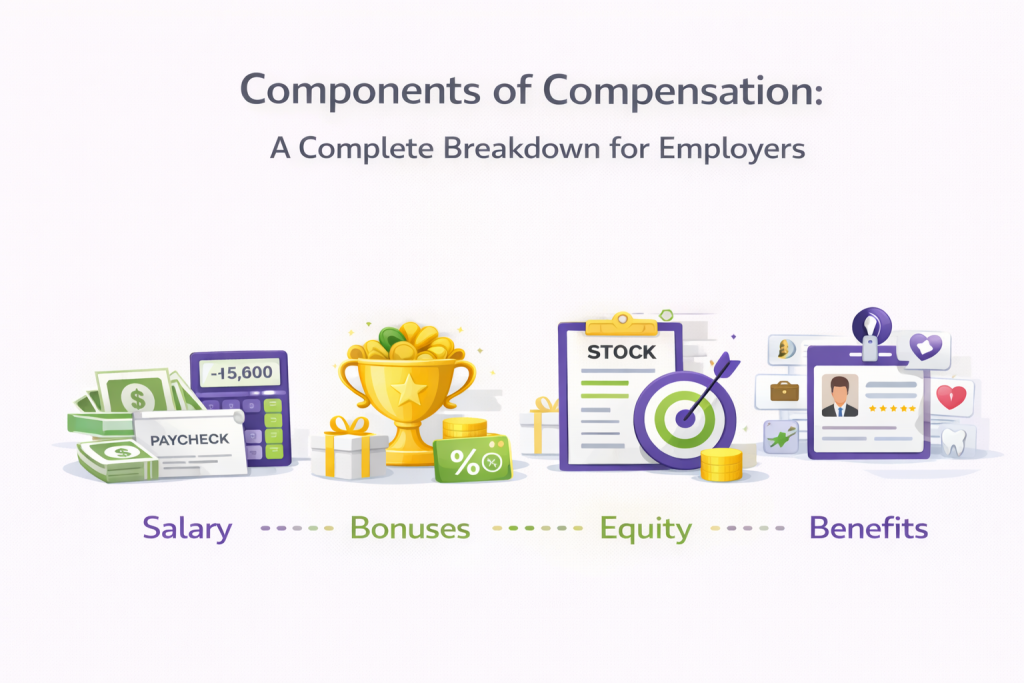
Compensation plays a central role in how organizations attract, retain, and motivate talent. It directly impacts hiring outcomes, employee performance, and long-term cost structures. Yet, compensation is often misunderstood as just salary. In reality, compensation is made up of multiple elements that work together to define an employee’s total value exchange with the organization. These components of compensation go beyond base pay to include incentives, benefits, equity, and non-cash rewards.
Understanding the components of compensation helps employers design pay structures that are competitive, equitable, and aligned with business strategy. It also enables clearer communication with employees, reducing pay-related confusion and improving engagement.
In this article, we break down the key components of compensation and explain how each contributes to a comprehensive total compensation strategy.
But to understand how compensation works in practice, it’s important to first define what compensation includes beyond just salary.
What Is Compensation?
Compensation refers to the total set of rewards an organization provides to employees in exchange for their work. It includes both direct and indirect forms of pay and reflects the overall value an employee receives from their employer.
While salary or wages are the most visible part, compensation extends far beyond fixed pay. It also includes incentives, benefits, equity awards, allowances, and non-cash rewards that support motivation, retention, and performance.
From an employer perspective, compensation is a strategic tool. It influences hiring competitiveness, workforce costs, and employee behavior. For employees, it represents financial security, recognition, and long-term growth potential.
Understanding what compensation encompasses is essential before breaking down the individual components of compensation, as each element serves a distinct purpose within the broader total rewards framework.

Base Pay
Base pay is the fixed portion of an employee’s compensation. It represents the guaranteed earnings an employee receives in exchange for their role and responsibilities, regardless of performance outcomes or business results.
Organizations typically provide base pay as an annual salary or hourly wage. Salaried roles are common for professional and managerial positions, while hourly wages are often used for operational or shift-based work.
Several factors influence base pay decisions. These include job scope, required skills, experience level, market benchmarks, and internal pay equity. Geography also plays a role, particularly in regions with significant cost-of-living differences.
As the foundation of the compensation structure, base pay supports financial stability for employees and predictability for employers. However, on its own, base pay is rarely sufficient to drive performance or retention. This is why it is typically complemented by variable pay, benefits, and other rewards.
Also read: AI Compensation Agent: How Enterprises Are Automating Compensation Decisions
Variable Pay (Incentive Compensation)
Variable pay is the performance-linked portion of compensation. Unlike base pay, it is not guaranteed and is earned based on individual, team, or company outcomes.
Organizations use variable pay to directly connect compensation with results. It helps drive specific behaviors, align employee efforts with business goals, and reward high performance without permanently increasing fixed costs.
Common forms of variable pay include performance bonuses, sales commissions, short-term incentives (STIs), and long-term incentives (LTIs). Short-term incentives typically reward annual or quarterly results, while long-term incentives focus on sustained performance over multiple years.
Variable pay plans can be structured at different levels. Individual incentives reward personal achievement, team-based incentives encourage collaboration, and company-wide incentives align employees with overall business performance.
When designed well, variable pay strengthens accountability and motivation. However, it must be supported by clear metrics, transparent eligibility criteria, and consistent governance to avoid confusion or perceived unfairness.
Also read: Best Incentive Compensation Management Tools for 2026
Benefits
Benefits are indirect forms of compensation that support employee well-being, security, and work–life balance. While they are not paid out as cash, benefits represent a significant portion of total compensation costs for employers.
Core benefits typically include health insurance, retirement or pension plans, paid time off, and statutory benefits required by law. These benefits help protect employees against health, financial, and life-related risks.
Many organizations also offer supplemental benefits to enhance their value proposition. These may include wellness programs, learning and development support, mental health resources, flexible work arrangements, or family-related benefits.
Benefits play a critical role in attraction and retention, especially in competitive labor markets. Employees often evaluate benefit offerings alongside salary when making job decisions, even though benefits are less visible than direct pay.
As part of the broader components of compensation, benefits help create a more stable and sustainable employment relationship while reinforcing the employer’s commitment to employee well-being.
Equity-Based Compensation
Equity-based compensation provides employees with ownership interests in the company. Instead of immediate cash payouts, equity rewards link compensation to the organization’s long-term value and performance.
Common forms of equity compensation include stock options, restricted stock units (RSUs), and employee stock purchase plans (ESPPs). These instruments typically vest over time, encouraging retention and long-term commitment.
Equity compensation is most common in startups, high-growth companies, and publicly traded organizations. It is often offered to senior leaders, critical talent, and employees whose roles have a direct impact on company value.
By tying rewards to company success, equity-based compensation aligns employee interests with shareholder outcomes. However, it also introduces complexity related to valuation, vesting schedules, and tax treatment, which must be clearly communicated to employees.
As part of the overall components of compensation, equity plays a strategic role in balancing cash costs while reinforcing long-term performance and loyalty.
Allowances and Perquisites (Perks)
Allowances and perquisites are additional components of compensation designed to cover specific work-related or lifestyle expenses. They are typically provided on top of base pay, incentives, and benefits.
Allowances are usually structured and recurring. Common examples include housing allowances, transportation allowances, meal allowances, and cost-of-living adjustments. These are often influenced by role requirements, location, or employment level.
Perquisites, or perks, are less standardized and may vary by role or seniority. Examples include company cars, executive travel privileges, flexible work setups, club memberships, or enhanced office amenities.
While allowances address practical needs, perks are often used to enhance the employee experience and differentiate the employer brand. However, they must be applied consistently to avoid perceptions of inequity.
Within the broader components of compensation, allowances and perks help organizations tailor rewards to employee needs while supporting productivity and satisfaction.
Also read: Best Compensation Management Tools for HR and Finance Teams
Recognition and Non-Cash Rewards
Recognition and non-cash rewards acknowledge employee contributions without direct monetary payouts. While they may not appear on a payslip, they play a meaningful role in employee motivation and engagement.
Common forms of recognition include spot awards, public appreciation, peer recognition programs, and performance acknowledgments during team or company forums. Non-cash rewards may also include career development opportunities, stretch assignments, or leadership exposure.
These rewards reinforce desired behaviors and values in real time. Unlike annual pay reviews, recognition programs allow organizations to respond quickly to employee contributions.
When used effectively, recognition strengthens morale, improves retention, and complements financial compensation. However, it works best when recognition criteria are clear, consistent, and aligned with business goals.
As part of the overall components of compensation, recognition and non-cash rewards support a more holistic and human-centered total rewards strategy.
Total Compensation
Total compensation represents the full value of all rewards an employee receives from an employer. It includes base pay, variable pay, benefits, equity, allowances, and non-cash rewards combined into a single view.
While employees often focus on salary, total compensation provides a more accurate picture of what an organization invests in its workforce. Benefits, incentives, and long-term rewards can significantly increase the overall value beyond base pay.
For employers, managing total compensation helps balance competitiveness with cost control. It allows organizations to allocate rewards strategically across fixed and variable components based on business priorities.
Clear communication of total compensation is critical. When employees understand the full scope of their compensation, it improves transparency, trust, and perceived fairness.
As organizations move toward more flexible and data-driven pay models, total compensation has become a key framework for aligning workforce rewards with long-term business outcomes.
As compensation programs grow more complex, many organizations rely on modern compensation platforms like Stello to model total compensation, assess cost impact, and support consistent decision-making across teams.
Book a demo today!
Factors Influencing Compensation Structure
Compensation structures are shaped by a combination of internal priorities and external market forces. Organizations must balance competitiveness, affordability, and fairness when designing pay programs.
Market conditions play a major role. Employers rely on compensation benchmarking to remain competitive within their industry and talent market. Labor supply, demand for skills, and economic conditions all influence pay levels.
Company size, growth stage, and business strategy also impact compensation design. High-growth organizations may emphasize incentives or equity, while mature companies often focus on stability and predictability.
Geography affects compensation through cost-of-living differences, local labor laws, and regional pay norms. Global organizations must account for these variations while maintaining internal consistency.
Legal and compliance requirements further influence compensation decisions. Minimum wage laws, pay equity regulations, and disclosure requirements must be factored into compensation planning.
Together, these factors determine how the components of compensation are structured, weighted, and adjusted over time.
Conclusion
Compensation is a strategic lever that shapes how organizations attract, motivate, and retain talent. It extends beyond fixed pay to include incentives, benefits, equity, allowances, and recognition.
Understanding the components of compensation allows employers to design pay structures that are competitive, equitable, and aligned with business objectives. Each component serves a specific purpose and contributes to the overall employee value proposition.
A balanced approach to compensation improves transparency, supports better decision-making, and helps manage workforce costs effectively. As compensation strategies continue to evolve, organizations that view compensation through a total rewards lens will be better positioned to meet both talent and business demands.
FAQs-
1. What are the main components of compensation?
The main components of compensation include base pay, variable pay or incentives, benefits, equity-based compensation, allowances, and non-cash rewards. Together, these elements make up an employee’s total compensation.
2. How is compensation different from salary?
Salary is only one part of compensation. Compensation includes all forms of financial and non-financial rewards an employee receives in exchange for their work, including incentives, benefits, and long-term rewards.
3. Why is total compensation important for employers?
Total compensation provides a complete view of workforce costs and employee value. It helps employers balance competitiveness, cost control, and fairness while aligning pay with business goals.
4. How often should companies review their compensation structure?
Most organizations review compensation annually. However, market shifts, regulatory changes, or business growth may require more frequent adjustments to ensure pay remains competitive and compliant.