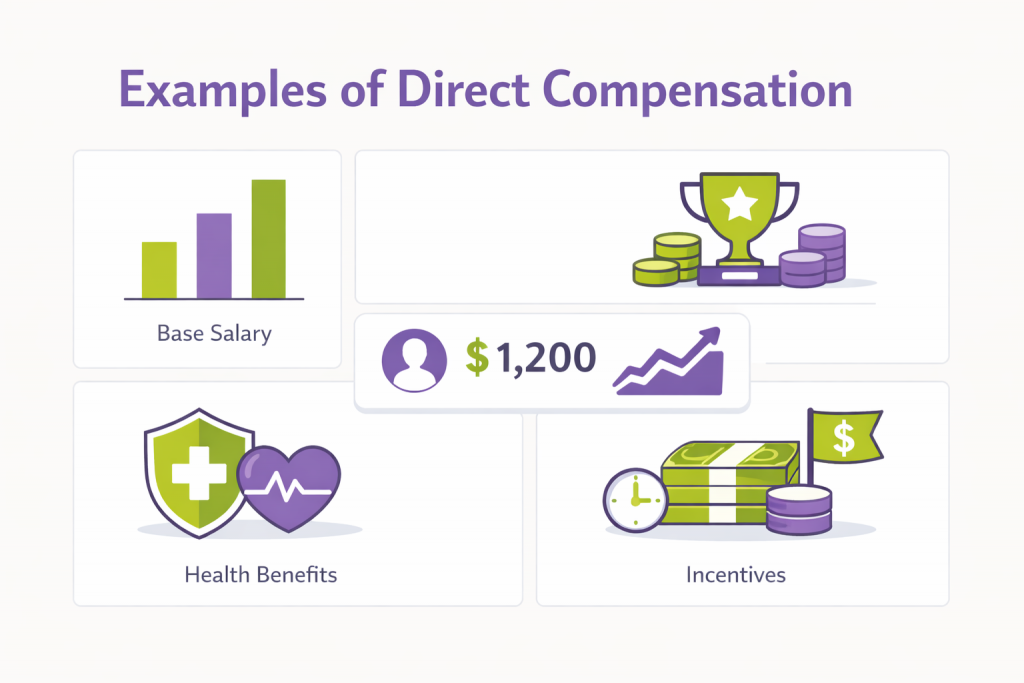
When most people think about compensation, they think about their paycheck. But direct compensation is more than just a number on an offer letter; it’s the full spectrum of monetary payments an organization makes to employees in exchange for their work.
For HR leaders and managers, understanding the different forms of direct compensation isn’t just a payroll exercise. It’s a strategic tool for attracting talent, driving performance, and building pay structures that hold up under scrutiny.
This guide breaks down 10 real-world examples of direct compensation with practical scenarios to show exactly how each one works in practice.
TL;DR
- Direct compensation covers all monetary payments made to employees in exchange for their work.
- Base salary is the most common form — a fixed annual amount paid regardless of hours or output.
- Hourly wages and overtime pay are variable, scaling with time worked or hours beyond the standard week.
- Performance bonuses and commission tie pay directly to results, making them popular in sales and output-driven roles.
- Signing bonuses are one-time payments used to close competitive offers or offset unvested compensation a candidate leaves behind.
- Profit sharing gives employees a stake in company-wide results, typically distributed at year-end.
- Stock options and equity compensation are common at startups, offering potential upside in exchange for below-market base pay.
- Merit increases permanently raise base salary based on performance — unlike bonuses, the benefit compounds over time.
- Piece-rate pay compensates for completed units of work, common in freelance, gig, and agricultural settings.
- Most employees receive more than one type of direct compensation — the right mix depends on role, industry, and what behaviors the company wants to incentivize.
1. Base Salary
Base salary is the fixed annual amount an employee receives for their role, paid out in regular intervals — weekly, biweekly, or monthly — regardless of hours worked or output delivered.
It forms the foundation of most compensation packages and is typically determined by factors like role scope, market benchmarks, experience level, and internal pay bands.
Scenario: A content marketing manager at a B2B SaaS company is hired at an annual base salary of $75,000. Whether she has a slow month or ships a major campaign, her paycheck stays the same. Her employer benchmarked the role against industry data and set the salary within a defined pay band for mid-level marketing positions.
Base salary matters beyond the number itself — it anchors how other forms of compensation (bonuses, equity, raises) are calculated and communicated.
Also read: What is Direct and Indirect Compensation? A Complete Guide
2. Hourly Wages
Unlike salaried employees, hourly workers are paid a fixed rate for each hour they work. Total pay fluctuates based on hours logged, making this model common in part-time roles, contract work, and industries with variable staffing needs.
Scenario: A freelance graphic designer is contracted by a DTC brand at $45 per hour to support a product launch campaign. Some weeks she works 20 hours, others just 8. Her pay reflects exactly what she puts in, and the company only pays for the hours they actually need.
Hourly wages give employers flexibility during busy and slow periods, while giving workers a direct line between time and earnings.
3. Overtime Pay
When hourly employees work beyond the standard 40-hour workweek, they are typically entitled to overtime pay. In the US, the Fair Labor Standards Act (FLSA) sets this at 1.5 times the regular hourly rate, though some employers offer double time for holidays or extended shifts.
Scenario: A customer support rep earns $20 per hour. During a major product release week, she works 48 hours to handle the spike in tickets. For the 8 hours beyond the standard 40, she earns $30 per hour instead of her usual rate, bringing her total weekly pay to $1,040 rather than $800.
For employers, overtime costs are worth tracking closely. Persistent overtime can signal a need to hire additional headcount rather than continuously absorbing the premium.
Also read: What is Compensation Management Software? Guide for HR Teams
4. Performance Bonuses
A performance bonus is a one-time cash payment tied to hitting specific goals, whether at the individual, team, or company level. Unlike a raise, it does not permanently increase base salary. Bonuses are typically paid out quarterly or annually and are defined in advance so employees know what they are working toward.
Scenario: A sales representative has a quarterly quota of $150,000 in closed revenue. She finishes the quarter at 120% of target, closing $180,000. Per her compensation plan, hitting above 110% triggers a $3,000 cash bonus on top of her base salary. The bonus is paid out the following month alongside her regular paycheck.
Performance bonuses are a popular tool because they tie direct cost to direct output. Companies only pay the premium when results are delivered.
5. Commission
Commission is a variable form of pay calculated as a percentage of the revenue or deals an employee generates. It is most common in sales roles but also appears in real estate, recruiting, and financial services. Commission structures can be standalone (commission-only) or layered on top of a base salary.
Scenario: A B2B account executive at a software company earns a base salary of $60,000 plus an 8% commission on every deal he closes. In a strong quarter, he closes $200,000 in new contracts, earning $16,000 in commission on top of his base. The structure rewards him for pursuing larger, higher-value accounts rather than simply closing volume.
A well-designed commission plan aligns employee incentives with business goals. A poorly designed one can drive the wrong behaviors, so the structure matters as much as the rate.
6. Signing Bonus
A signing bonus is a one-time payment made to a new hire when they accept a job offer. Companies use it to sweeten an offer, offset compensation the candidate is leaving behind at their current employer (such as unvested equity or a pending bonus), or simply compete in a tight talent market. Signing bonuses are typically paid on the first paycheck or within the first 30 days, and often come with a clawback clause if the employee leaves within a set period.
Scenario: A fintech company is recruiting a senior software engineer who is 18 months into a four-year vesting schedule at his current job. To compensate for the unvested equity he would forfeit by leaving early, the fintech offers a $10,000 signing bonus alongside his base salary and new equity grant. The bonus comes with a 12-month clawback clause, meaning he would need to repay it if he leaves before his first anniversary.
Signing bonuses are most effective when they solve a specific barrier to joining rather than being used as a blanket recruiting tactic.
Also read: Employee Bonus Plans: Strategy, Structure, and Compliance
7. Profit Sharing
Profit sharing is a compensation model where a portion of the company’s profits is distributed to employees, typically at the end of the fiscal year. The payout is tied to company performance rather than individual output, making it a way to give employees a stake in the organization’s overall success. Distribution can be equal across all employees or weighted by salary, tenure, or role level.
Scenario: A mid-sized manufacturing company has a strong fiscal year, posting $4 million in net profit. Leadership decides to distribute 5% of that, totaling $200,000, across the workforce. Payouts are calculated proportionally based on each employee’s base salary. An operations manager earning $80,000 receives a larger share than a line worker earning $40,000, but both see a direct financial benefit from the company’s performance.
Profit sharing builds a sense of shared ownership and can strengthen retention, particularly when employees feel their day-to-day work contributes to a larger outcome.
8. Stock Options and Equity Compensation
Stock options give employees the right to purchase company shares at a predetermined price, known as the strike price or exercise price, at a future date. They are a common form of direct compensation at startups and high-growth companies, where cash compensation may be below market but the potential upside of equity makes the overall package competitive. Options typically vest over a multi-year period to encourage retention.
Scenario: A startup grants its new marketing lead options to purchase 5,000 shares at a strike price of $2 per share, vesting over four years with a one-year cliff. After two years, the company’s valuation grows and the share price rises to $10. She has vested 2,500 options at that point and can exercise them at the original $2 strike price, realizing a gain of $8 per share on her vested options.
Equity compensation requires careful communication. Employees need to understand vesting schedules, tax implications, and what their options are actually worth under different company outcomes, otherwise it functions more as a retention mechanism on paper than a meaningful part of their total pay.
9. Merit Pay Increase
A merit increase is a permanent raise to an employee’s base salary, awarded based on performance, contribution, or skill growth. Unlike a bonus, it does not reset after each cycle. The raise compounds over time, which means it has a longer-term impact on total earnings and future compensation benchmarks.
Scenario: An operations analyst has a strong annual review cycle. His manager rates him as exceeding expectations across all core competencies. Based on the company’s merit increase budget and his performance rating, he receives a 7% raise, bringing his base salary from $65,000 to $69,550. That increase carries forward into the next year’s calculations, including any future bonuses tied to his base.
Merit increases are one of the more powerful signals a company can send to a high performer. Because the raise is permanent, it communicates longer-term recognition rather than a one-time reward.
10. Piece-Rate Pay
Piece-rate pay is a model where employees or contractors are compensated for each unit of work completed rather than for time spent. It is common in agriculture, manufacturing, and increasingly in the gig economy and freelance content world. Pay is directly tied to output, which can motivate high producers but also raises questions around quality control and minimum wage compliance.
Scenario: A freelance content writer is hired by a digital publisher at $150 per published article. Some articles take her two hours, others take four. Her total earnings depend entirely on how many pieces she completes and gets approved, not on how many hours she logs. In a productive month, she publishes 20 articles and earns $3,000.
Piece-rate structures work well when output is clearly measurable and quality can be consistently verified. They are less suitable for roles where the work involves collaboration, judgment, or tasks that are difficult to standardize.
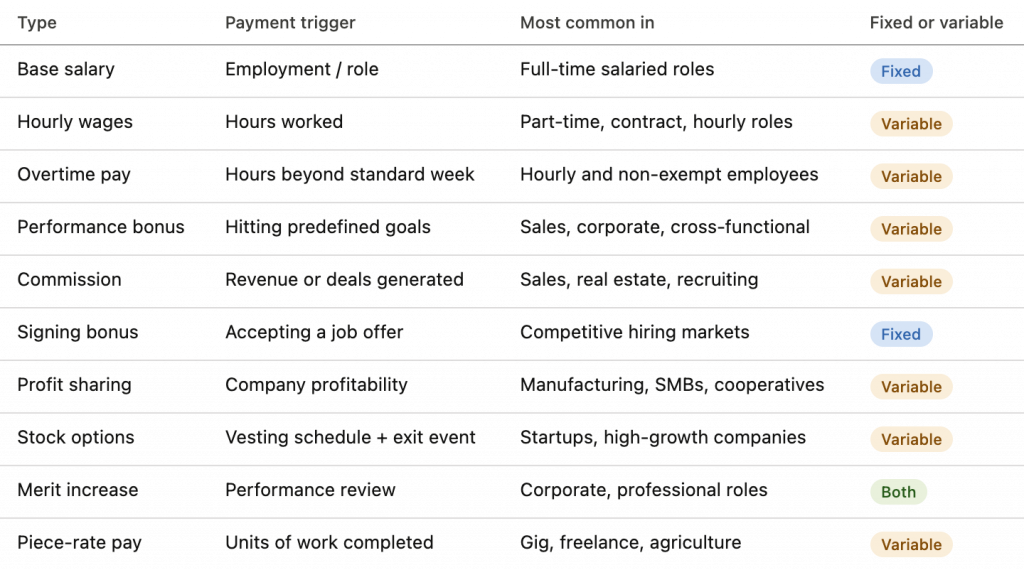
Direct Compensation Types at a Glance
Here is a quick reference summary of all 10 types covered in this guide.
Conclusion
Direct compensation is not one-size-fits-all. The right mix depends on the role, the industry, the stage of the company, and what behaviors the organization wants to reinforce. A startup competing for engineering talent will lean heavily on equity. A sales-driven organization will prioritize commission and bonuses. A company focused on long-term retention might invest in merit increases and profit sharing.
Understanding each type, how it is triggered, and what it signals to employees, gives HR leaders and managers the foundation to build pay structures that are both competitive and intentional. For a fuller picture, direct compensation is just one part of the equation. Total compensation, which includes benefits, perks, and non-monetary rewards, is where strategy comes together.
FAQs-
What is the difference between direct and indirect compensation?
Direct compensation refers to all monetary payments made to employees in exchange for their work, including salary, bonuses, and commission. Indirect compensation covers non-cash benefits such as health insurance, paid time off, retirement contributions, and flexible work arrangements. Both are part of a total compensation package, but only direct compensation shows up as a cash payment to the employee.
Which type of direct compensation is most common?
Base salary is the most widely used form of direct compensation across industries and role types. Most full-time employees receive a fixed annual salary as the core of their pay package, with other forms of direct compensation layered on top depending on role, seniority, and company structure.
Can an employee receive more than one type of direct compensation?
Yes, and most do. A sales representative might receive a base salary, commission, and a performance bonus within the same role. A startup employee might have a base salary plus stock options. Organizations often combine multiple types to create a compensation package that balances stability with performance incentives.
How do companies decide which direct compensation types to offer?
The decision typically depends on the role’s function, the industry standard, the company’s financial position, and the behaviors it wants to incentivize. Sales roles almost always include variable pay. Executive roles often include equity. Hourly and contract roles are paid for time or output. Compensation benchmarking data helps companies stay competitive within their market.
Is a signing bonus considered part of base salary?
No. A signing bonus is a one-time payment and does not factor into base salary calculations. It will not affect future merit increases, bonus targets, or benefits that are tied to base pay. Some candidates negotiate signing bonuses to bridge a compensation gap when switching roles, but it is a separate component from ongoing pay.